They Took the Chance: The Norse Who Beat Columbus to the Americas by Five Centuries
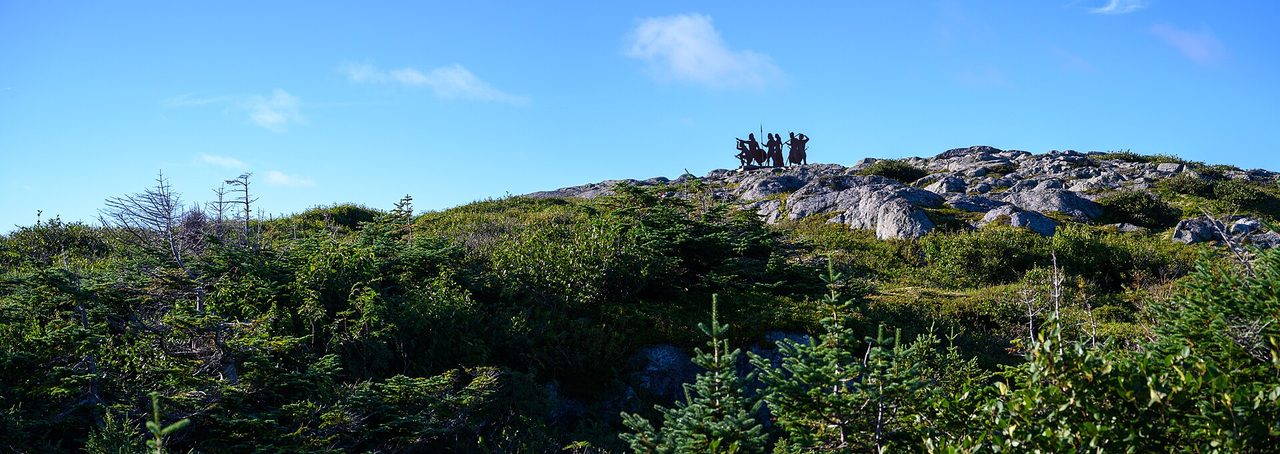
Photo: Gordon Leggett / CC BY-SA 4.0 · via Wikimedia Commons
They Took the Chance: The Norse Who Beat Columbus to the Americas by Five Centuries
A camp on the northern tip of Newfoundland
The BBC's recent feature on the Norse crossing is a reminder of a chronology most schoolbooks compress: North Atlantic sailors were living on the coast of present-day Canada around the year 1000, roughly 500 years before Christopher Columbus reached the Bahamas on 12 October 1492. The site is L'Anse aux Meadows, a windswept field of grassy ridges above a bay on Newfoundland's Great Northern Peninsula.
Iceland first, Greenland next, then 200 miles of open water
The Norse found Iceland around 870 and Greenland about a century later, in the 980s, under Erik the Red. From Greenland's west coast it is about 200 miles across the Davis Strait to Baffin Island, which the sagas call Helluland, the land of flat stones. Southward lay Markland, Labrador's land of forests, and then Vinland, the land of vines. "The sagas describe not only these guys stopping off in one place, but stopping off in a number of places," Emily Lethbridge of the University of Iceland said on the BBC's Timewatch in 2016. "They had a whole new world to explore."
The sagas, and the men who believed them
Almost everything narrative comes from two 13th-century Icelandic works, the Saga of the Greenlanders and the Saga of Erik the Red, which contradict each other and give no years. In the telling, Bjarni Herjólfsson sighted a forested coast while blown off course, never landed, and sold his ship to Leif Erikson, who sailed west with a crew of 35. Leif's brother Thorvald died of an arrow wound in a skirmish with the people the Norse called Skraelings, among the first Europeans known to have died in the Americas.
1960: a fishing village gives up its secret
The turning point came in 1960, when Norwegian lawyer-turned-explorer Helge Ingstad and his wife, archaeologist Anne Stine Ingstad, worked the northern Newfoundland coast. A local man, George Decker, walked them to a terrace of low grassy mounds that villagers assumed were an old Indigenous camp. Excavations from 1961 to 1968 proved the turf walls were Norse and belonged to the 11th century. Parks Canada took over the site in 1968, and UNESCO listed it as a World Heritage Site in 1978.
A solar storm fixes the year at 1021
In October 2021 a team led by the University of Groningen published in Nature a dating result that had never been possible before. A cosmic-ray event in 992–993 raised atmospheric carbon-14 and left a marker in tree rings worldwide. Three pieces of wood cut with metal tools at L'Anse aux Meadows carried that marker 29 rings in from the bark edge, meaning all three trees were felled in AD 1021 — 471 years before Columbus's 1492 voyage, and the first known moment at which humans had circled the globe.
A felling year, not a landing year
Researchers are careful about scope: 1021 records one year of activity, not arrival and not departure. The paper describes it as the only secure calendar date for Europeans in the Americas before Columbus. If the sagas are right that Leif sailed around 1000, the first landfall may have come roughly two decades earlier — a guess, not a measurement.
A base camp, not a colony
The eight turf buildings excavated between 1961 and 1968 could hold communal halls for 30 to 160 people, with iron nails, bronze pins and evidence of smelting — but no stables, fields or cemeteries. The interpretation is a wintering base and ship-repair station. Butternut wood and wild grapes, which do not grow on Newfoundland, point to voyages south toward New Brunswick or New England. One estimate suggests the site may have drawn 10 to 20 percent of Greenland's entire colonial population.
Why the story disappeared
"Columbus had better PR," John Steinberg, an archaeologist at the University of Massachusetts Boston, told the Washington Post. The Norse left no lasting colony and no report that reached European ports, while the 1492 voyages connected the Americas permanently to the rest of the world. The discovery survived in fragments until archaeology reconstructed it — and even the Vinland Map, once the best-known document of the claim, was confirmed a fake.
The people already there
First claim on the continent belongs to Indigenous peoples, whose ancestors arrived thousands of years earlier and built cultures across two continents. Norse accounts treat contact as hostile, and the word Skraelings is dismissive. Scholars generally identify the people Leif's party met as ancestors of the Beothuk or the Dorset people of Labrador and Newfoundland; recent scholarship is pushing back on reading the sagas as a story of inevitable war.
Caution from the tree-ring specialists
The precision is not unanimous. A 2026 review in New Phytologist led by Amy E. Hessl of West Virginia University cautions that individual trees do not always record a carbon-14 spike in the same ring — some register it early, some late, some spread it across rings — which complicates using such markers for exact years. A reminder of the same risk: the much-publicised Point Rosee site, spotted from satellite imagery by Sarah Parcak, produced no Norse evidence when excavated in 2015 and 2016.
The search and the argument continue
The searches continue along the Newfoundland and Labrador coasts for a second confirmed site, alongside tighter dating work on 1021 itself. Public memory lags: the United States first marked Leif Erikson Day with a presidential proclamation in 1935 and made 9 October an annual observance in 1964, yet the anniversary remains largely invisible. The evidence has never been stronger; the argument over what it means has never quite ended.
Sources
- BBC: 'They were people who took chances': The Vikings who reached the Americas 500 years before Columbus
- He reached the Americas centuries before Columbus. Why doesn't he get more credit?
- Economic Times: The Vikings crossed the Atlantic centuries before Columbus. Why did their American adventure disappear from history?
- Jagranjosh: How did Vikings Discover America 500 Years Before Columbus?
- Live Qurious: How Scientists Dated the Vikings' Arrival in America