Halley's 1986 Flop, 40 Years On: The Comet That Disappointed Millions and Rewrote Astronomy
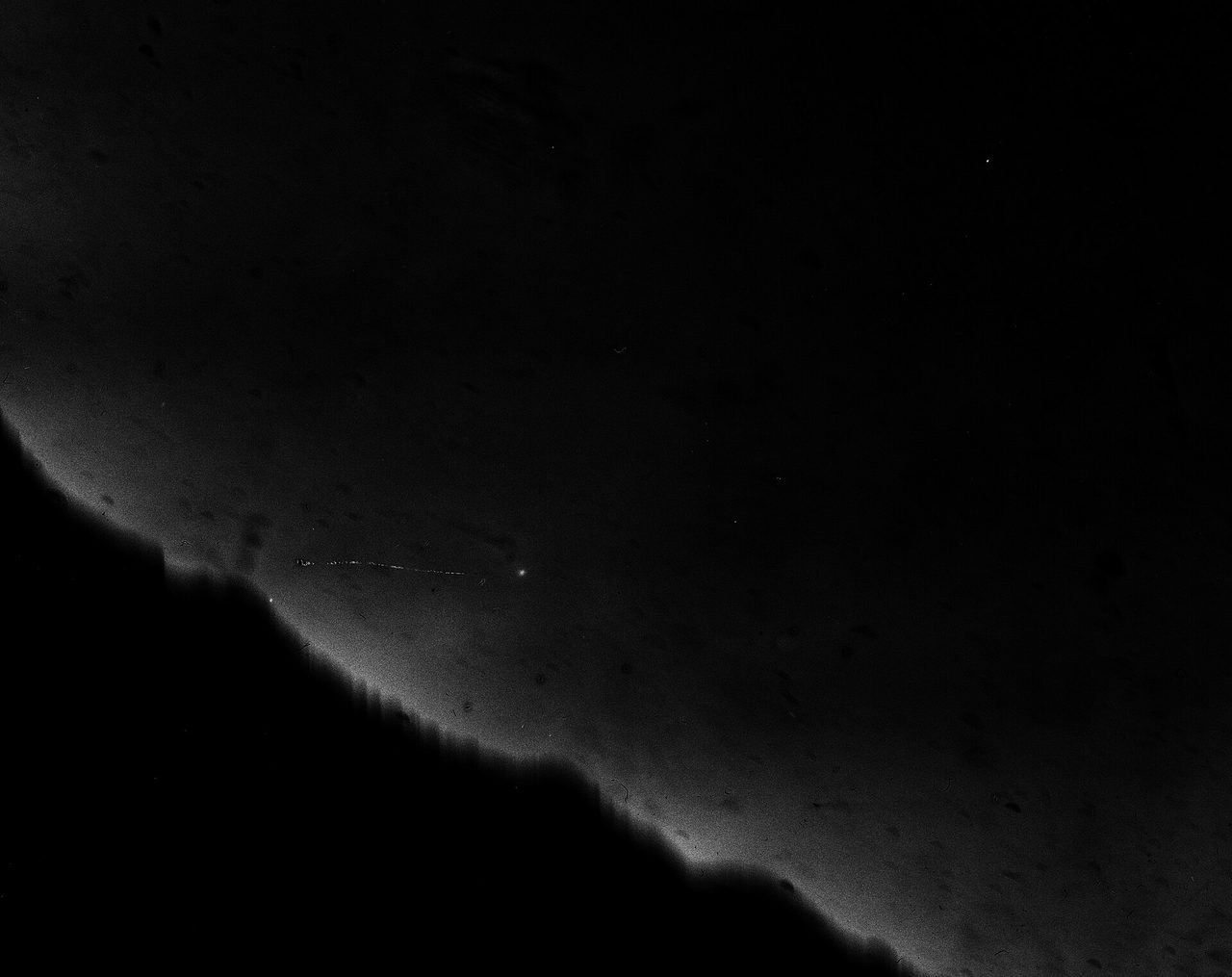
Photo: ESO/C. Madsen / CC BY 4.0 · via Wikimedia Commons
Halley's 1986 Flop, 40 Years On: The Comet That Disappointed Millions and Rewrote Astronomy
A once-in-a-lifetime promise, a faint smudge
Twenty twenty-six marks 40 years since Halley's Comet last came through the inner solar system. Halley returns roughly every 76 years — writer Guy Ottewell calls it "the wildest of the tame comets," tame because it can be predicted, wild because it is still fresh and bright, the brightest of all the recurring comets and the only one that periodically becomes conspicuous to the naked eye. It reached perihelion on February 9, 1986, and came closest to Earth on April 10, about 63 million kilometers away. Billed as the most anticipated celestial event of the second half of the 20th century, it delivered a faint smudge that belied promises of a spectacle never to be seen again.
The geometry was against everyone
Nobody could claim they had not been warned. German astronomy guide SternGucker calls the 1985–86 apparition the least favorable in about 2,000 years: at perihelion, the Sun stood directly between Earth and the comet. From North America, Halley was a usable evening target only from November 1985 to January 1986, then a faint, low, pre-dawn object in March 1986 that mostly needed binoculars. The Alaska Science Forum told readers in advance that the show would fall far short of 1910, when the comet passed 0.14 astronomical units from Earth; in 1986 the closest approach was 0.42 AU. Its peak apparent magnitude was about 2.1 — naked-eye territory, but barely.
City lights finished the job
Space.com's 40th-anniversary retrospective adds a second culprit: light pollution. Total outdoor illumination in the United States had risen enormously since Halley's previous visit, and many of the largest cities were bathed in permanent twilight, with only the brightest stars and planets visible from near city centers and astronomically unacceptable conditions out to 50 miles (80 km) away. Hype did the rest.
Five spacecraft stole the show
While the public squinted, astronomy collected its first close-up of a comet. An international fleet nicknamed the "Halley Armada" — the Soviet Vega 1 and Vega 2, Japan's Suisei and Sakigake, and the European Space Agency's Giotto — intercepted the comet in March 1986. Vega 1 flew by on March 6 and Vega 2 on March 9, each passing within roughly 8,500 km and returning the first-ever images of the nucleus, plus tracking data that helped refine Giotto's trajectory. Giotto passed within about 600 km (370 miles) on March 13–14 and sent back more than 2,000 images.
The dirty snowball, confirmed in close-up
Those images rewrote the textbooks. Halley's nucleus was larger than expected — a peanut- or potato-shaped body about 14 km long and 8 km wide, spinning once every 7.4 days around its longest axis while the whole body wobbled in half that time. It was as black as coal or velvet, encrusted in a dark shroud of its own debris, with three active regions venting gas and dust; jets blasted material out with explosive intensity as sunlight heated the surface. Giotto was struck at least 12,000 times by dust grains, including a roughly one-gram fragment that briefly cut communication with the ground. The probes measured some three tonnes of material ejected per second from about seven jets, confirming Fred Whipple's "dirty snowball" model of volatile ices mixed with dust and ending older "flying sandbank" theories.
Halley's real legacy falls as meteors
The comet itself is now far beyond Neptune — on October 4, 2026, about 34.95 AU (roughly 5.23 billion km) from the Sun, still falling back at around 1 km/s after turning around at the far end of its orbit in late 2023. Its debris, however, crosses Earth's orbit twice a year: the Eta Aquariids in May and the Orionids in October. The 2026 Orionids peak overnight October 21–22, offering 10 to 20 meteors per hour from a dark site, with grains entering the atmosphere at about 66 km/s — among the fastest meteors there are.
Next stop: July 2061
Halley's next perihelion is July 28, 2061, and observers expect a far easier show than 1986 — in mid-July, a pre-dawn object in the northeastern sky, most likely visible to the naked eye from the United States. Forbes reports a mission concept that would launch in the 2030s and rendezvous with Halley in 2060, ahead of that return. For anyone let down in 1986, the consolation is simple: the comet never broke its promise — it just handed the better half of the payoff to scientists instead of sightseers.
Sources
- Space.com: The great Halley's Comet disappointment of 1986 and the discoveries that changed astronomy forever
- Forbes: New Plan To Rendezvous With Halley's Comet Targets 2036 Launch
- BBC: Orionid meteor shower 2026: How and when to see it
- ScienceDaily: Watch Saturn shine and Halley's Comet debris streak across the sky
- Alaska Science Forum: The Return of Halley's Comet