Five Dead as Twin Storms Batter Mexico's Pacific Coast
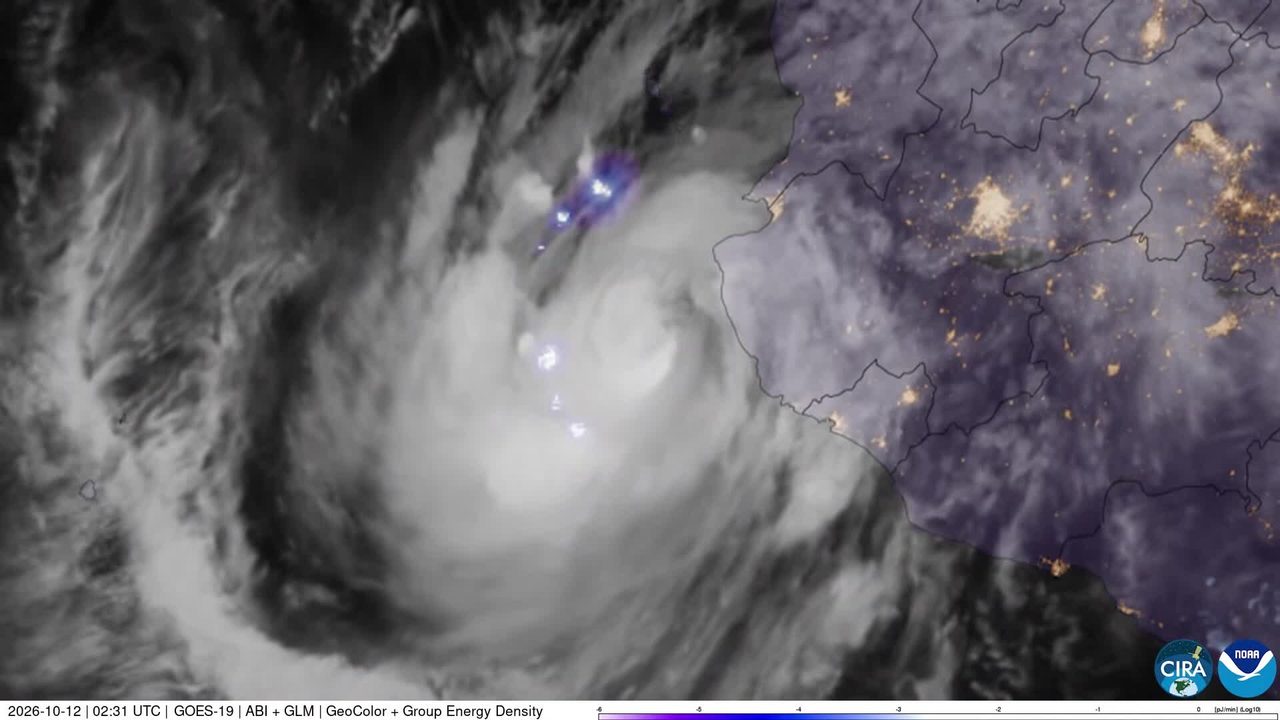
Photo: GOES imagery: CSU/CIRA & NOAA / Public domain · via Wikimedia Commons
Five Dead as Twin Storms Batter Mexico's Pacific Coast
Five confirmed dead across two states
Mexican authorities said on Monday, October 12, that Hurricane Simon and Tropical Storm Rachel battered the country's Pacific coast with flooding, landslides, downed power lines and blocked roads, killing at least five people. The deaths were reported in two states far apart: one in Guerrero in the south and four in Baja California in the north. The toll marks a shift in coverage from the pre-landfall warnings issued on October 10 to the damage already on the ground.
A wall collapse kills a 71-year-old in Chilpancingo
Guerrero Governor Evelyn Salgado confirmed at President Claudia Sheinbaum's morning news conference that a retaining wall in Chilpancingo, the state capital, collapsed after intense rain and killed a 71-year-old man. The Guerrero-based news agency IRZA, citing the family, identified him as Albino Moreno Jimenez, who had been feeding his animals on the city's western outskirts when the wall fell. Salgado said the storm also toppled trees and electricity poles, blocked roads and flooded homes in coastal towns, including the major seaport of Acapulco.
A family of four, including two children, found near Ensenada
Baja California's prosecutor's office said Tropical Storm Rachel killed four members of one family, including two children, whose bodies were found on the outskirts of Ensenada. State civil protection coordinator Ignacio Lozoya said a 13-year-old girl was found on Sunday and two women and a 4-year-old boy on Monday, all in Ensenada. Officials gave slightly different missing-person counts: the prosecutor's office reported five still missing, while Lozoya said six remained unaccounted for — four in Ensenada and a father and son from San Felipe who went fishing on Saturday and never returned. The state had earlier reported as many as 10 missing.
Rescuers airlift 32 from a flooded ranch
Mexican military helicopters evacuated 32 people from a ranch in Ensenada on Monday afternoon, 22 of them foreigners and 13 of them youths. State security secretary Gen. Laureano Carrillo said some in the group were missionaries gathered at the ranch, including Germans and Americans. Governor Marina del Pilar said more than 50 people were being helped in temporary shelters and that roughly 14,000 federal and state personnel had been deployed across Baja California, where landslides and overflowing rivers cut off several communities.
Ports shut, airports closed, hundreds sheltered
The Mexican Navy closed nine ports on Sunday, among them Manzanillo and Lázaro Cárdenas — the country's two largest Pacific cargo ports and its main gateway for trade with Asia — plus Puerto Vallarta and San Blas. Airport operator Grupo Aeroportuario del Pacífico said Puerto Vallarta International Airport would stay closed to all operations until 08:00 on October 13 and Manzanillo until 08:00 on October 12. Officials reported 579 people evacuated or sheltered across Jalisco, Colima and Nayarit.
The centre never came ashore — but the rain did
Accounts differ on whether Simon actually made landfall. The US National Hurricane Center, along with AFP, the Associated Press and the Guardian, reported that the centre stayed offshore and that the storm weakened to Category 2 late Monday while drifting away from the coast, with a rain alert still in place and waves of up to five metres expected in some coastal areas. Mexican media, cited by The Rio Times, reported a Category 3 landfall near Playa Perula in Jalisco on October 11 with winds around 205 km/h. The NHC put Simon's maximum sustained winds at 155 km/h late Monday.
Mazatlán in the crosshairs later this week
National civil protection coordinator Laura Velázquez said Simon is expected to approach the west-central coast between Wednesday and Thursday, with the latest official forecast calling for a Category 1 landfall on Mazatlán in Sinaloa. The NHC warned that 12.7 to 25.4 centimetres of additional rain over the next few days could still produce life-threatening flooding and mudslides. Flooding and landslides had already hit communities along rivers and streams in Michoacán and Colima.
What comes next
Three threads run ahead: the search for the missing in Ensenada and San Felipe; slope and river-crest checks along the Michoacán, Colima and Jalisco coasts; and the fallout from Rachel's remnants, which caused severe street flooding in Las Vegas over the weekend and tore apart a Long Beach boardwalk in California before flood watches were issued across the US Southwest.
Sources
- The Guardian
- Associated Press
- Al Jazeera
- Xinhua
- CNN