Carolinas Wake Up to a SpaceX Sky Show, Then a Sonic Boom Back in Florida
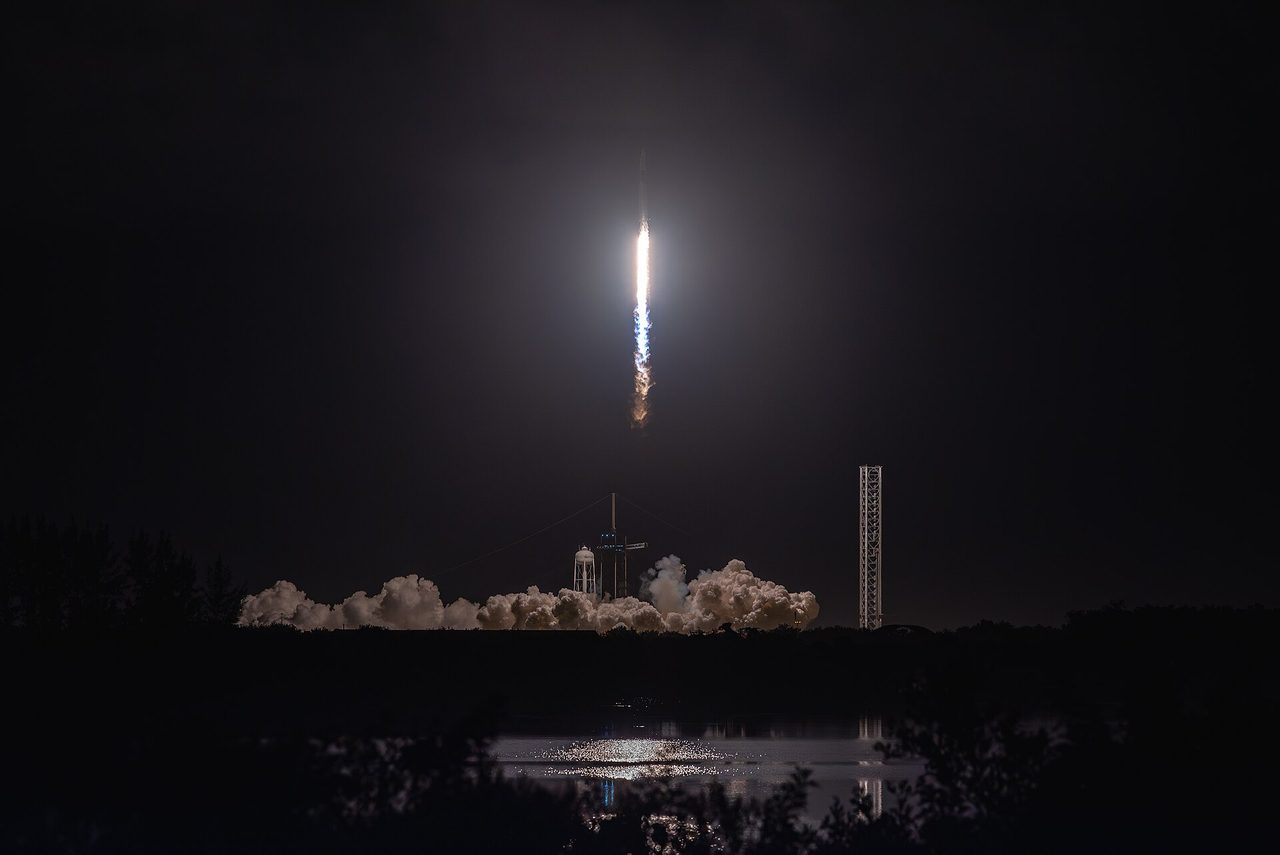
Photo: U.S. Space Force photo by Joshua Conti / Public domain · via Wikimedia Commons
Carolinas Wake Up to a SpaceX Sky Show, Then a Sonic Boom Back in Florida
A glowing cloud over two states before sunrise
Residents across North Carolina and South Carolina looked east early Tuesday and saw something that had no business being there: a bright, glowing cloud hanging in a sky that was supposed to still be dark. It was the exhaust trail of a SpaceX Falcon 9 that had lifted off from Florida minutes earlier. WECT said viewers sent in photos, WRAL asked readers to submit pictures and video to its ReportIt line, and WPDE's Conway, S.C., station reported the rocket was captured on camera right outside the building. Sightings also came in from Georgia, Virginia and across Florida.
Liftoff at 6:33 a.m., heading northeast
According to SpaceX and multiple Florida outlets, the Falcon 9 launched at 6:33 a.m. EDT (10:33 GMT) on Tuesday, Oct. 13, from Space Launch Complex 40 at Cape Canaveral Space Force Station. After clearing the pad the rocket climbed on a northeast trajectory, timing its ascent so that it entered sunlight while the ground below remained dark. The sunlit, expanding exhaust plume painted the glowing "jellyfish" effect across the East Coast sky. FOX Carolina reported that Upstate residents around Greenville saw it clearly. A backup window opened at 6:08 a.m. Wednesday.
NASA's 35th commercial resupply run
CRS-35 is SpaceX's 35th cargo delivery to the International Space Station under NASA's Commercial Resupply Services contract. The Cargo Dragon flying the mission, tail number C211, is on its fourth flight after previously supporting CRS-26, CRS-29 and CRS-33. NASA's mission overview states the spacecraft is carrying more than 6,300 pounds (about 2,867 kilograms) of supplies and research hardware.
The jellyfish is sunlit exhaust, not a cloud
Several space outlets explained the optics: rocket exhaust expands rapidly in the thin upper atmosphere, and near dawn the plume can be lit by sunlight still below the horizon while observers on the ground sit in darkness, producing a bright, cloudlike shape against a dark sky. FOX 35 noted that NASA has documented the effect during previous SpaceX launches, but that neither NASA nor SpaceX specifically predicted a jellyfish for CRS-35 — visibility depends on trajectory, lighting and weather.
The boom came from the booster coming home
About seven to eight minutes after liftoff, the Falcon 9 first-stage booster B1096 returned to Cape Canaveral and touched down at Landing Zone 40 next to the pad on its eighth flight. The booster previously supported the KF-01, IMAP, NROL-77, GPS III-9, CRS-34 and NROL-95 missions, plus one Starlink flight. Ahead of the launch, SpaceX warned in a media alert that residents of Brevard, Orange, Osceola, Indian River, Seminole, Volusia, Polk, St. Lucie and Okeechobee counties "may hear one or more sonic booms" depending on weather and other conditions. Florida Today reported sharp booms across Brevard County after the landing.
Two final solar arrays in the trunk
The science haul was only half the story. Stowed in Dragon's unpressurized trunk were the final pair of ISS Roll-Out Solar Arrays, which will augment power generation from the station's aging rigid solar arrays. Also aboard: a foam clamshell shipping container built to carry home the failed Canadarm2 joint that was removed during a June 30 spacewalk, so engineers can analyze it on the ground.
Heart tissue, artificial retinas and brain organoids
Among the experiments riding up: Stellar Spheroids, studying how microgravity affects three-dimensional human heart tissue and the development of blood vessel networks, work that could improve heart disease models and drug testing; a study of manufacturing artificial retinas in microgravity, aimed at restoring vision on Earth; brain organoids that could reveal treatment targets for Alzheimer's, Parkinson's and multiple sclerosis; and materials work on how a new type of glass forms without gravity. NASA KSC program manager Bill Spetch also listed a dose pump for the station's toilet, pre-treat quality sensors and a robotic micro-cutting tool for maintenance tasks.
Docking set for Thursday morning
After roughly 52 hours of autonomous flight, Dragon is scheduled to dock around 11 a.m. EDT (15:00 GMT) on Thursday, Oct. 15, at the space-facing zenith port of the Harmony module — the same port just vacated by Crew-12's Crew Dragon Freedom. NASA astronauts Anil Menon and Joshua Kutryk will monitor the arrival for the Expedition 75 crew. Coverage begins at 9:15 a.m. Thursday; SpaceX's own launch webcast started about 20 minutes before liftoff.
About a month aboard, then a California splashdown
Dragon will stay at the station for roughly a month, giving Expedition 75 time to unload supplies and reload the capsule with completed experiments and unneeded gear. It is scheduled to splash down off the California coast in mid-November carrying time-sensitive research samples, a spacesuit for refurbishment, hardware from the station's urine processor and water filtration systems, and the failed Canadarm2 joint. For Carolinas skywatchers, the next show like this depends on the next Florida dawn launch.
Sources
- WECT: SpaceX launch lights up North Carolina skies
- WRAL: Look up: SpaceX launch may be visible in NC skies Tuesday morning
- FOX Carolina: SpaceX launch spotted in Upstate skies early Tuesday
- WPDE: PHOTOS: SpaceX rocket launch visible outside ABC15
- Florida Today: SpaceX rocket launch from Cape Canaveral for NASA creates jellyfish