NASA's SkyFall: Three Helicopters, No Lander, and a 1,000-Meter Drop Into the Martian Sky
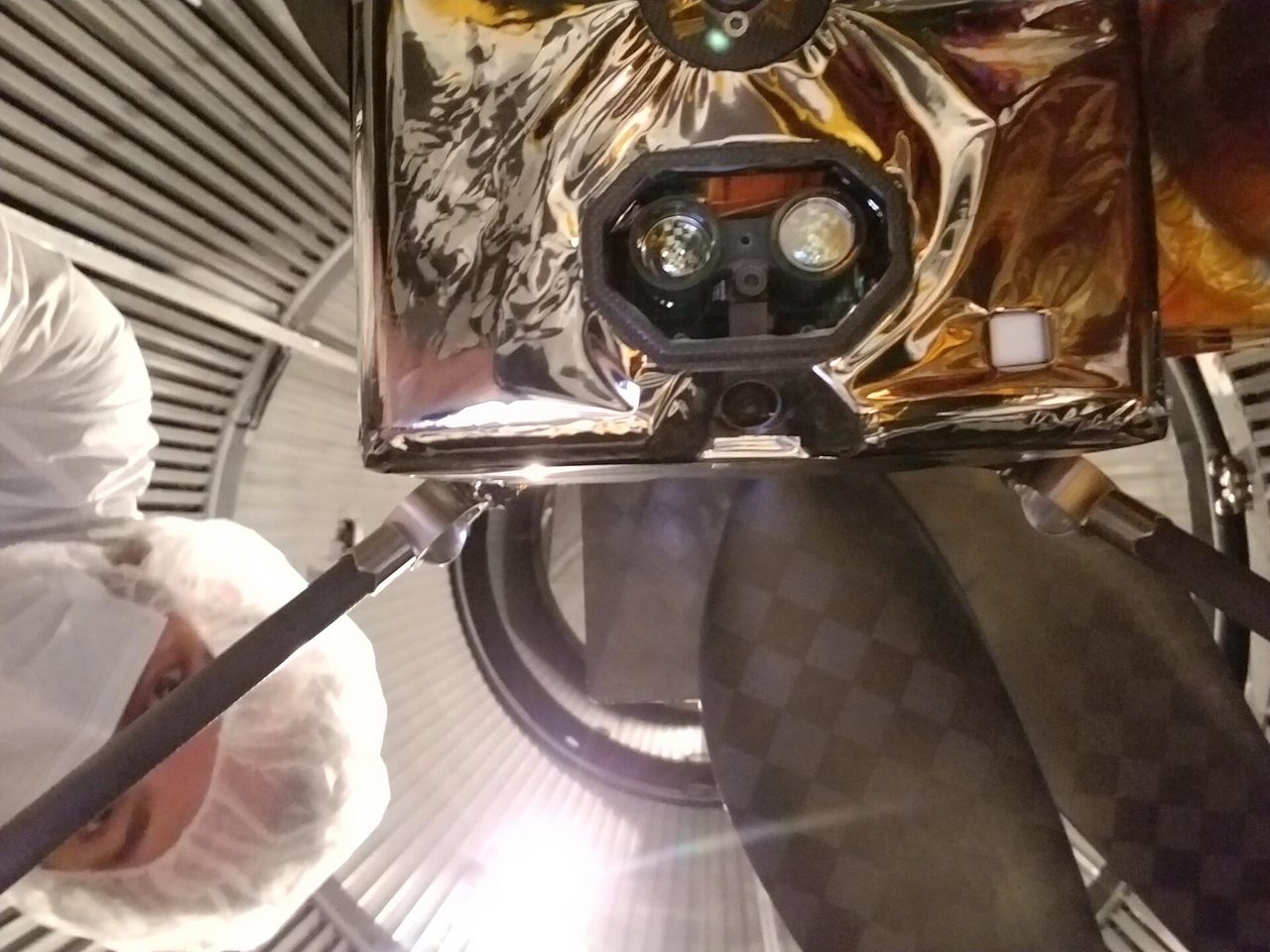
Photo: NASA / Public domain · via Wikimedia Commons
NASA's SkyFall: Three Helicopters, No Lander, and a 1,000-Meter Drop Into the Martian Sky
Three helicopters let go 1,000 meters up
NASA is moving fast on SkyFall, a mission that will send three identical autonomous helicopters to Mars aboard a nuclear-powered spacecraft. Some 1,000 meters above the surface they will be released straight from the entry capsule, unfurl their rotors and fly themselves down to a landing. No lander stage, no carrier rover — a first for Mars aviation.
A "SkyFall maneuver" that skips the lander
AeroVironment describes the technique as a "SkyFall maneuver": the helicopters enter the Martian atmosphere from the carrier craft, then separate, deploy, descend and land under their own power. Removing the single-use lander and the host rover that Ingenuity needed alongside Perseverance, the company says, "significantly reduces the technical and financial risk of getting to the Martian surface."
Five kilos each, nearly three times Ingenuity
SkyFall keeps Ingenuity's architecture but scales it up: 52 centimeters tall and 5 kilograms, against Ingenuity's 1.8 kilograms. Two counter-rotating coaxial blades measure 1.35 meters each, spinning at 3,570 rpm for a tip speed close to the speed of sound — Mach 0.98 in operation, with a design rating of Mach 1.08. Ingenuity stayed subsonic at Mach 0.7. Ingenuity was built for five flights and flew 72 at Jezero Crater before a damaged rotor ended it in January 2024.
A contract that moved SkyFall from concept to mission
On August 27, AeroVironment announced that its MacCready Works advanced solutions team was awarded a contract to co-design and co-manufacture the three helicopters with NASA's Jet Propulsion Laboratory. The award turned SkyFall from a future concept into a formally funded Mars science mission and locked in a late-2028 launch window.
Hitching a ride on a nuclear spacecraft
SkyFall is a co-manifested payload on Space Reactor-1 Freedom, described as humanity's first fission-powered interplanetary spacecraft. Its reactor starts up 48 hours after launch, driving electric thrusters with 20 kilowatts of power on a HALEU fuel load. The U.S. Department of Energy issued a conditional commitment to supply that fuel in July 2026, and NASA and the DOE signed a space fission reactor agreement on October 8, 2026.
A 2029 flyby, a landing in 2030
The schedule is patient. Launch comes in late 2028; the spacecraft makes its first Mars flyby in 2029, and the actual SkyFall deployment follows a second encounter with Mars, with touchdown planned for the fall of 2030. The trajectory delivers the helicopters to the northern hemisphere in Martian spring, when dust-storm risk is lowest.
Radar that must fly low to see ice
The fleet's primary instrument is a JPL ground-penetrating radar operating between 500 and 2,500 megahertz, able to resolve near-surface layering that orbiting radars cannot see — layers that may be rock, buried ice, or a mix. JPL lead scientist Adrian Tang put it plainly: the only way to detect shallow subsurface ice remotely is to fly close to the ground. Cameras and atmospheric and radiation sensors round out five science instruments.
An antenna that survives 200 landings
The antenna was one of the hard problems. The team miniaturized a standard Vivaldi design until it was about one and a half times longer than the helicopter's legs, wrapped it in polyester and Vectran — the fabric used for the Spirit and Opportunity landing airbags — and added flexible fiberglass tape springs and a lightweight magnesium mount for a total of roughly 150 grams. JPL confirmed successful testing on August 6: the antenna weathered temperature swings of up to 170 degrees Fahrenheit and repeated flexing and inversion, surviving the equivalent of 200 Mars landings without performance loss.
Two kilometers every other Martian day
A standard flight lasts 2.5 minutes and covers 1 to 2 kilometers; flying every other Martian day, the helicopters could rack up 200 to 300 kilometers of routes. That reach is what ground vehicles cannot match, says JPL project scientist Matthew Golombek: the helicopters can range beyond a landing ellipse to sites that actually matter scientifically.
Landing sites: a workshop in February 2027
Candidate terrain sits between 30 and 45 degrees north. NASA will hold a virtual landing site workshop on February 9 and 10, 2027, to gather community input and rank the zones, with a second workshop later that year; selection comes only after both. Golombek says the project has already identified a design reference landing site targeting subsurface water ice in glacial and periglacial terrain.
Ice is both a science question and a survival question
The hunt for ice is not academic. Water ice helps reconstruct Mars' climate history and would supply drinking water, oxygen and fuel for future crews — and orbital radar is nearly blind to the top few yards of regolith where it matters most. SkyFall's low-altitude radar could also help pick landing sites for later missions, scouting ahead for people.
Missing rocket, seven agencies, $2 billion
Risks remain. SR-1 Freedom has no booked launch, no named launch vehicle and an unfinished spacecraft; the reactor still needs a safety sign-off that a NASA Glenn project lead says requires seven U.S. government agencies to certify there is no chance of negative issues. Budget documents viewed by Politico put SR-1 Freedom itself at about $2.1 billion, not including the SkyFall payload. with Firefly Aerospace holding a $13 million award for the aeroshell and TRL11 supplying imaging systems.
Scientists: parts of Mars we have never seen
Will Pomerantz, head of space ventures at AeroVironment, framed the payoff: as on Earth, Mars helicopters cover distance quickly and reach places ground vehicles cannot. "The three SkyFall helicopters are going to show us parts of Mars we've never seen before and return mountains of data for scientists to pore over." Earlier this month, an actual SkyFall prototype made a brief flight during a California air show preview event.
Sources
- Space.com: NASA SkyFall helicopters will show us parts of Mars we have never seen before
- AeroVironment: AV Awarded Contract for Three Autonomous Helicopters in Support of NASA SkyFall Mission to Mars
- Interesting Engineering: Mission Skyfall: NASA next Mars helicopters will survey the Red Planet
- AirPro News: NASA SkyFall Mission To Deploy 3 Helicopters On Mars In 2028
- Wikipedia: SkyFall (helicopter)