Nasdaq Ends Worst Week Since June as AI Stocks Shed $1 Trillion
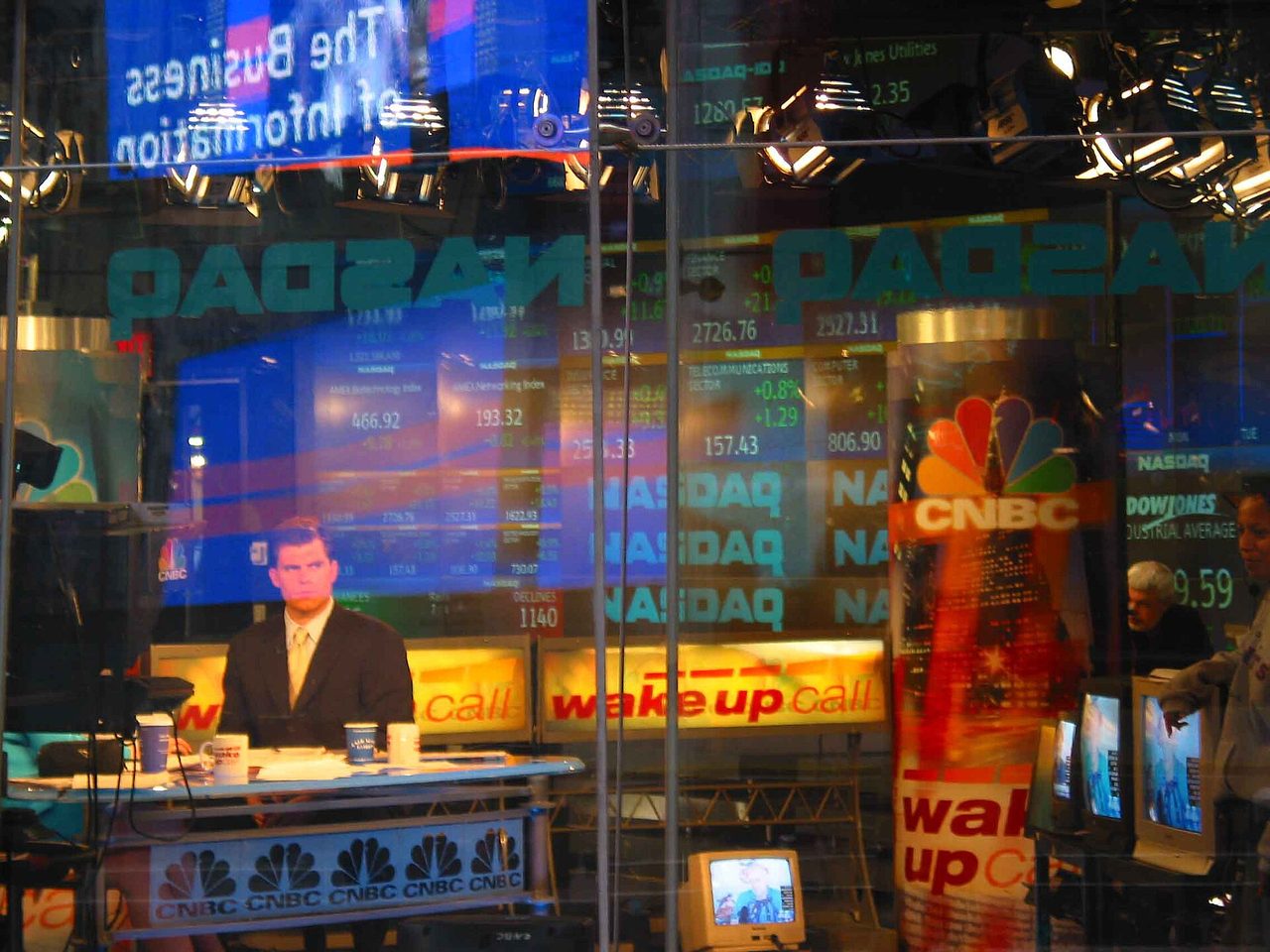
Photo: ed100 from US / CC BY 2.0 · via Wikimedia Commons
Nasdaq Ends Worst Week Since June as AI Stocks Shed $1 Trillion
Nasdaq closes down 2.1%
U.S. stocks closed lower on Friday, Oct. 16. The Nasdaq Composite fell 572.99 points, or 2.1%, to 26,140.03, while the S&P 500 dropped 84.62 points, or 1.1%, to 7,659.44. The Dow Jones Industrial Average lost 175.28 points, or 0.3%, closing at 52,002.41, according to The Associated Press.
Worst week for the Nasdaq since June
Aggregated closing data put the Nasdaq's weekly decline at 4.48%, with the S&P 500 down 1.95% and the small-cap Russell 2000 off 3.05% at 2,721.37. The Dow bucked the trend, gaining 0.67% for the week. The AP called it the worst week for both the S&P 500 and the Nasdaq since June.
$1 trillion gone from AI names
CNBC reported that 20 of the world's most valuable AI and semiconductor companies have shed more than $1 trillion in market value this week, a loss that Sedaily dates to four trading sessions. The Philadelphia Semiconductor Index sits about 12% below its early-October high, and the iShares Semiconductor ETF fell 4.14% on Friday alone.
Micron and Intel lead the chip slide
Chip stocks kept sliding into the close: Micron Technology fell 5.6% and Intel lost 5.8% on Friday, according to the AP, while AMD dropped 5.96% and Broadcom 4.53%. Broadcom CEO Hock Tan warned this week that the cost and availability of financing may slow the AI build-out more than chip or power shortages do.
CoreWeave becomes the stress point
The anxiety centers on neoclouds, the companies that rent Nvidia chips to AI developers. CoreWeave fell about 11% on Friday and is on track for a weekly drop of more than 21%, its worst since November 2025, while a CoreWeave bond maturing in 2032 yielded close to 15%. The company carries more than $40 billion of debt and has raised its capital-spending plan by $4 billion, to as much as $39 billion.
Huang says no bailout is needed
Nvidia owns roughly 10% of CoreWeave. "CoreWeave's strength is improving every day," CEO Jensen Huang said in Stockholm. "Their cost of capital is actually decreasing," he added, saying Nvidia sees no need for a rescue. CoreWeave CEO Mike Intrator told employees in an internal memo that its backlog more than covers its debt and that markets sometimes "misunderstand and act irrationally," Reuters reported.
Inflation rekindles the rate debate
September consumer prices rose 3.7%, and producer prices climbed 6.3% year over year against a 5.3% consensus. The 10-year Treasury yield eased to 5.09% on Friday, the AP reported. Bets on an October hike swung hard, from about 22% to roughly 50% after the inflation data and back to about 30% after Warsh spoke, according to CME FedWatch via Euronews, while The Straits Times reported a slide from about 27% to below 15%.
Warsh keeps October open
Fed Chair Kevin Warsh, speaking in Bangkok at the IMF and World Bank annual meetings, described AI as a "very bumpy" but ultimately "very good" path and gave no signal on the Oct. 27-28 decision. The Fed raised rates a quarter point in September to 3.75%-4.00%, its first hike in three years; Goldman Sachs expects the year's final hike in December.
Oil touches $110 a barrel
Brent briefly touched $110 for the first time since May and settled $3.94, or 3.7%, higher at $109.86, its highest since May 19. West Texas Intermediate closed at $101.41, up $3.44, or 3.5%. Brent gained 4.9% and WTI 10.4% for the week. Houthi attacks on Saudi Aramco facilities and uncertainty over Russian diesel supply drove prices, with Goldman estimating a risk premium of just over $20 a barrel.
Asia bounces as Europe posts its best week since June
South Korea's Kospi, which slid 7.6% and triggered a 20-minute trading halt on Thursday, rebounded Friday, up 1.8% in CNBC TV18's tally and 3.6% per MarketScreener, with Samsung Electronics and SK Hynix gaining 4.3% and 3.5%. Japan's Nikkei 225 rose 1.38% and the MSCI Asia-Pacific index added 0.6%; Europe's STOXX 600 gained 0.67% and the FTSE 100 0.38%.
The selling is in AI, not the whole market
On Thursday the equal-weight S&P 500 gained 0.5% while its cap-weighted counterpart fell 0.5%, and advancers outnumbered decliners 2.48 to one. Morgan Stanley noted that in September the cap-weighted index fell 0.5% while the equal-weight version fell 5%, as the top six contributors added about 190 basis points and the rest dragged by roughly 240.
China's memory advance adds pressure
CXMT said on Oct. 10 that it had made progress on a 4F2 DRAM design that TrendForce estimates could raise memory density by 30% to 50%. Its global DRAM share has climbed to about 10% from roughly 4% a year ago, according to HSBC, and it plans a data-center DDR5 product built on the design by the end of the year.
What to watch next
The Fed meets Oct. 27-28 and has entered its pre-meeting blackout period; Tesla and Bloom Energy report next week; and oil traders will watch whether tensions around Yemen and the Strait of Hormuz ease.
Sources
- How major US stock indexes fared Friday 10/16/2026
- Stocks edge lower as dollar heads for weekly loss
- CNN Business: Nasdaq sinks more than 2% as investors raise questions about AI debt
- CNBC: Why this little known Chinese chipmaker has caused a global stock rout
- Nvidia CEO Downplays CoreWeave Concerns, Bolstering Stock