Asian Chip Stocks Bounce Back as Jakarta Suffers Its Worst Day Since 1998
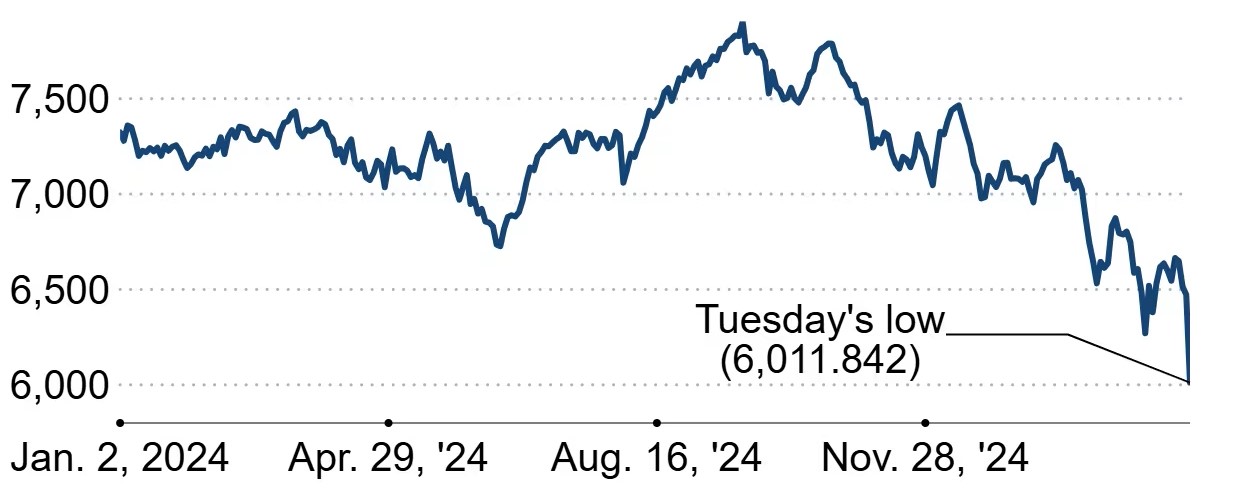
Photo: Nikkei Asia, QUICK / Public domain · via Wikimedia Commons
Asian Chip Stocks Bounce Back as Jakarta Suffers Its Worst Day Since 1998
Chips lift a region still shaken by Thursday's rout
Asian equities mostly rose on Friday, October 16, led by beaten-down semiconductor names, a day after a technology selloff dragged markets lower. MSCI's Asia Pacific index gained about 1.1%. South Korea's KOSPI rebounded more than 2.5%, after Thursday's 7.57% slide to 5,554.22 points triggered a circuit breaker. Japan's Nikkei 225 closed about 1.4% higher at 65,324, ending a six-day losing streak and clawing back part of the previous session's nearly 5% drop; it was up as much as 1.9% during the day. SoftBank Group added 1.7%. Hong Kong's Hang Seng rose about 1.1%, and the Shanghai Composite gained about 1% to 3,742.66.
Memory makers led the recovery
Samsung Electronics rose 2.9% and SK Hynix 2.2%. Japan's Kioxia advanced 3.3%, Sony 2.9% and Tokyo Electron about 2.6%. Foxconn added 1.3%, even as Taiwan's Largan fell 5.7%.
Jakarta broke away with an 11% plunge
Indonesia did not share in the rebound. The Jakarta Composite Index opened 8% lower, triggering a 30-minute trading halt, then extended losses to as much as 11.4% — its steepest one-day fall since January 1998 and its lowest level since November 2020. An early reading put the index at 5,393 points, down 469 points, after closing Thursday at about 5,863. The benchmark has now lost close to 40% this year, making it the worst-performing equity market in the world.
MSCI moved to strip Indonesia of emerging-market status
The trigger was MSCI's decision to open a consultation on reclassifying Indonesia from "emerging market" to "standalone market" status. The index provider cited market participants' significant concerns about the investability of Indonesian equities, including persistent opacity in shareholding structures, suspected coordinated trading, and a lack of evidence of meaningful enforcement. It said a demotion to "frontier" status would "not properly recognise the depth of the market problems." MSCI kept its existing freeze on certain index changes involving Indonesian securities.
Officials say the Bangkok meeting gave no warning
Indonesia's senior economic minister, Airlangga Hartarto, said there was "a big question mark" over why MSCI did not raise a downgrade to standalone status during a meeting in Bangkok this week. The Indonesia Stock Exchange said MSCI had asked about the effectiveness of its reforms but never mentioned standalone status, and that it would supply stronger evidence. The exchange insisted listed companies remain fundamentally sound and that the problem was one of perception. Jakarta has introduced enhanced shareholder disclosure rules and a roadmap for a 15% minimum free float, and said in April that its reforms were complete.
The AI debt scare that started the selloff
The regional slump began with questions about how the artificial-intelligence boom is being financed. CoreWeave, an AI cloud provider, saw its 9.625% notes due in 2032 trade at yields near 14.8%, with prices below 78 cents on the dollar — distressed territory. The cost of five-year protection against default on its debt topped 1,000 basis points, a record. CoreWeave's stock closed down 15.46% on Wednesday, fell as much as 9.5% early Thursday, then reversed to end 5.9% higher. In the United States, Nvidia closed 1.8% lower, Broadcom lost 0.6% and AMD 1.5%.
Foreign money has been leaving all year
Indonesia's slide is not new. Foreign investors have booked roughly $4.7 billion in net equity sales in 2026, with Bloomberg putting the figure near $4.9 billion, potentially the worst year on record. Goldman Sachs cut Indonesian equities to underweight in January and estimated a downgrade could push outflows to $7.8 billion. Citi said standalone status would be "unambiguously worse" than a frontier downgrade: there would be no offsetting inflow from frontier indexes, and every remaining emerging-market-benchmarked passive dollar would have to exit.
A weaker rupiah and an intervening central bank
The rupiah slid about 0.6% to 0.8% to around 18,070 per dollar, its weakest since late July and close to June's record low of 18,209, and is down roughly 8% this year. Bank Indonesia said it remains committed to rupiah stability and intervened in currency and bond markets.
Next: evidence, flows and a June 2027 verdict
MSCI's consultation runs until April 30, 2027, with a final decision due by June 30. Unless it finds clear evidence of material improvement in market governance and functioning, MSCI intends to proceed. Argentina is the most recent example of a market moved to standalone status. For now, the day has been widely described as a "wake-up call": without credible governance fixes, Indonesia faces not a few volatile sessions but a lasting valuation discount.
Sources
- Reuters: Indonesia gets a wake-up call as MSCI prepares to expel it from global indexes
- Yahoo Finance/Investing.com: Asia stocks rebound as chipmakers recover, Indonesia rout deepens with 11% slump
- Associated Press: Stocks rebound after tech sell-off and Indonesia shares sink on market downgrade warning
- AFP: Indonesian stocks dive 11% as MSCI weighs market reclassification
- The Star/Reuters: Jakarta stocks plunge 11% as MSCI set to drop Indonesia from indexes