Magnitude 7.0 Quake Strikes Russia's Kamchatka Peninsula; No Tsunami Threat, and a False 9.9 Alert in Japan
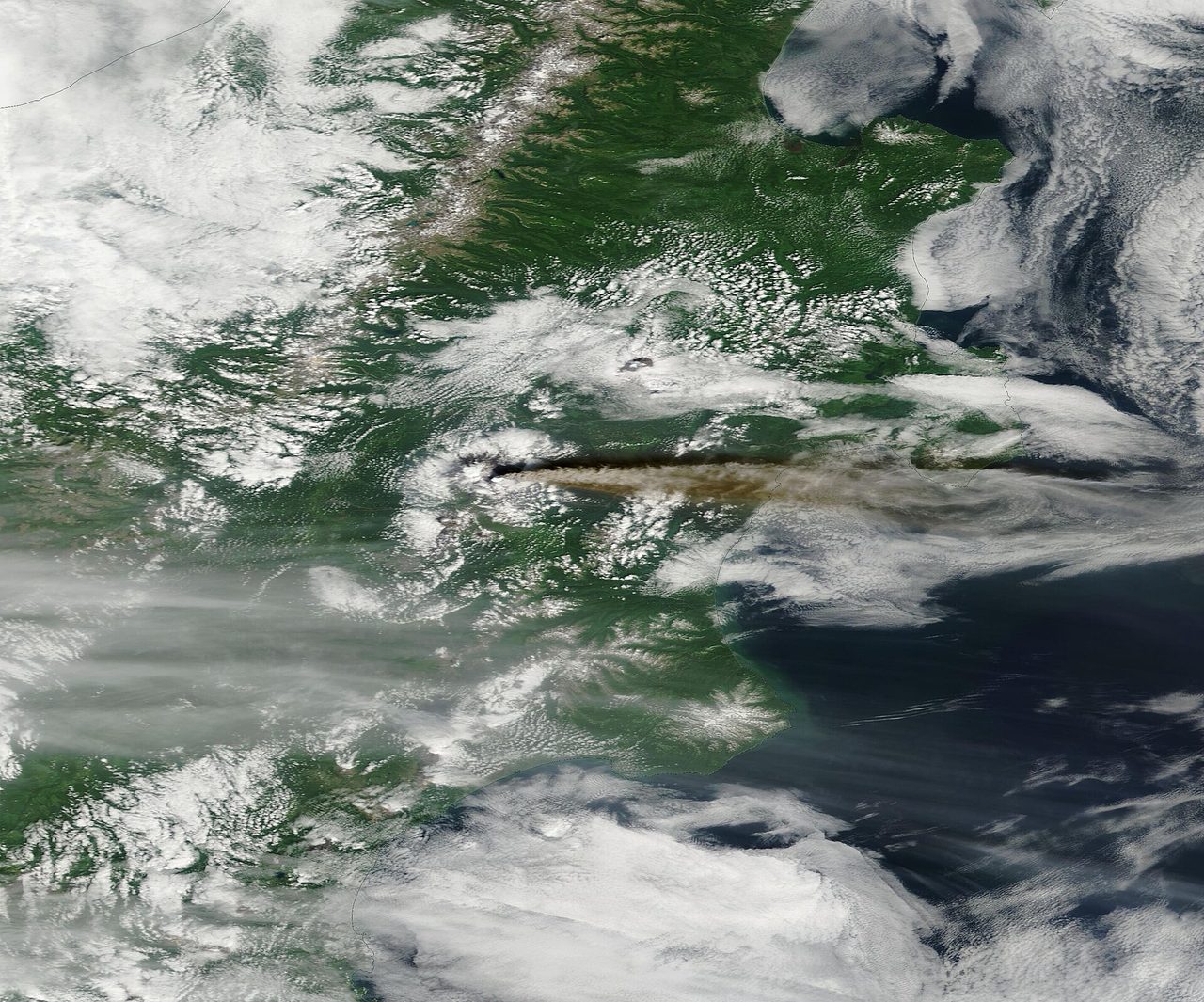
Photo: MODIS Land Rapid Response Team, NASA GSFC / Public domain · via Wikimedia Commons
Magnitude 7.0 Quake Strikes Russia's Kamchatka Peninsula; No Tsunami Threat, and a False 9.9 Alert in Japan
A magnitude 7.0 earthquake struck southern Kamchatka on Friday
The European-Mediterranean Seismological Centre (EMSC) reported a magnitude 7.0 earthquake in Russia's Kamchatka Peninsula region on Friday, at a depth of 140 km (86.99 miles). The quake hit at 03:35 UTC, or 15:35 local time, and EMSC placed the epicentre about 123 km southwest of Vilyuchinsk. Reuters was first out with the EMSC headline, and outlets from India to Singapore and the United States followed within hours.
Agencies disagree slightly on magnitude and depth
EMSC initially put the event at magnitude 7.0 and 140 km deep, then revised its detailed data to 6.9 at 130 km. The U.S. Geological Survey recorded 6.9 at 135 km. India's National Centre of Seismology reported 7.0 at 152 km, at 52.068 degrees north and 157.164 degrees east. The U.S. National Oceanic and Atmospheric Administration listed 7.0 at roughly 148 km. The Kamchatka branch of the Russian Academy of Sciences' Unified Geophysical Service settled on 6.9 — first estimated at 6.5 — with the epicentre on land, about 156 km southwest of Petropavlovsk-Kamchatsky.
Russian officials report no injuries and no damage
TASS, citing the Kamchatka branch, said instrumental intensity in Petropavlovsk-Kamchatsky reached only 4, with residents in the region feeling something closer to a magnitude-5 event. Russia's Ministry of Emergency Situations said tremors were felt in parts of Petropavlovsk-Kamchatsky, Ust-Kamchatsky, Aleutsky, Vilyuchinsk and Yelizovsky, and that no injuries or infrastructure damage were reported. Xinhua, reporting from Vladivostok, put the epicentre about 161 km from the region's largest city and also reported no casualties or damage. Indian outlets described light fixtures swinging violently, doors slamming shut and tableware rattling, with the shaking lasting about a minute. AFP and News18 quoted the regional head, Vladimir Solodov, as saying there were no damage reports at the time and urging residents to stay calm.
No tsunami, because the rupture was deep and inland
The Pacific Tsunami Warning Center said at 03:43 UTC that there was no tsunami threat, and NOAA reported no tsunami warning, advisory, watch or threat. The rupture at 130 to 152 km sat inside the subducting slab, limiting seafloor displacement, and the epicentre was on land, well away from open water. USGS estimates about 110,000 people felt shaking of MMI II or higher, with level V — moderate shaking and very light damage — affecting roughly 10,820 people; about 90,000 were in level IV, where shaking is light and damage unlikely.
A subduction zone still settling after 2025's magnitude 8.8
Kamchatka sits on the northern stretch of the Pacific Ring of Fire, next to the Kuril-Kamchatka Trench. On 29 July 2025, a magnitude 8.8 earthquake struck offshore there — the strongest worldwide since the 2011 Tohoku quake and the sixth largest since 1900 — sending a tsunami across the Pacific, with warnings from Japan to Chile and a maximum wave height of about 19 metres recorded at Shumshu in the Kuril Islands. A magnitude 7.8 quake followed in September 2025, prompting a tsunami alert that was later lifted. Germany's GFZ classifies the sequence as a subduction-zone megathrust event, in which the Pacific plate sinks beneath the Eurasian plate.
Japan's 9.9 alert stood for eight minutes
The secondary shockwave of the day landed in Japan. The Japan Meteorological Agency recorded the quake near the Kamchatka Peninsula at about 12:36 p.m. local time and issued an earthquake early warning at 12:40 p.m., forecasting strong shaking across northern, eastern and central Japan and setting off alarms on public speakers and mobile phones. It cancelled the alert at 12:48 p.m. Several outlets reported the warning had predicted magnitude 9.9. At a press conference the agency apologised, saying its system had placed the epicentre near the Kuril Islands and overestimated the magnitude; it ruled out a cyberattack and said the cause remains under investigation. Japan's strongest actual reading was intensity 1 in Hakodate, Hokkaido. No tsunami warnings or advisories were issued, and no damage was reported.
Why the shaking stayed mild
The contrast with 2025 comes down to depth and location. The magnitude 8.8 event ruptured shallow, roughly 21 to 35 km down, lifting the seafloor and driving a Pacific-wide tsunami. Friday's quake released its energy 130 km or deeper, so much of it was absorbed before reaching the surface, and an intermediate-depth event of the same magnitude shakes the ground less. With the epicentre inland, the ocean was never disturbed. USGS issued a Green — its lowest — alert for shaking-related impact, indicating a low probability of casualties and losses.
Small population, one main city in the shaking zone
The affected area is sparsely populated southern Kamchatka. Petropavlovsk-Kamchatsky, the regional capital, has roughly 181,000 residents, with some reports near 187,000; Vilyuchinsk, home to a Russian Pacific Fleet submarine base, about 25,200; Yelizovo about 40,700; and Ozernovskiy, 76 km northeast of the epicentre, about 2,600. USGS analysis puts all exposed population inside Russia, with Japan feeling only light shaking in places such as Hakodate.
What to watch next
Intermediate-depth quakes tend to produce fewer and smaller aftershocks, but magnitude 4 to 5 events remain possible in the coming days. Three things are worth tracking: aftershock and damage-assessment updates from Russian scientists and the emergencies ministry; what the JMA concludes about the 9.9 mis-warning and whether its algorithm changes; and how long the Kuril-Kamchatka subduction zone keeps adjusting after 2025 — a stretch of seafloor that UNESCO's Intergovernmental Oceanographic Commission described as a live test of the Pacific tsunami warning system.
Sources
- Reuters: 欧洲地中海地震中心称堪察加半岛发生7级地震
- TASS: 堪察加记录到有感地震
- Xinhua: 俄罗斯堪察加发生6.9级地震
- The Hindu: 俄罗斯奥泽尔诺夫斯基附近发生6.9级地震
- Watchers.news: 堪察加半岛发生M6.9强震