The First Green Star Is a Dead Sun That Ate Its Planets
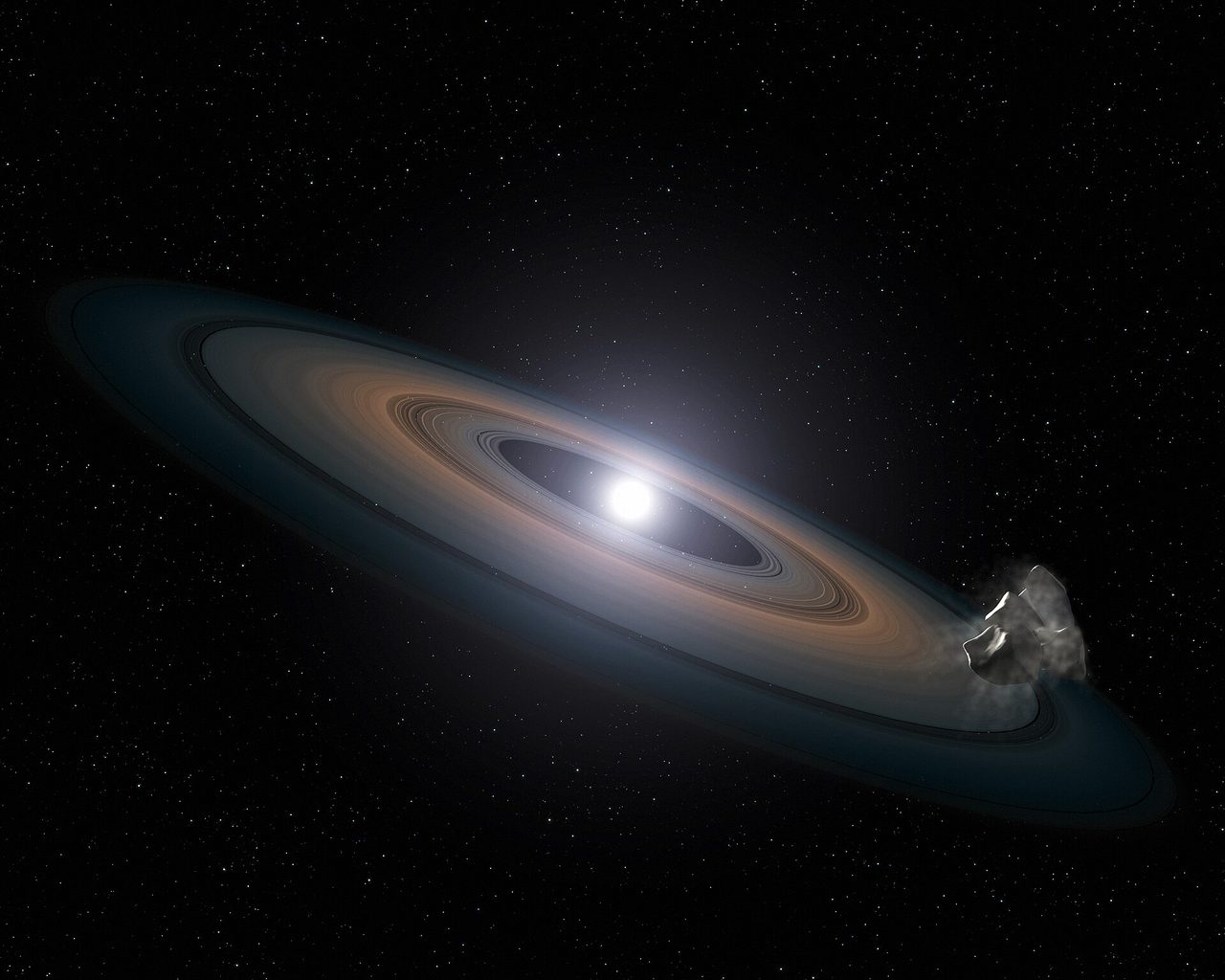
Photo: NASA, ESA, STScI, and G. Bacon (STScI) / CC BY 4.0 · via Wikimedia Commons
The First Green Star Is a Dead Sun That Ate Its Planets
A dead star with a green glow
Astronomers have identified the first star that would credibly appear green to the human eye. Designated WD J1330+6435, it is a white dwarf — the dense leftover of a star like our sun — and it has been feeding on rocky material from its own planetary system, enriching its atmosphere until the whole star took on a ghostly chartreuse hue. Space.com framed it as a "cosmic zombie" that is still eating long after death.
Warwick team led by Mark Hollands
The work, titled "Any colour you like: The diverse chromaticities of white dwarfs," was published in RAS Techniques and Instruments and led by Dr Mark Hollands of the University of Warwick's Astronomy and Astrophysics Group, with Professor Boris Gänsicke of the university's Department of Physics. "Most stars, including most white dwarfs, behave like 'perfect radiators,' so their colour is set almost entirely by temperature," Hollands said. "But nobody had really looked into what else might be possible for white dwarfs."
Sodium soaks up the orange light
WD J1330+6435 sits at about 4,000 degrees Celsius (7,232 degrees Fahrenheit), among the coolest white dwarfs known. Accreted rocky debris loaded its atmosphere with calcium, lithium and sodium. The sodium absorbs much of the yellow, orange and red light, and the surviving colours combine into green. "The traces of sodium in the atmosphere of this white dwarf absorb the orange part of the spectrum, leaving behind a ghostly green glow," Hollands said. "Imagine standing on a planet and looking up at a green star. It feels like something out of science fiction." Reports put the star's distance at roughly 284 to 326 light-years away.
Density near that of water does the rest
The underlying mechanism is density. The coolest white dwarf atmospheres reach around one gram per cubic centimetre — roughly the density of water, and millions of times denser than the sun's photosphere. In that environment, trace elements such as carbon, calcium and sodium no longer absorb light the way they do in a diffuse gas; they interact with the surrounding dense helium plasma and soak up far broader ranges of wavelengths, pushing the star's colour away from the orange-white-blue of a perfect radiator.
Colour tracks chemistry, not just temperature
The team found the colours fall into chemical families. Carbon-rich white dwarfs come out pink or purple. Stars enriched with the debris of busted asteroids and comets — the remains of old planetary systems — lean yellow. Cool white dwarfs with mixed hydrogen and helium atmospheres glow cyan or pale blue, an effect produced as hydrogen molecules collide with helium atoms in their ultra-dense atmospheres.
Five oddballs in a sample of 151
The researchers examined 151 white dwarfs within 20 parsecs, about 65 light-years, of the sun. Only five showed unusual colouring: two yellow and three pink. That suggests roughly one in 30 white dwarfs across the universe shines with an unusually coloured light. The median colour temperature of the sample came out near 6,800 K, which our eyes read as white. "One in 30 might not sound like a huge fraction, but across the entire population of white dwarfs in the universe, that is still a lot of oddly coloured stars out there," Gänsicke said. The median also corrects a long-standing impression that white dwarfs are typically blue: hotter, bluer white dwarfs are brighter and easier to spot, so brightness-limited surveys over-represent them.
The reddest star on record, too
At the opposite end of the spectrum, the team flagged WD J1011+2845 as possibly the reddest star ever recorded. Just 48 light-years from Earth, it has a deep convection zone that has dredged carbon up from its core to its surface; the resulting carbon molecules distort the star's light so severely that almost all of it is squeezed into wavelengths beyond 600 nanometres, producing a deep salmon-pink glow.
Our own sun could go green
Space.com noted that the sun could in principle turn green as well — but only billions of years from now, after its death, and only if it then starts devouring planets like a cosmic zombie. On average, white dwarfs really are white.
A fast diagnostic for what dead stars ate
Because an odd colour flags a specific chemistry — sodium from accreted rocky debris, carbon dredged from a degenerate core, molecular hydrogen colliding with helium — colour becomes a rapid diagnostic of what a white dwarf is made of and what it has recently consumed. With large surveys cataloguing hundreds of thousands of white dwarfs, the Warwick method should surface many more green, pink and purple stars.
You have to get close to see it
The colours are what the stars would look like if we could view them close enough to resolve their stellar discs; the researchers converted spectra into human-perceived colour rather than photographing a green star. From Earth, each is only a point of light.
Sources
- Space.com: Astronomers discover the 1st ever green star, a cosmic zombie just in time for Halloween
- Phys.org: Green, pink and purple: Astronomers reveal the surprising true colors of white dwarf stars
- Popular Science: Astronomers discover first green star and the reddest star ever recorded
- The Independent: Astronomers find the first ever green star
- Sci.News: White Dwarfs Really are White, But Few are Green, Pink or Vivid Blue