Washington's Interest Bill Tops Trillion for the First Time
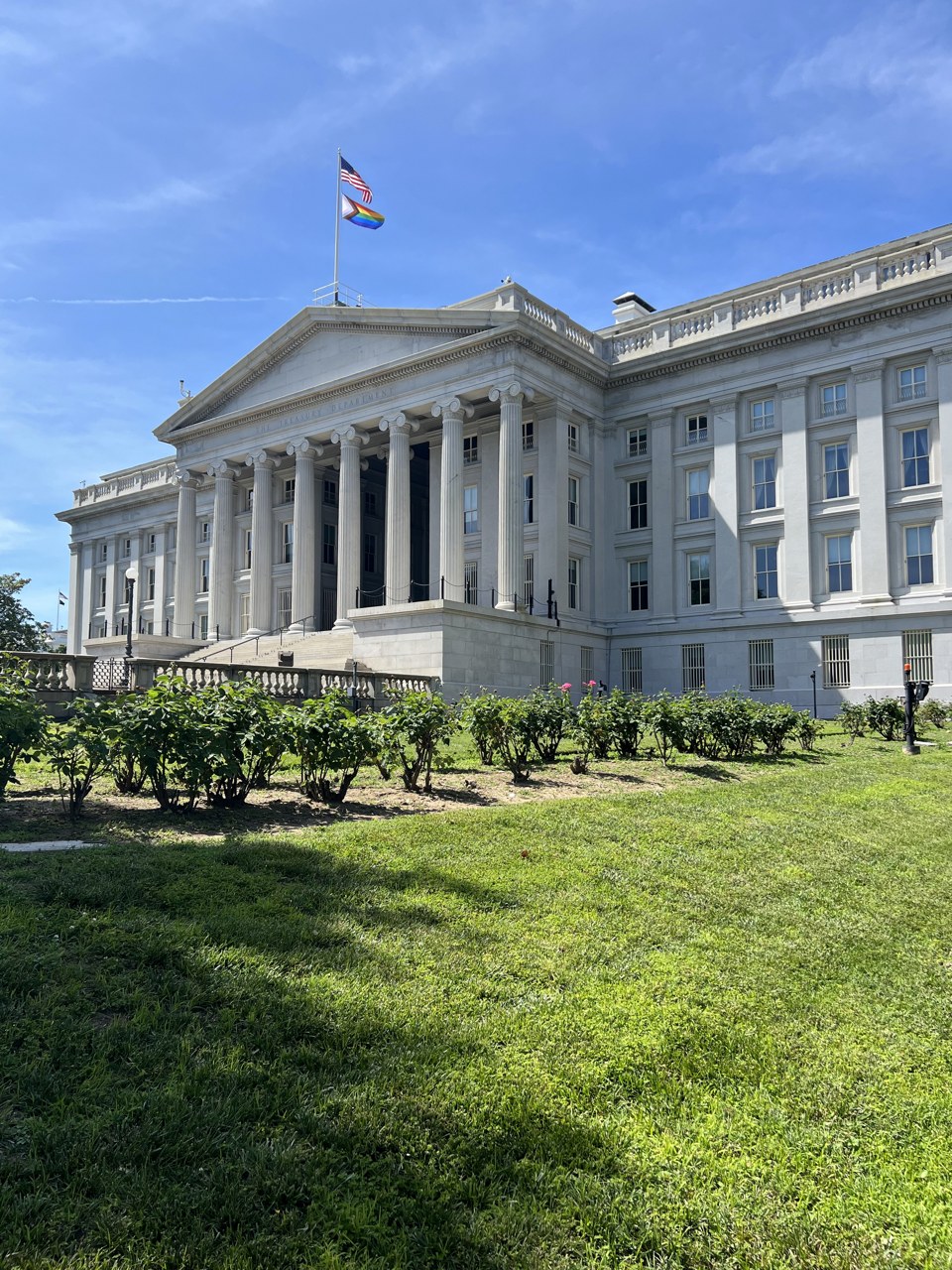
Photo: 颐园居 / CC BY-SA 4.0 · via Wikimedia Commons
Washington's Interest Bill Tops $1 Trillion for the First Time
Net interest hits $1.05 trillion, a record
The U.S. government paid $1.05 trillion in net interest on its debt in fiscal 2026, which ended Sept. 30, up more than 8% from $970 billion a year earlier, according to Treasury Department data released Friday. It was the first time the annual bill has crossed $1 trillion. Bloomberg reported the figure under a headline warning of a "debt snowball"; Yahoo Finance noted that interest payments have more than doubled since 2022 and now rank among the three largest federal outlays, behind Social Security and Medicare.
About $3 billion a day, faster than the economy
Fortune calculated that $1.05 trillion works out to roughly $2.9 billion to $3 billion a day, and stressed that the 8% increase outpaced total federal spending (up 6%), federal revenue (up 3%), nominal GDP (about 6%) and real GDP (about 2%). Treasury data also show gross interest costs of $1.36 trillion for the year at an average rate of 3.53% — more than double the 2021 level.
The CBO's tally: interest beats Medicare
In its October monthly budget review, the Congressional Budget Office put net interest on the public debt at $1.143 trillion for fiscal 2026, an increase of $115 billion, or 11%. That exceeded what Washington spent on Medicare ($1.069 trillion) and on national defense, leaving only Social Security ahead of it. The CBO attributed the rise to a larger debt load and higher long-term rates, partly offset by lower short-term rates, and put the fiscal 2026 deficit at $1.993 trillion.
Roughly 15 cents of every federal dollar
Estimates of the interest share converge. The CBO, Commerzbank and the American Enterprise Institute, cited by Fortune, all put net interest at about 15% of federal spending in fiscal 2026, against about 6% a decade earlier. By AEI's accounting interest consumes about 20% of federal revenue; the freight publication FreightWaves puts the share at a record 18.5% and notes the CBO projects it reaching 25% by 2036.
More debt, repriced at higher rates
The Committee for a Responsible Federal Budget estimates interest cost about $1.1 trillion in fiscal 2026, a record 3.4% of GDP, second only to Social Security and above both defense and Medicare. Debt held by the public stands at about $32.3 trillion, close to 100% of GDP. Yale's Budget Lab estimates fiscal policy since 2015 has pushed long-term Treasury yields up about 97 basis points.
The bond market sets the price
The market side showed up in auctions. On Oct. 7 the Treasury sold $39 billion of 10-year notes at a yield of 5.300%, the highest since November 2000; the 10-year yield touched 5.35% intraday that day, its highest since 2002, while the 30-year hovered near 5.67%. The Federal Reserve raised its benchmark rate by a quarter point on Sept. 16 to 3.75%-4% and signaled more may come, feeding straight into what Washington pays to borrow.
A $10 trillion refinancing wall
Fortune reported that Treasury Secretary Scott Bessent has favored short-term issuance, and that about one-third of publicly held debt — more than $10 trillion — matures within the next 12 months, forcing the government to roll it over at today's higher rates. The Financial Times, citing bank forecasts, said the Treasury may need to add roughly $961 billion to $1.09 trillion in bills. Bridgewater founder Ray Dalio warned that even a modest pullback in investors' willingness to reinvest could open a funding gap.
What gets squeezed
Interest is not discretionary, so every dollar of it is a dollar unavailable elsewhere. A Senate Joint Economic Committee brief says that under a higher-rate scenario interest could absorb 55% of federal receipts outside payroll taxes by 2036, with $23 trillion in interest over the decade. For households, the Center for American Progress estimates federal debt already costs a family carrying a mortgage, an auto loan and a student loan about $4,500 a year, while Yale's Budget Lab puts the extra mortgage cost at about $2,500 a year.
Can growth outrun it?
Treasury's argument is growth. Bessent said last month at Southern Methodist University that "with 3% growth, we grow our way out of this." IMF Managing Director Kristalina Georgieva warned last week that the U.S. cannot grow its way out of a debt that costs more than $1 trillion a year in interest. CBO Director Phillip Swagel said on Oct. 8 that growth alone is "probably not plausible" to stabilize the debt: at 4%-5% rates, nominal GDP would need to expand 7%-8% and real GDP 5%-6%, against current real growth of about 2.2%.
Next up: the debt ceiling in early 2027
Scope Ratings kept the U.S. at AA- and expects the $41.1 trillion debt limit to be reached by early 2027; Treasury can use extraordinary measures for months, but post-midterm politics could harden the standoff. The CRFB estimates that if yields stay about 1 percentage point above CBO forecasts, interest costs will reach $2.8 trillion, or 5.9% of GDP, by the end of the decade — and even without further rate increases, the interest bill will keep growing faster than the economy and revenue.
Sources
- Bloomberg: US Interest Costs Hit Record $1 Trillion, Risking Debt Snowball
- Fortune: U.S. debt interest payments hit $3 billion a day and jumped 8% in fiscal 2026
- Yahoo Finance: US Interest Costs Hit Record $1 Trillion, Risking Debt Snowball
- U.S. federal budget deficit hits $2 trillion in fiscal year 2026
- Committee for a Responsible Federal Budget: U.S. Ran a $2 Trillion Deficit Last Year