The Orionids Peak Oct. 21-22: Halley's Comet Debris, and How to Beat the Moon
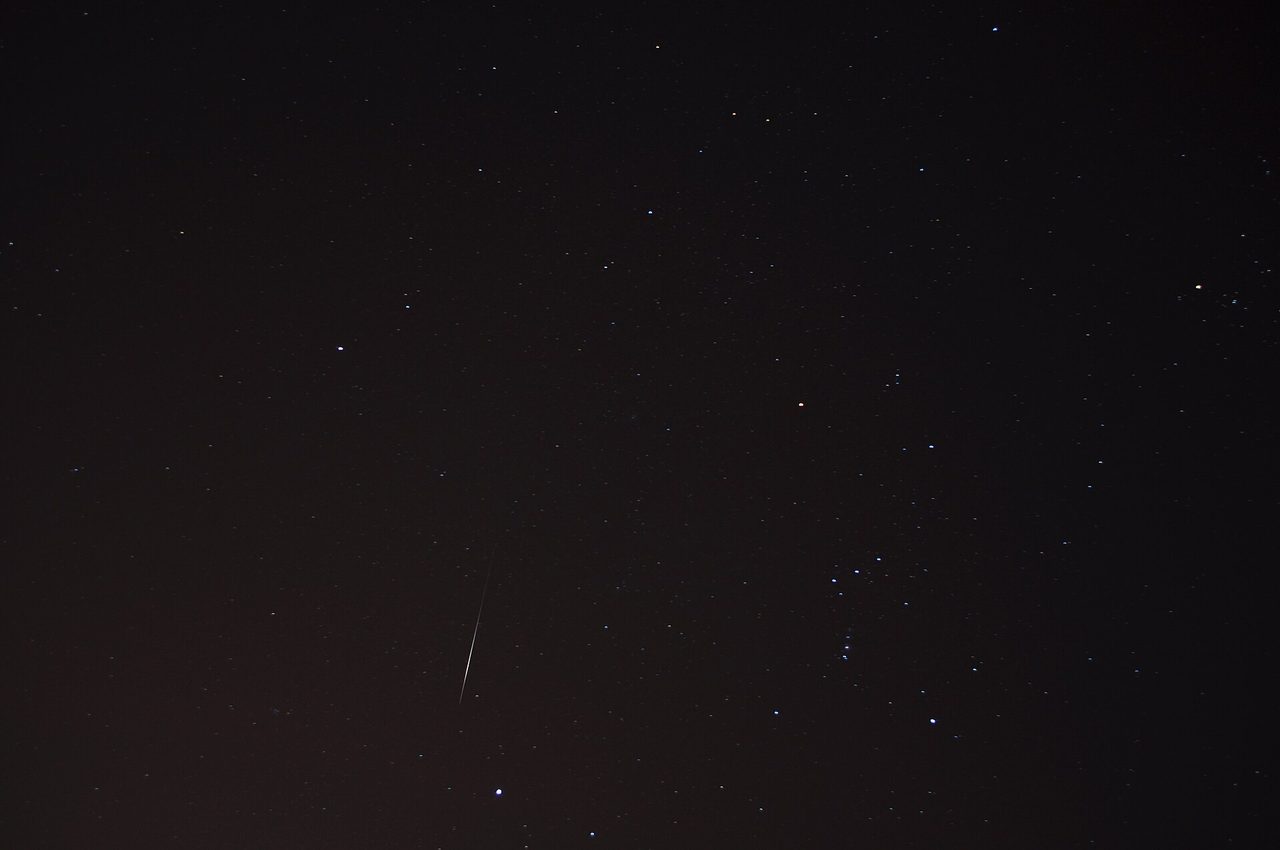
Photo: Tom Shockey from St Charles, IL, US / CC BY 2.0 · via Wikimedia Commons
The Orionids Peak Oct. 21-22: Halley's Comet Debris, and How to Beat the Moon
The shower runs Oct. 2 to Nov. 7 and peaks overnight Oct. 21-22
The Orionids are the reliable middle act between the Perseids of August and the Geminids of December, and in 2026 they reach peak activity on the night of Oct. 21 into the morning of Oct. 22. NASA's October skywatching guide, BBC Weather and Space.com all point to the same two nights; the shower is active from Oct. 2 through Nov. 7. EarthSky puts the greatest number of meteors on the morning of Oct. 23, which is worth remembering because the maximum is broad: the nights on either side of the peak are reasonable backups.
NASA's working figure is 10 to 20 meteors an hour
Under a genuinely dark sky, NASA expects about 10 to 20 Orionids per hour; Sky & Telescope quotes roughly 20. That is a guide for ideal conditions, not a promise for your garden, and light pollution, cloud and moonlight all cut into it. What the shower lacks in quantity it partly makes up for in character: the meteors hit the atmosphere at about 66 kilometres per second, or 41 miles per second, making the Orionids one of the fastest showers of the year. Fast meteors can leave glowing trains that persist for seconds or even minutes, and occasionally flare into fireballs.
The debris is Halley's, and it arrives head-on
The parent body is 1P/Halley. The comet last came through the inner solar system in 1986 and will not return until 2061, on an orbit of roughly 76 years, so nothing about this week's display depends on the comet being anywhere nearby. Earth crosses Halley's dusty orbit twice a year: the Eta Aquariids in May arrive on the way in, and the Orionids in October on the way out. Because Halley's orbit runs backwards relative to the planets, its grains meet our atmosphere almost head-on - the reason those streaks are both fast and bright.
A gibbous Moon sets around 2 a.m. - that is your window
The Moon is the main variable this year. It will be a waxing gibbous, and estimates of how bright differ slightly: Sky & Telescope gives 82 percent illuminated, StellarHound about 80 percent, Night Sky Today 78 percent. What matters more is when it gets out of the way. Space.com has it setting shortly after 2 a.m. local daylight time, leaving roughly three and a half hours of dark sky before dawn, with as many as 15 to 20 Orionids an hour visible to a single observer in that stretch. Sky & Telescope puts moonset nearer 3 a.m., followed by almost three hours of darkness. Tempo, citing Space, reports moonset at about 2:15 a.m. in the central United States - the exact time is local.
Look 40 to 90 degrees away from Betelgeuse
Orionid meteors appear to stream from a radiant close to the red giant star Betelgeuse in the constellation Orion. Early in the evening the radiant is still low: Orion does not fully clear the eastern horizon until after 11 p.m. local daylight time. By about 2 a.m. it is well up, and around 5 a.m., just before dawn, it reaches its highest point in the southern sky. Space.com suggests looking 40 to 90 degrees away from the radiant, where the streaks cross your view at length instead of coming straight at you. Dark Skies Directory lists a zenithal hourly rate near 20 for an ordinary year, with outburst years having produced 50 to 75 an hour.
No telescope - darkness is the equipment
This is a naked-eye event. Meteors can appear anywhere across a wide swath of sky, so a telescope's narrow field is a liability rather than an advantage. The real difficulty is that Orionids tend to be faint, and city lights wash out exactly those. A garden with the house lights off is a start; a rural spot away from street lamps is much better.
Both hemispheres, and a wide window after the peak
The Orionids are visible from both hemispheres, and because the peak is broad the shower keeps offering chances well past Oct. 22. Activity continues until Nov. 7, and the full Moon of October does not arrive until Oct. 26, so the darker evenings before then are all usable.
What to do next: check your own moonset time
Look up the moonset time for your location, plan to be outside before it, and give your eyes time to adapt. Face a broad, unobstructed southern sky away from town lights, and keep one or two nights either side of the peak in reserve for weather. Cloud, moonlight and light pollution will all reduce your count, so treat 10 to 20 an hour as a ceiling rather than a target.
Sources
- BBC Weather: Orionid meteor shower 2026: How and when to see it this week
- Space.com: How to see the Orionid meteor shower 2026 peak this week — and when to look
- NASA/JPL: What's Up: October 2026 Skywatching Tips from NASA
- Sky & Telescope: Rise Early on October 22nd for the Orionid Meteor Shower
- EarthSky: Orionid meteor shower 2026: All you need to know