Earth's Core Has Been Oozing Primordial Material Since the Planet Was Born
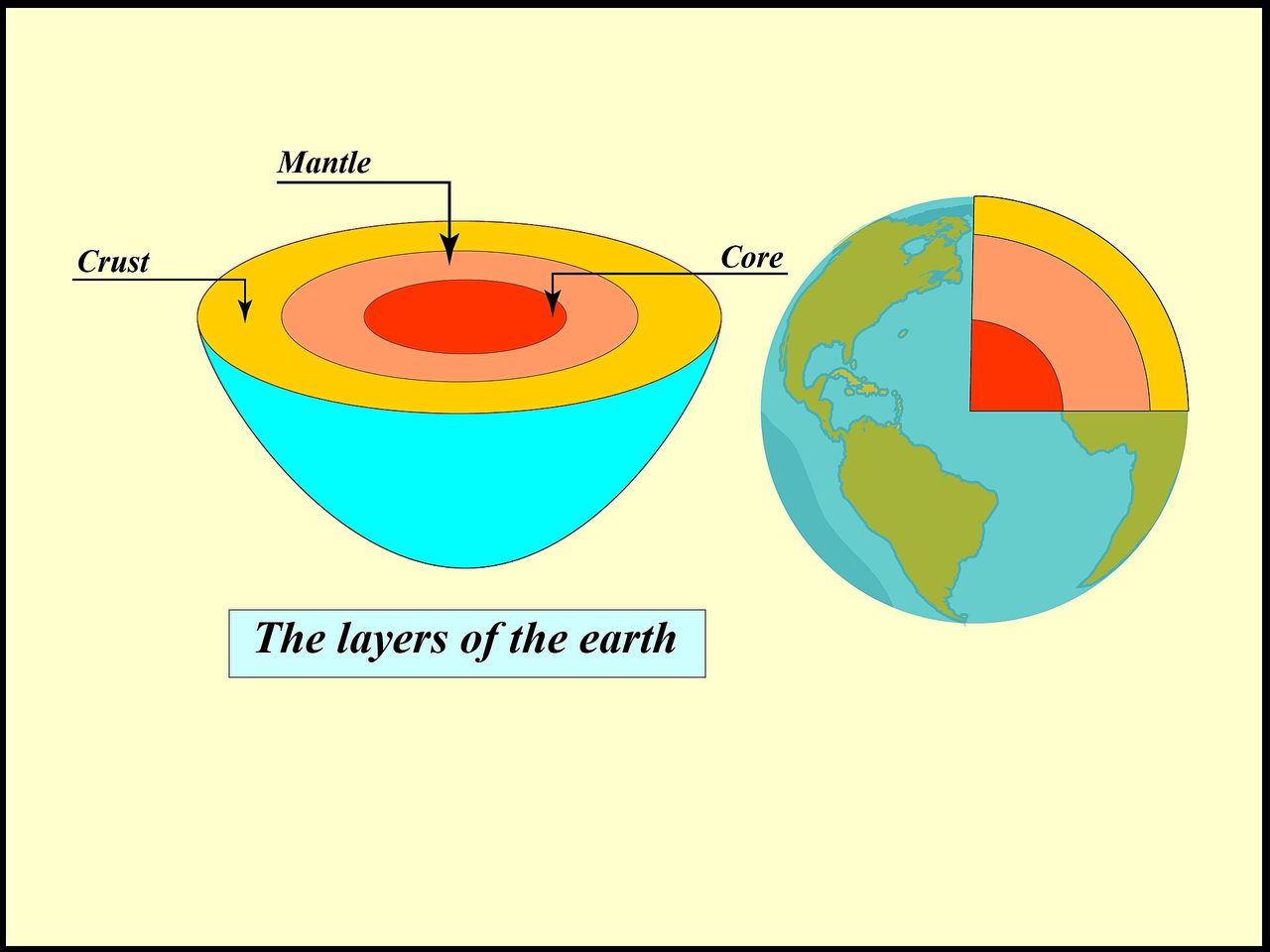
Photo: Rajneesh kumar Thakur / CC BY-SA 4.0 · via Wikimedia Commons
Earth's Core Has Been Oozing Primordial Material Since the Planet Was Born
The deepest layer never stopped leaking
Earth's core is not sealed. A new study argues that the planet's innermost region has been seeping material upward into the mantle since the very beginning — hydrogen, helium and tungsten that were locked into the iron core during planetary differentiation, drifting up along deep plumes over roughly 4.5 billion years. The researchers describe this as an ongoing chemical exchange between core and mantle, not a one-off leak.
A Hefei team tracked hydrogen's quantum trek
The work comes from geoscientists at the University of Science and Technology of China in Hefei, published in Science Advances. Nobody can sample the deep interior directly, so the team ran machine-learning-boosted "path-integral simulations" to model how hydrogen behaves quantum-mechanically under extreme pressure and temperature. Because hydrogen is so light, the team focused on the deuterium-to-hydrogen ratio, testing whether the lighter hydrogen climbs toward the surface through molten plumes.
Crystallization should have left a uniform fingerprint
The simulation produced a counterintuitive result: a magma ocean that crystallizes should leave a primitive mantle with an essentially homogeneous hydrogen isotope composition, even when pressure, temperature and model assumptions vary widely. That makes the uneven hydrogen isotope signals measured in the present-day deep lower mantle hard to explain as static relics of early differentiation. In the team's words, they reflect "dynamic modification by ongoing core-mantle exchange throughout Earth's evolution."
Iceland and Baffin Island lavas carry core signatures
The observational evidence comes from ocean island basalts, rocks built by upwellings from near the core-mantle boundary — erupting at places such as Baffin Island in Nunavut, Canada, and Iceland. They carry three core fingerprints: unusually low deuterium-to-hydrogen ratios pointing to light hydrogen drawn from the primordial solar nebula and later swallowed by the core; elevated helium-3 to helium-4 ratios, since helium-3 is primordial while helium-4 comes from radioactive decay in the upper layers; and tungsten-182 signatures, tungsten having mostly sunk into the iron core during early differentiation.
Hawaiian ruthenium backs the picture
A separate line of evidence comes from Hawaiian volcanic rocks. Researchers at the University of Göttingen reported in Nature traces of ruthenium with a rare isotope signature that points to the core, alongside the estimate that more than 99.999 percent of Earth's gold is locked in the core. The combined tungsten-182 and ruthenium-100 signals were used to rule out alternative explanations such as asteroid impacts or recycled surface crust.
Researchers stress: slow exchange, not a rupture
The word "leaking" sounds alarming, but the researchers are measured. The core makes up about one-third of Earth's total mass, and even across geological timescales the transfer removes only a minuscule share — perhaps grams per year, or a few tens of kilograms over billions of years. The core-mantle boundary sits roughly 2,900 kilometers (about 1,800 miles) down, with the lower mantle beginning near 660 kilometers. The team sees no near-term threat to the geodynamo, which depends on heat and flow in the outer core and on many factors beyond trace metal exchange.
Deep water and hotspot models need rewriting
What really changes is the textbook picture: core and mantle are no longer two static drawers that stopped talking at birth. Three areas feel it first — deep-Earth water research, since hydrogen rising from the core ends up as water trapped in mantle and crust minerals, shifting estimates of deep water reservoirs; hotspot volcanism, where source descriptions for Iceland and Hawaii must now include a core contribution; and models of early differentiation and magma ocean crystallization, where the initial water content has been estimated at up to two ocean masses.
Next: cross-checking independent tracers
The way forward is convergence between tracers. Each one has limitations: helium-3 can survive in the deep mantle on its own, and hydrogen readily dissolves in metals and takes part in mantle chemistry, so interpretation usually needs corroboration. The researchers' point is that confidence rises when helium, tungsten, ruthenium, neon and hydrogen all point the same way — which requires more ocean island basalt samples and higher-precision isotope measurements.
Sources
- ScienceAlert: Earth's Core Is Leaking All Sorts of Materials That Have Been Trapped Since Our Planet's Birth
- Yahoo News: Earth's Core Is Leaking All Sorts of Materials That Have Been Trapped Since Our Planet's Birth
- NDTV: Scientists Find Evidence That Earth's Core Is Still Leaking Hydrogen, Helium and Tungsten
- NewsBytes: Chinese study finds Earth's core slowly leaking hydrogen helium tungsten
- Inshorts: Earth's core may be leaking hydrogen & helium since planet formed: Study