A Thousand Drones Over the Neva: St Petersburg's Largest Air Raid of the War
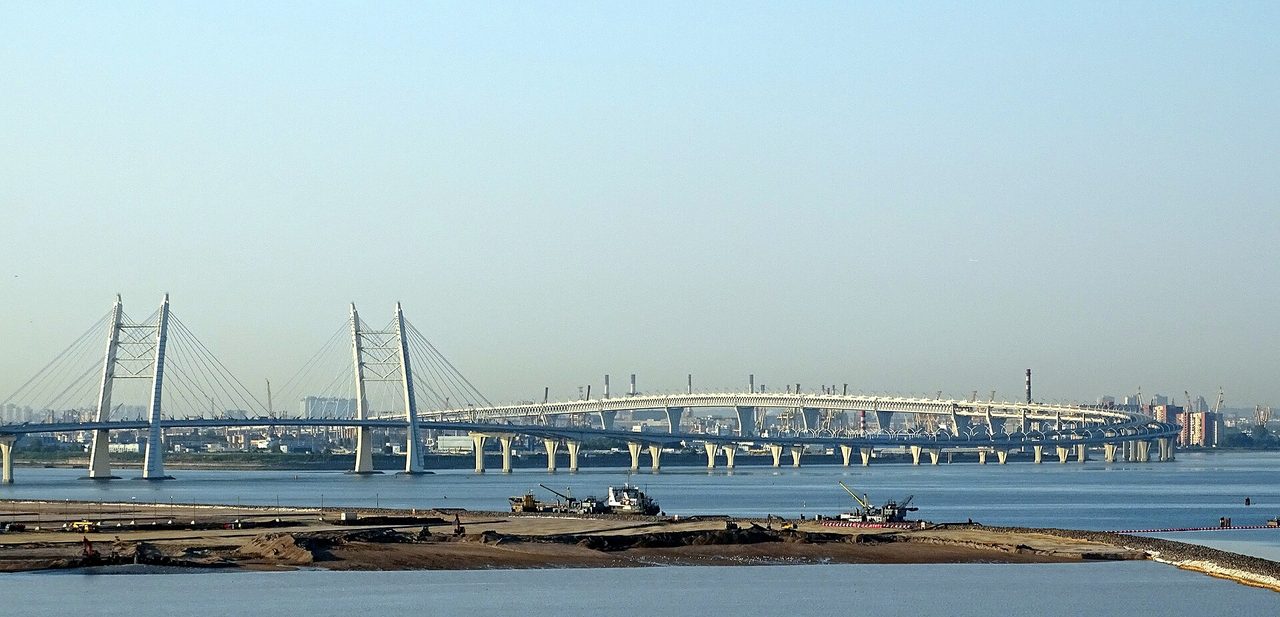
Photo: Ad Meskens / CC BY-SA 4.0 · via Wikimedia Commons
A Thousand Drones Over the Neva: St Petersburg's Largest Air Raid of the War
The sky lit up at 2:50 a.m.
Residents of St Petersburg were woken by explosions in the early hours of October 18. Ukrainian monitoring channels Exilenova+ and Supernova+ logged the first wave entering the city's airspace at about 2:50 a.m.; videos filmed from apartment blocks showed interceptor trails crossing the night sky and black smoke rising from the port. Russia's emergency ministry declared a drone alert at 2:30 a.m. and lifted it only at 8:30 a.m. Meduza, an independent Russian outlet, called it the largest attack on the city and Leningrad region since the full-scale invasion began in 2022. The Financial Times called it the biggest Ukrainian drone attack on St Petersburg to date.
An oil terminal, a fuel depot, a warehouse
St Petersburg governor Alexander Beglov said fires broke out at the St Petersburg Oil Terminal, the Ruchi oil depot and industrial warehouses in the Kolpino district. Ukraine's drone manufacturer Fire Point claimed its FP-1 long-range drone struck the terminal in the city's Great Port, describing it as one of the largest oil-handling complexes in Russia's northwest, with annual throughput of about 12.5 million tonnes. Reuters reported that the logistics hub of e-commerce group Ozon was on fire, and that VK, the company behind Russia's largest social network, confirmed its data centre in the Leningrad region had been attacked — while saying services remained available.
First "no casualties", then fifteen injured
The earliest official statements said no one had been hurt. The numbers changed within hours: Beglov reported one dead and five injured in the city, Leningrad region governor Alexander Drozdenko said injuries in the region had risen to ten, and Reuters put the combined toll at one killed and fifteen injured. There were also poisoning cases: in the Vsevolozhsk district drone debris fell on a residential building, and a woman and three children were hospitalised with carbon-monoxide poisoning.
The interception count climbed all morning
Russian officials kept revising how many drones they had shot down. TASS quoted Drozdenko with 126 over the Leningrad region; Russian outlets later reported 135; Euronews cited the same governor at 144; Izvestia's morning copy said 145. The defence ministry in Moscow said 1,015 Ukrainian drones were destroyed across the country overnight. The Associated Press reported that Kyiv launched more than 1,000 drones at Russia in one of its largest aerial bombardments of the war. Ukraine has not published its own launch figure.
Server halls and a cable-stayed bridge
The targets went beyond fuel. VK's data centre in Novosergiyevka, in the Vsevolozhsk district, houses four data halls, 640 server racks and more than 20,000 servers, according to the Ukrainian defence outlet Militarnyi; VK confirmed the strike but said services were running normally. Astra reported that a cable-stayed bridge over the Korabelny Fairway was also hit — 622 metres long, 39 metres wide and eight lanes across, part of the Western High-Speed Diameter toll road and about 4.5 km from the oil terminal. The central section of that highway was closed in both directions.
Twenty thousand people in the dark
Drozdenko said two transformer substations failed in Yanino, cutting power to about 20,000 residents, with water pressure dropping in some areas. Pulkovo airport suspended all arrivals and departures and moved passengers and staff to safe locations; by 7 a.m., 15 flights had been cancelled and 25 delayed. The airport itself was not damaged and operations resumed after roughly six hours. For a city built on port traffic and logistics, the bill for the night arrived at four points: the quay, the warehouse, the substation and the runway.
Why now: the energy truce is over
Timing is the story. On October 11, President Donald Trump announced that Moscow and Kyiv had agreed to an "energy ceasefire", and Ukraine paused long-range strikes on Russian refineries. Three days later Volodymyr Zelensky declared the pause over; on October 15 Ukrainian drones hit the Ryazan refinery, and Trump called the resumption "a disgrace". The raid on St Petersburg was the largest since that break — carried out, as the FT put it, in defiance of US demands to halt strikes on Russian energy infrastructure.
A 1,000-km flight against a 12.5-million-tonne terminal
Euromaidan Press reported that the drones flew roughly 1,000 km to reach the city. It was not the terminal's first visit from Ukrainian drones: the same facility was hit on July 4, and on June 3 the SBU announced a joint operation against the terminal and warships at the Kronstadt naval base. Three strikes on one site point to a consistent logic — oil export revenue is the most interruptible part of Russia's war budget.
Warehouse shifts and one poisoned family
The human cost was scattered. A fire broke out at an Ozon logistics centre of about 79,000 square metres in Kolpino, one of the company's busiest fulfilment hubs in northwestern Russia; the sorting lines stopped first. Moscow was attacked the same night, with mayor Sergei Sobyanin reporting 87 drones downed by 3 a.m. In the fifth year of the war, both sides answer front-line stalemate by hitting the rear, and the price is paid in airport lounges, dark apartment blocks and one family carried out on stretchers.
What to watch next
First, whether waves of this size become routine: if St Petersburg has to shut its airport every week, air-defence resources will be pulled towards the northwest. Second, whether Washington follows through on what Ukrainian officials say was a warning to cut intelligence support unless the strikes stopped. Repeatedly piercing the president's home city is an embarrassment for the Kremlin; for Kyiv, that embarrassment is precisely what might be traded at a table.
Sources
- Financial Times
- Reuters
- Associated Press
- Al Jazeera
- Euronews