The AI Bull Meets Its Credit Test, and Oracle Is the One on the Hook
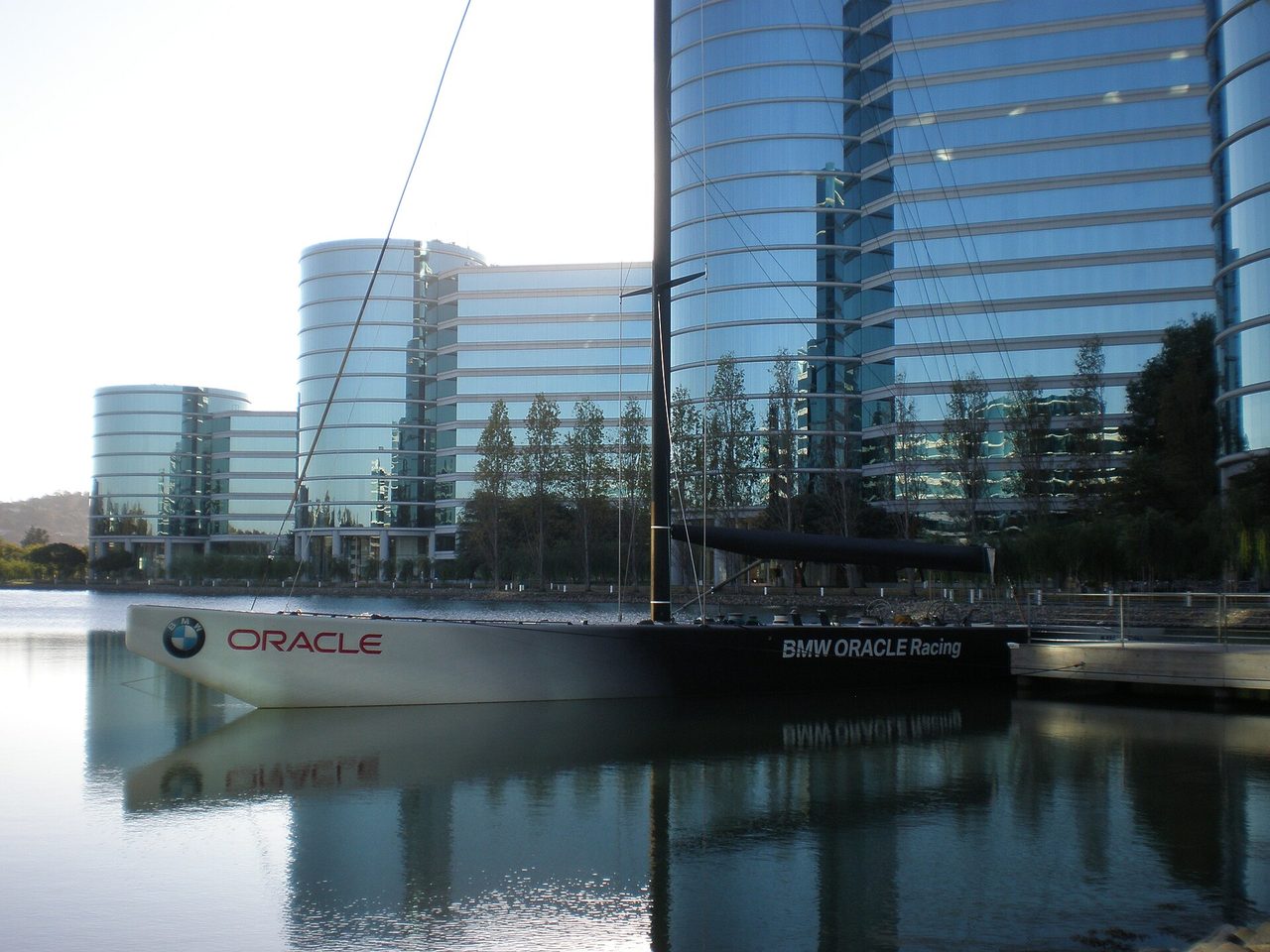
Photo: BrokenSphere / CC BY-SA 3.0 · via Wikimedia Commons
The AI Bull Meets Its Credit Test, and Oracle Is the One on the Hook
Insurance costs broke records first
On October 15, Reuters reported that the cost of insuring against defaults on U.S. technology debt hit an all-time high. The instrument is a credit default swap, quoted in basis points: the wider the spread, the higher the market's implied probability of a credit event. CoreWeave, a data-center operator, saw its five-year CDS blow past 1,000 basis points, which Reuters calculated as a nearly 63% chance of default within five years, up from roughly 30% a year earlier.
Oracle widened 26 basis points overnight
Oracle's five-year spread widened 26 basis points to a record 288, according to S&P Global Market Intelligence. SoftBank's widened 24 basis points to 424. Reuters noted that Amazon, Alphabet, Meta and Nvidia also traded at record-wide levels, though nowhere near Oracle's move.
The trigger sat in someone else's bonds
The selloff did not start with Oracle. Seeking Alpha reported that CoreWeave bonds due in 2032 changed hands at 77 cents on the dollar, and the stock fell 15.46% on October 14 before dropping another 6% in premarket trading. CNBC reported the same day that some CoreWeave bonds yielded close to 15%, while Oracle fell nearly 7% and the yield to maturity on its 6.25% notes due in 2032 rose to 7.24%.
S&P already cut it to BBB-
CNBC's October 19 piece points out that Oracle's S&P rating is BBB-, the lowest rung of investment grade. When the agency downgraded the company in July, it said the rapidly expanding infrastructure business was raising overall credit risk and that operating cash flow would weaken in 2027.
The real hole is free cash flow
Total debt including leases reached about $167 billion at the end of fiscal 2026 in May, up from $109 billion a year earlier. Interest expense hit $1.43 billion in the August quarter, up 55% year over year. Capital expenditure was $28.5 billion in the first quarter against $8.5 billion a year earlier, pushing free cash flow to negative $5.4 billion. Guidance for the fiscal year is $90 billion to $95 billion of capex, with net cash capex capped at $70 billion, and management has not said when free cash flow turns positive.
Both the company and S&P say payback comes later
S&P wrote in the same downgrade that the AI infrastructure business has "strong economic returns" and will produce strong free cash flow once projects ramp, even as it projected a free cash flow deficit of nearly $42 billion in fiscal 2027. Oracle's management says scaled projects convert free cash flow at roughly 100% of post-tax EBITDA, and that more than $30 billion of AI contracts signed in the first quarter needed no additional Oracle capital because of customer prepayments, customer-owned hardware and supplier financing. The company plans to raise about $40 billion of debt and equity this fiscal year, including a $20 billion at-the-market equity program.
A downgrade would force selling
Jim Reid, Deutsche Bank's global head of macro and thematic research, called Oracle an AI "bellwether" and warned that a cut to junk "would risk pressuring IG-only investors into forced sales." Analysis cited by Seeking Alpha puts roughly $120 billion of Oracle bonds on the wrong side of investment-grade indexes after such a move. Dynasty Financial Partners' Nerney framed the episode as a "financing test" that the company will either pass or fail.
The banks are edging away too
JPMorgan and Mitsubishi UFJ have spent more than six months trying to syndicate a record $38 billion construction loan tied to Oracle-linked data centers in Texas and Wisconsin, and some lenders are now willing to sell slices at a discount to non-bank buyers. Axios also reported that Oracle served a force majeure notice on the developer of its Project Jupiter campus in New Mexico.
Goldman says equities lag the credit move
Goldman Sachs traders wrote on Friday that AI credit spreads, and hyperscaler spreads in particular, sit at the widest levels of the year, adding that the last time spreads were nearly this wide the underlying equities were 15% lower. Oracle closed at $128.31 on October 16, down 4.6% on the day and roughly 60% below its 52-week high of $322.54. The 8.8% drop on October 14 followed a September CPI print of 3.7% year over year, which pushed back expectations for rate cuts.
October 28 is the first real test
Oracle holds an investor day on October 28, where investors expect detail on financing, construction timelines and the free cash flow trajectory. Close to half of its $664 billion of remaining performance obligations comes from a $300 billion, five-year contract with OpenAI that does not begin paying until 2027, at roughly $60 billion a year. JPMorgan estimated in June that $4.1 trillion of AI-related debt will be issued through 2030, and hyperscalers now account for 10% of global investment-grade issuance.
Who can hold, and who is waiting
Oracle is not CoreWeave. Operating cash flow was $23.1 billion last quarter, up 184%, and cloud infrastructure revenue grew 121%, which is why the rating still clears investment grade. But the bond market is already pricing the company like a junk borrower while the equity market still pays a premium for a $664 billion backlog. Those two views have to converge, and October 28 is the first round.
Sources
- Reuters
- CNBC
- Seeking Alpha
- Axios
- Yahoo Finance