Six Minutes of Night at Noon: Why 2027 Is the Eclipse to Book
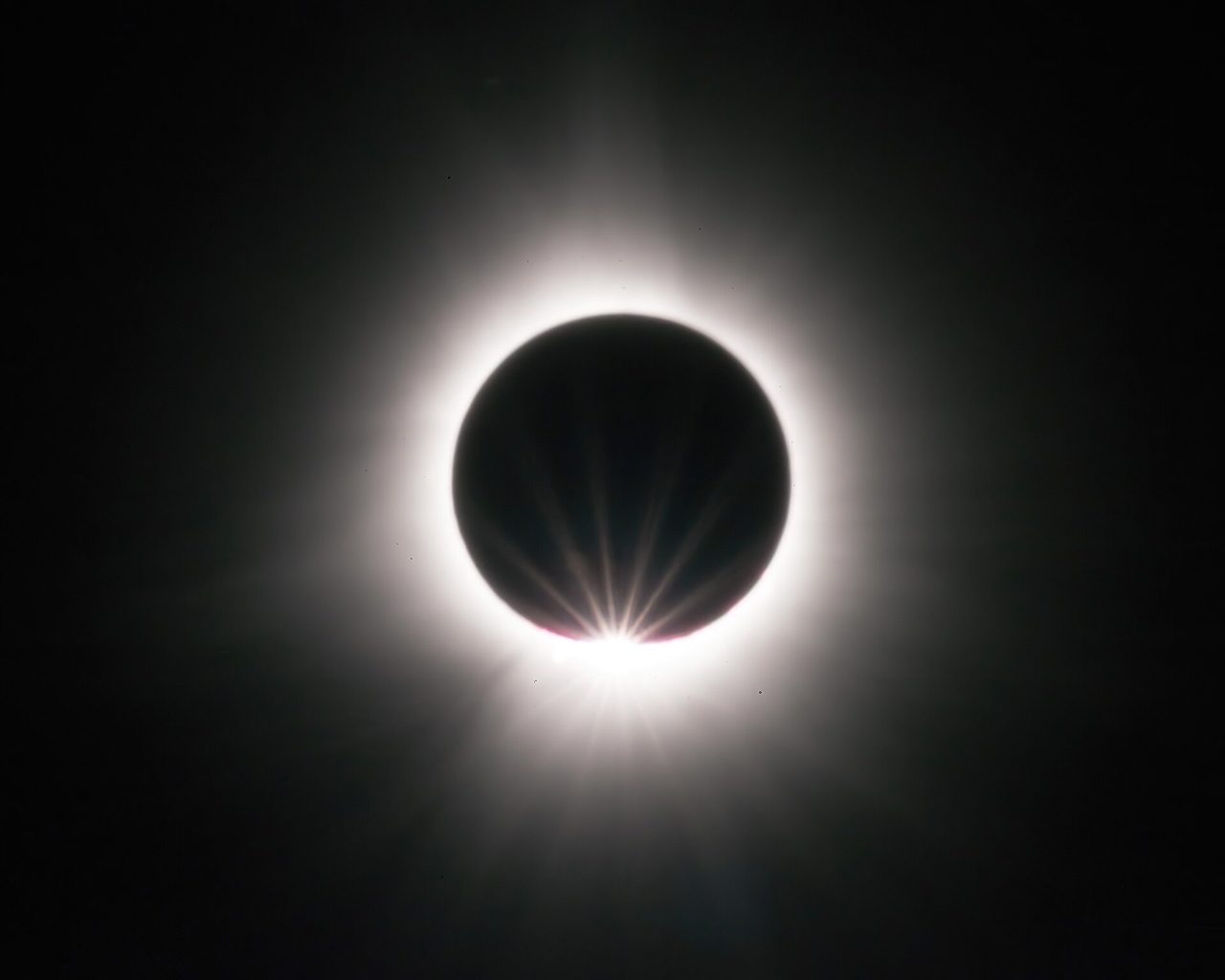
Photo: Sltim / CC0 · via Wikimedia Commons
Six Minutes of Night at Noon: Why 2027 Is the Eclipse to Book
The Moon's shadow takes a 15,000-kilometer road trip
On Monday, Aug. 2, 2027, the Moon will slide directly between Earth and the Sun in a total solar eclipse nicknamed the Eclipse of the Century. Calculations prepared for NASA by Fred Espenak put the central shadow about 258 kilometers wide at maximum. It makes landfall over southern Spain and Gibraltar, races east across Morocco, Algeria, Tunisia and Libya, crosses Egypt, then jumps the Red Sea to Saudi Arabia and Yemen before ending near Somalia. The track runs about 15,227 kilometers. Spain is the only European country to get totality.
Luxor gets 6 minutes 23 seconds, a record you can actually reach
The eclipse belongs to Saros 136 with a magnitude of 1.079. Greatest eclipse falls over Egypt at roughly 25.5 degrees north, 33.2 degrees east at 10:06 UTC, with maximum totality of 6 minutes and 23.2 seconds in the northeastern New Valley Governorate. In Luxor the Sun goes out at about 13:02 local time for 6 minutes 20 to 22 seconds, with the Sun 82 degrees overhead. It is the longest totality visible from easily reached land between 1991 and June 3, 2114, when Saros 139 takes over.
Sixteen seconds short of 2009, but far easier to see
Space.com contributor Jamie Carter notes the awkward footnote: the July 22, 2009 eclipse lasted 6 minutes 39 seconds, so 2027 is only the second-longest of the 21st century, exactly 16 seconds shorter. The difference is access. The 2009 maximum sat over the Pacific, and its longest land duration was on remote, uninhabited North Iwo Jima, closed without special permission. Egypt's Nile Valley, by contrast, has airports, hotels and temples. That accessibility is why chasers call 2027 the eclipse of the century.
Aphelion plus perigee stretches darkness to the limit
The physics is a double coincidence. Earth is near aphelion, its farthest point from the Sun, so the solar disk looks slightly smaller, while the Moon is near perigee, its closest to Earth, so the lunar disk looks larger. A smaller Sun plus a bigger Moon equals a long cover-up. The gap to recent eclipses is stark: under two minutes for Spain in August 2026, about 2 minutes 18 seconds on some counts, and 4 minutes 28 seconds for North America in April 2024.
From Tarifa to Sanaa, every minute has a price
Duration fades along the track. Tarifa at Spain's southern tip gets about 4 minutes 38 to 40 seconds, Gibraltar about 4 minutes 27 seconds, Tangier about 4 minutes 51 seconds, Oran about 5 minutes 6 seconds, Jeddah about 5 minutes 55 seconds, and Sanaa only 2 minutes 39 seconds. Travel writers say about 89 million people live under the path. Luxor pairs more than six minutes of darkness with Karnak and the Valley of the Kings, but August heat above 45 degrees Celsius, near-vertical Sun and sold-out hotels punish anyone chasing only the maximum number.
Book for clear skies, not just the clock
Veteran chasers rank weather above duration, and here Luxor leads with a historic August cloud-cover frequency near 0.7 percent. Coastal Spain is logistically easier but crowded in peak season; one six-day UK tour based in southern Spain at 3,699 pounds is already listed as sold out. Recent travel surveys put a five-to-seven-day Spain centreline trip at roughly 3,000 to 6,000 U.S. dollars per person, against 5,000 to 9,000 dollars or more for a guided Luxor trip with a Nile-view hotel. Wherever you go, NASA's rule holds: use viewers meeting ISO 12312-2, and remove them only while the Sun is completely covered.
Sources
- Space.com: Why is the 2027 total solar eclipse being called the 'eclipse of the century'?
- Travel and Leisure: The Longest Total Solar Eclipse Until 2114 Is Coming in 2027
- WorldTimeData: Total Solar Eclipse August 2, 2027: Where, When, How Long
- Meteorologiaenred: Spain prepares for the longest total solar eclipse of the century
- Scientific American: Can there be a 'best' total solar eclipse?