Japan Launches Five-Year Bid to Bring Home a Piece of Phobos
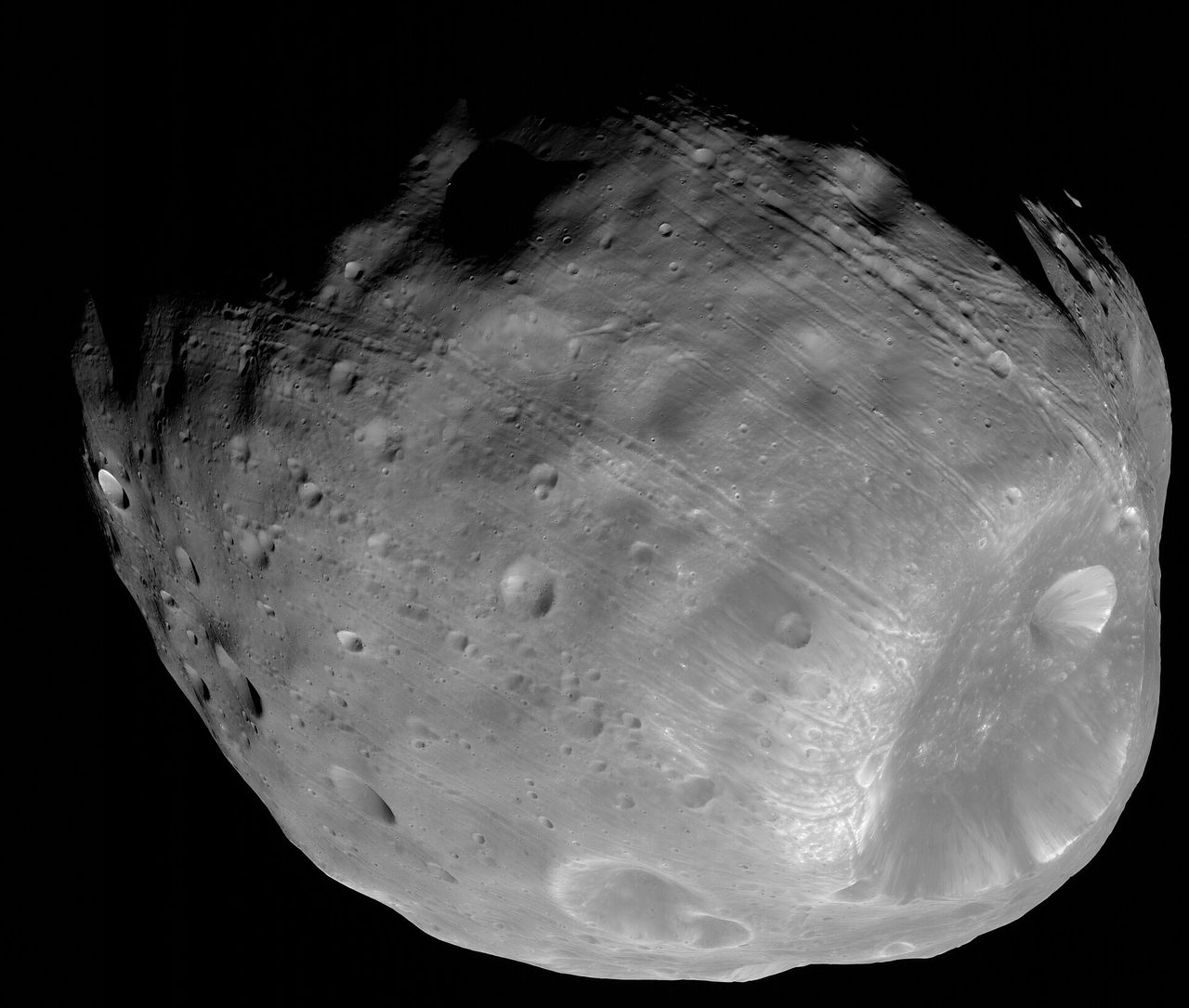
Photo: NASA / JPL-Caltech / University of Arizona / Public domain · via Wikimedia Commons
Japan Launches Five-Year Bid to Bring Home a Piece of Phobos
H3 roars off Tanegashima before dawn
Japan launched the Martian Moons eXploration spacecraft before dawn on Oct. 20 at 4:41 a.m. Japan time from Tanegashima Space Center, corresponding to 1941 GMT on Oct. 19. The flagship H3 rocket, aided by four solid-fuel strap-on boosters and two hydrogen-powered first-stage engines, lit up the night sky. After two burns of the upper-stage engine, the 9,900-pound MMX probe separated about 1 hour and 11 minutes after liftoff, and the Japan Aerospace Exploration Agency declared the launch a success.
JAXA hails first-ever attempt, NASA cheers on
JAXA President Hiroshi Yamakawa said a five-year journey had just started. Science minister Yoshihiro Seki called MMX a challenging mission aiming for the world's first sample return from the Martian moons, saying he hoped results would advance Japanese space science and exploration technology. Nicky Fox, associate administrator of NASA's Science Mission Directorate, said in a message carried on the JAXA livestream that MMX samples would bring paradigm-shifting science on the Mars system for generations, especially as NASA prepares to send astronauts to Mars.
Two moons of mysterious birth drive the science
Phobos, the larger Martian moon, averages about 22 kilometers, or 14 miles, across, with a surface area comparable to Houston, orbiting Mars at about 6,000 kilometers. A day there lasts just over 7 hours and 30 minutes. Its lumpy shape and spectra resemble primitive D-type asteroids dating to the solar system's formation about 4.6 billion years ago. One hypothesis says Phobos and Deimos are asteroids captured by Martian gravity; the rival giant-impact hypothesis says debris from a collision with Mars coalesced into moons. A returned sample should settle much of that debate and trace volatile delivery to habitable planets.
An international spacecraft built to go and return
JAXA leads MMX with NASA, the European Space Agency, France's CNES and the German Aerospace Center. The spacecraft has three modules for cruise, landing and return. France and Germany supplied Idefix, a 25-kilogram rover about the size of a large shoebox, designed to drop from 40 to 100 meters, right itself and drive for up to 100 days in gravity less than one-thousandth of Earth's. NASA supplied an air-powered sampler built by Honeybee Robotics, a spectrometer from Johns Hopkins APL and Deep Space Network support, and will receive at least 15 percent of the planned 10-gram sample for curation at Johnson Space Center in Houston.
A decade-long itinerary ending in the Australian desert
MMX faces about a 10-month cruise before Mars orbit insertion in August 2027, then about three years around Mars. It will orbit Phobos from September 2027, release Idefix in early 2029, and make two touchdowns in 2030, spending only about two hours on the surface each time to drill and vacuum at least 10 grams, about one-third of an ounce, of soil. The craft will then conduct Deimos flybys, depart the Martian system in November 2030, and send its capsule to a parachute landing in the Woomera region of Australia in 2031. MMX was originally meant to launch in 2024 but slipped after H3 rocket problems, missing the alignment that occurs just once every 26 months. It builds on Hayabusa2, which returned 5.4 grams from an asteroid in 2020.
Sources
- The Guardian
- Ars Technica
- Space.com
- AFP
- CBS News