It's Time to Find a New Browser
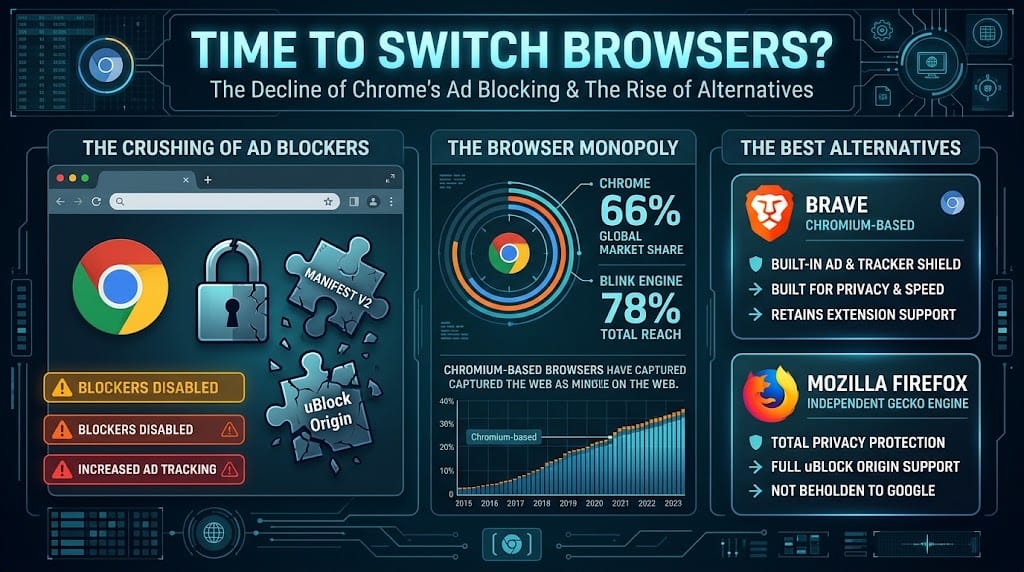
Photo: AI-generated
It's Time to Find a New Browser Chrome still runs two-thirds of the web, but the case for staying is getting thinner by the month. Google has finished retiring Manifest V2, killing the full version of uBlock Origin inside Chrome. Meanwhile one company effectively dictates what the web platform becomes. Switching browsers is the cheapest vote for choice you can cast.
The full-strength ad blocker is dead on Chrome
The phase-out was a long goodbye. Warnings began on Chrome's Beta, Dev and Canary channels on June 3, 2024; stable-channel disabling started October 9, 2024; Manifest V2 extensions were switched off by default for everyone on March 31, 2025; and Google confirmed the shutdown for all users in Chrome 138 on July 24, 2025, with the enterprise escape hatch removed in Chrome 139. The official successor, uBlock Origin Lite, is a subset of the original: advanced filtering and fine-grained rules are gone. Anyone who wants the real thing has to leave Chrome.
Google says the new rules mean faster and safer
Google's official line is that Manifest V3 improves extension security, performance and privacy by curbing extensions' free access to page content, and that the new framework is enough for most users. The company points to sync, sandboxing and silent updates as an integrated safety story you abandon when you switch. Critics reply that the new architecture happens to neuter the exact tools that block Google's ads and trackers, while advertising funds the overwhelming bulk of Google's revenue — an awkward coincidence for a "security upgrade."
Two-thirds of the market answers to one engine
The numbers describe the monopoly's shape. StatCounter's September 2026 worldwide snapshot for all platforms puts Chrome at 66.36 percent, Safari at 18.27 percent, Edge at 6.04 percent and Firefox at just 2.8 percent. On desktop PCs Chrome reached 75.23 percent in March 2026, with roughly 3.62 billion users. At the engine layer the skew is starker: Google-steered Blink serves about 77 to 78 percent of usage, Apple's WebKit about 16.5 percent, and the independent Gecko just 3.3 percent. When nearly four in five page loads run through Blink, "open web standards" start to mean whatever ships in Chrome, and sites breaking in Firefox stop being news.
The user hurt most is the one who never changed a setting
The people most affected are the majority who never touch defaults: Android phones that ship with Chrome preinstalled and preset, office laptops with one permitted browser, parents and teachers with no afternoon to spare for extension manifests. Europe's remedy proved the diagnosis. Since the Digital Markets Act compliance deadline of March 7, 2024 forced Apple and Google to show randomized browser choice screens during setup in the EU, users there have picked Firefox at a rate of one selection every ten seconds, and those users stick around five times longer than typical downloads. People were never loyal to Chrome; they were never asked.
The forced sale of Chrome is off the table
The US Justice Department sued Google in 2020 under Section 2 of the Sherman Act, and on August 5, 2024 the court ruled in a 277-page opinion that Google had illegally maintained monopolies in general search and search text advertising. Prosecutors asked for Chrome to be divested, but after the April-to-May 2025 remedies trial, Judge Amit Mehta rejected the structural fix as "incredibly messy and highly risky," opting instead for limits on distribution deals plus data access and search syndication. In the July 28, 2026 appellate brief, the plaintiffs expressly declined to cross-appeal the divestiture ruling. Google keeps its browser, but the final judgment ordinarily runs six years, to February 3, 2032 — and Chrome can no longer serve as Search's lock-in machine the way it did.
Brave is the easiest move, Firefox the most independent
For most people Brave is the lowest-friction move: same Chromium engine, so Chrome Web Store extensions largely carry over, with built-in Shields blocking for ads and trackers and explicit support for original uBlock Origin. To leave Google's engine entirely, Firefox is the only mainstream answer, with the independent Gecko engine, Enhanced Tracking Protection, locally encrypted sync, and a single switch to turn off every AI feature. Heavy tab users should look at Vivaldi, minimalists at Opera, and anyone wanting hardened privacy out of the box at LibreWolf. Run two browsers side by side for two weeks, migrate bookmarks and passwords, then flip the default. The way back stays open.
Choice screens are spreading from Europe toward Britain
Watch the regulators next. Mozilla is pressing Britain's Competition and Markets Authority to copy the EU model and show a browser choice screen before any search choice screen, arguing that picking a search engine inside a browser you never chose puts the cart before the horse. Mozilla's new pitch is blunt: no billionaires, full-power blockers, and you alone decide how AI features touch your browsing. The browser war is no longer about speed. It is about who decides less on your behalf.
Sources
- MakeUseOf: I tried every major Chromium browser and one seriously beats Chrome
- RottenWifi: Chrome Ended Support for uBlock Origin: Dates and Alternatives
- Wikipedia: Google Chrome
- ScreenshotNeo: Key Browser Statistics for Web Developers and QA Teams
- LearnInternetGrow: Browser Engine Monoculture: Is Chrome Too Dominant?