Oregon State Scientists Develop Material to Capture Carbon in Humid Exhaust
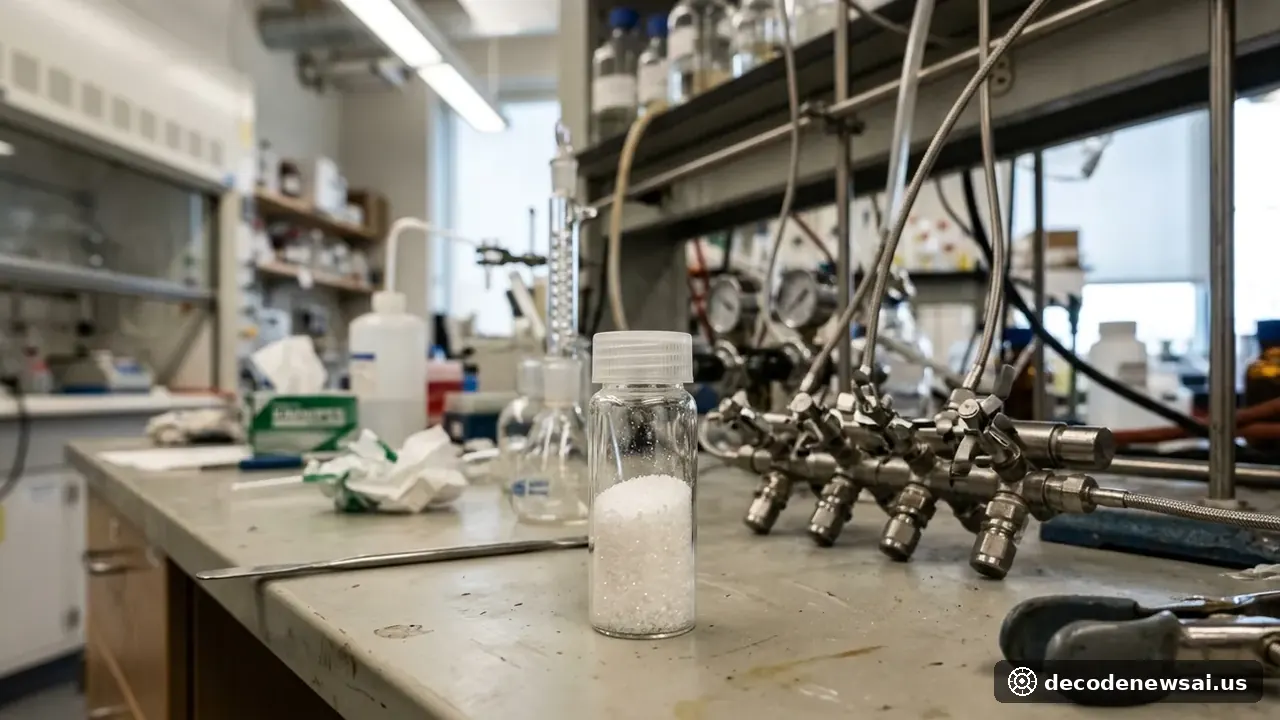
CORVALLIS, Ore. — Scientists at Oregon State University have engineered a new crystalline material called BVR-X that captures carbon dioxide even in moisture-heavy industrial exhaust, according to research highlighted on Nov. 17, 2026. Published in Angewandte Chemie and backed by a patent filing, the material could lower costs for power plants and factories.
Pore Design Turns Moisture Into Asset
Conventional metal-organic frameworks often lose carbon-capture capacity when exposed to humid smokestack gases because water molecules block internal adsorption sites. Drying exhaust gases before treatment adds steep equipment and energy costs. BVR-X avoids that bottleneck by directing water and carbon dioxide into separate regions inside its microscopic pores. "Water usually makes capturing carbon dioxide more difficult. Our new material does something unusual: It responds to water by changing in a way that lets it keep capturing CO2 effectively even under very humid conditions," said Oregon State chemistry professor Kyriakos Stylianou.
Reliable Capture Under Natural Gas Conditions
In laboratory experiments, BVR-X efficiently extracted carbon dioxide from a highly humid gas stream containing just 4% carbon dioxide, matching exhaust from natural gas combustion. Researchers also verified that the material can be regenerated and reused through dozens of capture-and-release cycles without losing effectiveness, a critical requirement for keeping commercial operating expenses manageable.
Collaboration Targets Industrial Emissions
Industrial operations account for 30% of total U.S. greenhouse gas emissions, according to the Environmental Protection Agency. While the world's largest direct-air capture plant opened in Iceland in 2024, removing emissions roughly equal to 7,200 cars annually, smokestack capture remains more established. The study included researchers from Oregon State, UC Berkeley, the University of Oregon, and Saudi Aramco's research center.
Sources
- sciencedaily.com: This remarkable new material could solve a major carbon capture problem -
- eurekalert.org: New material developed at Oregon State provides boost to carbon capture technologies -
- carboncapturemagazine.com: Oregon State scientists develop new material to improve carbon capture in humid conditions -
- eponline.com: Oregon State Develops Carbon Capture Material for Humid Conditions -
- ua.news: US scientists create material to capture CO2 in humid emissions -