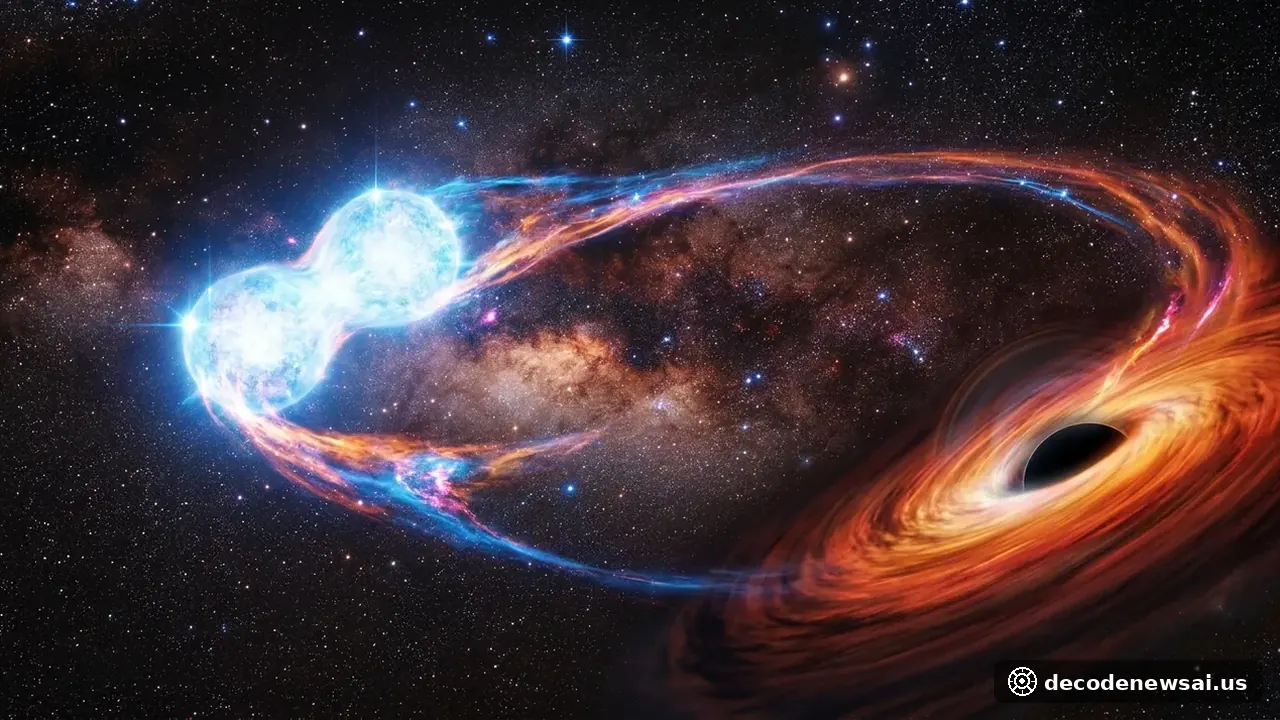
GARCHING, Germany — An international team announced the finding on Nov. 19, 2026. The team was led by the Max Planck Institute for Extraterrestrial Physics. The source is IRS 16SW. Mysterious gas clouds near the Milky Way's central black hole originate from the massive contact binary star IRS 16SW.
Infrared Data Trace Clouds to a Binary System
Researchers used the SINFONI and ERIS infrared spectrographs on the Very Large Telescope. They traced the G1, G2, and trailing G2t clouds backward along their orbits. Those clouds are part of a unified G1-2-3 streamer. The path led to IRS 16SW.
"By working backward from the clouds' observed motions and their velocities along our line of sight, the researchers identified a promising source: IRS 16SW, a massive contact binary system consisting of two stars in extremely close proximity," ScienceDaily reported from the Astronomy & Astrophysics study. The finding solves a puzzle open since G2's discovery in 2012.
Small Gas Supply Sustains Black Hole
Fuel can sustain activity. Calculations show that if roughly one Earth mass of gas reaches Sagittarius A* every 10 years, it provides enough fuel. That fuel maintains the supermassive black hole's current level of activity.
Strong stellar winds and mass ejection from the tightly orbiting stars in IRS 16SW feed dense gas clumps. The clumps follow orbits. Those orbits pass near the galactic center.
Ongoing Monitoring Tracks Tidal Stretching
Astronomers plan continued high-resolution infrared observations. They will watch the G1-2-3 streamer. It stretches and accretes as it swings past Sagittarius A*. The finding also offers a direct model for how binary stars fuel supermassive black holes in other galaxies.