ESA Selects Seven-Spacecraft Plasma Observatory as Next Medium-Class Science Mission
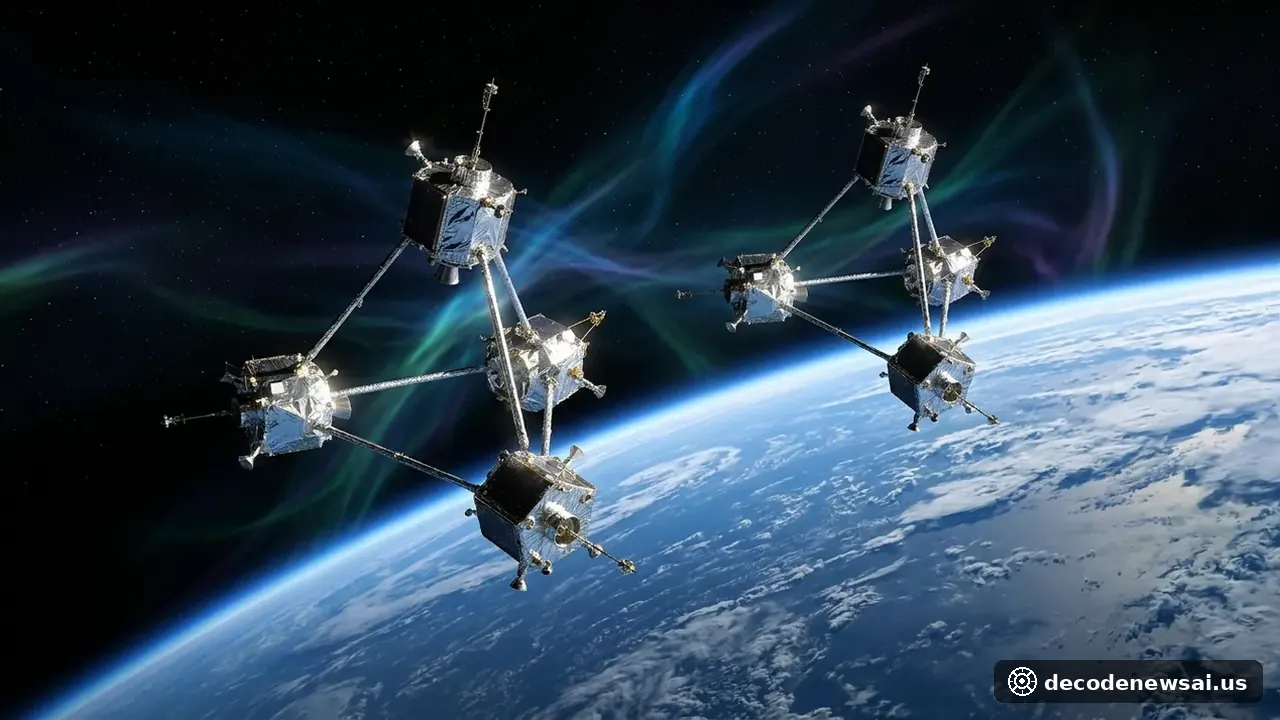
PARIS - European Space Agency member states on Nov. 19 selected Plasma Observatory. It is a constellation of seven coordinated spacecraft and the agency's next medium-class science mission. Launch is targeted for the late-2030s.
Seven-Probe Fleet Targets Multi-Scale Space Weather
Plasma Observatory fills the M7 slot. It is the first medium-class mission of ESA's Voyage 2050 program. It will track how solar wind energy moves through Earth's magnetic field.
"The European Space Agency Member States have selected Plasma Observatory as the agency's next medium-class mission," the Royal Belgian Institute for Space Aeronomy reported on Nov. 20. Plasma accounts for 99% of the visible universe.
Earlier four-spacecraft missions could observe only one spatial scale at a time. Examples include ESA's Cluster and NASA's MMS.
Nested Tetrahedral Formations Connect Fine and Large Scales
ESA will arrange the seven identical probes into two nested tetrahedral formations. The formations share one central spacecraft. They will capture ion-scale and fluid-scale dynamics simultaneously.
"Plasma Observatory's simultaneous measurements of magnetic and electric fields and particles in seven places at once will reveal how small, fast events connect to much larger changes across key regions of the magnetosphere," ESA Study Scientist Matt Taylor said. Measurements span key regions.
Extreme solar plasma interactions can disrupt satellites. They can also disrupt critical electrical grids. Scientists say so.
European Institutes Advance Instruments and Next Mission Slots
Research teams in Belgium and France will develop flight software. They will develop ion-composition instruments. The mission moves toward formal adoption and construction.
During the same meeting, ESA's 23-nation Science Programme Committee narrowed candidates. They were for its future M8 and F3 missions. Seven concepts entered initial studies in 2027.
Sources
- aeronomie.be: Seven-spacecraft observatory to study plasma universe —
- starlust.org: ESA's next major science mission will send seven spacecraft to study plasma —
- geopolitiki.com: Plasma Observatory: ESA picks its next medium-class science mission to study how plasma moves energy —
- lira.observatoiredeparis.psl.eu: PSL (LIRA) — Selection of the Plasma Observatory mission by ESA —