Inner Ear Study Challenges Longstanding Theory of Low-Frequency Hearing
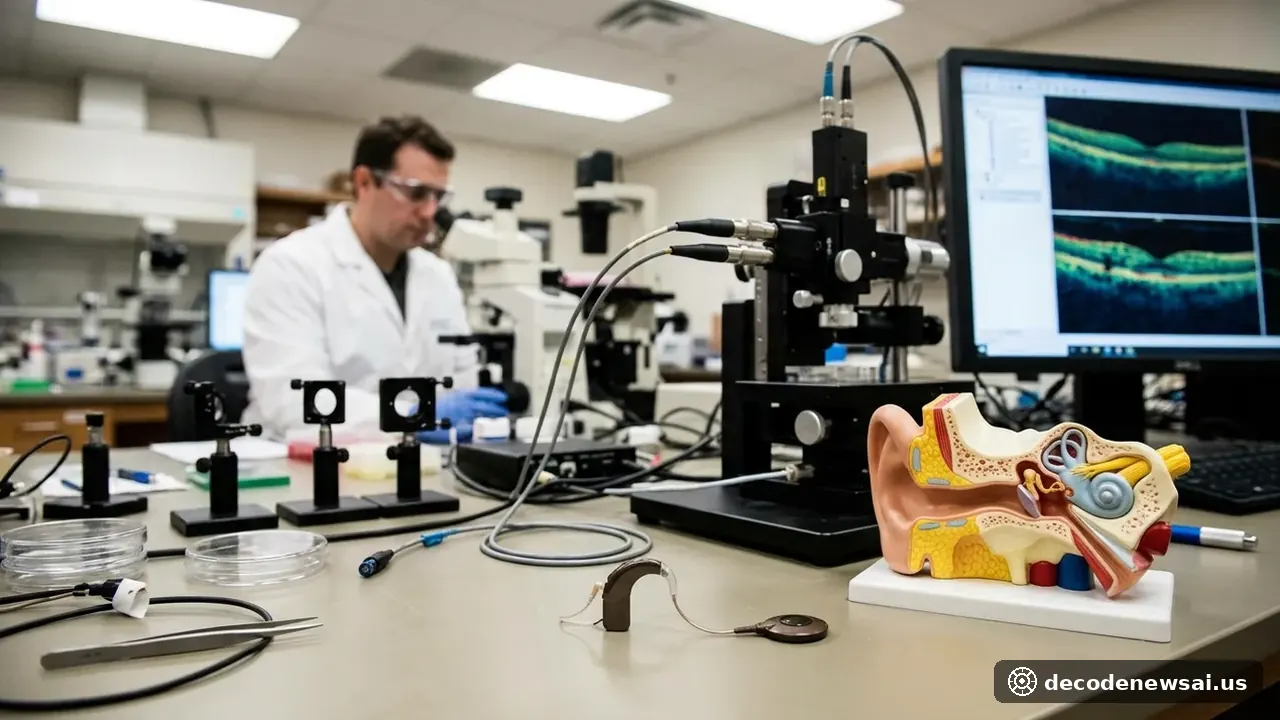
PORTLAND, Ore. - Researchers led by Oregon Health & Science University reported in Science Advances on Nov. 20 that the inner ear's cochlea senses low-frequency sounds almost simultaneously across distant regions. The finding challenges a 1961 Nobel Prize-winning place-code model and could reshape cochlear implant design.
Optical Imaging Reveals Synchronized Cochlear Motion
Since Georg von Békésy's 1961 Nobel Prize work, scientists treated the cochlea like piano keys mapping pitches to fixed spots. Using optical coherence tomography—common in eye exams—and new noise-canceling software, researchers recorded low-frequency vibrations in guinea pigs across wide distances.
The measurements expand on 2022 research, showing synchronized motion across the cochlear apex helps mammals distinguish speech amid noise, the University of Michigan and Bioengineer.org reported.
Findings Point to More Complex Cochlear Implants
Current cochlear implants stimulate specific locations to mimic the place code, even though low-frequency cues are vital for hearing speech in noisy environments.
"Cochlear implants are geared to take advantage of a place code. Our study suggests the optimal pattern of stimulation by electrodes in a cochlear implant may be more complex than just where and how intensely it's being stimulated," said lead author George Burwood, according to OHSU News.
Brain Processes Frequencies Beyond Spatial Maps
Oregon Hearing Research Center director Laurence Trussell said the brain can differentiate frequencies without a rigid spatial map. Backed by National Institutes of Health award R01DC00141-44, the study included Linköping University, the University of Michigan, the University of Washington, and the late Alfred Nuttall, Mirage News reported.