HILO, Hawaii - An international astronomy team used the James Webb Space Telescope and Hawaii's Gemini North telescope. It found the oldest and tightest compact pair of quasars ever observed. The pair is compact. It dates to just 900 million years after the Big Bang.
Two Monster Black Holes Challenge Early Growth Models
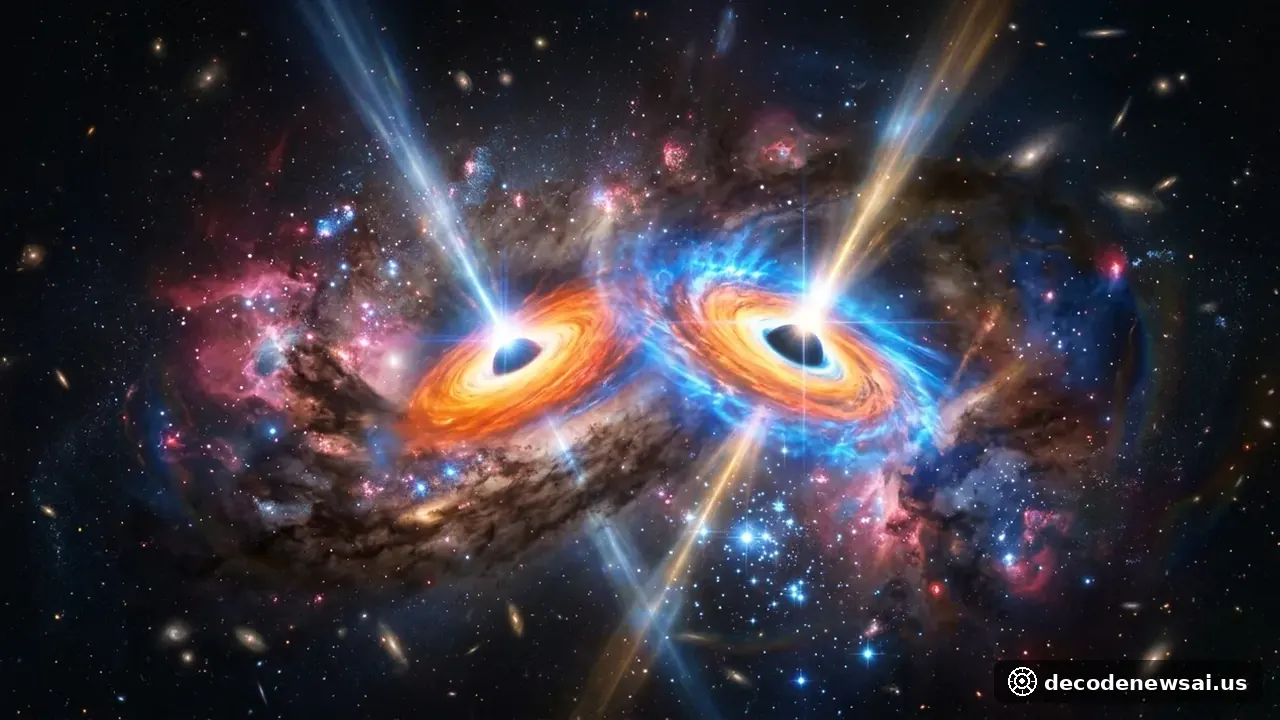
Designated J1602+4228AB and named Nāpōwawāʻenakaulua, it existed in a universe then just a thirteenth of its current age; NSF NOIRLab postdoctoral researcher Silvia Onorato led work published in The Astrophysical Journal Letters. It is compact. About 18,100 light-years apart, roughly one-fifth the Milky Way's diameter, two actively feeding supermassive black holes weigh 1.5 billion and 400 million times the Sun's mass. "There is no definitive theoretical explanation for how a single one of these giant quasars exists so early in the age of our Universe, much less two," Onorato said.
Dense Matter Peak and Gravitational Lens Check
Researchers spotted the faint companion while inspecting 200 early quasars from the Webb Aether survey and resolved the pair over two clear nights on Maunakea using Gemini North spectrographs. The companion is faint. The team suggests frequent young galaxy collisions in an unusually dense region of the early universe may have funneled gas to feed both black holes rapidly. Further gravitational lens modeling is still required to definitively rule out optical lensing.