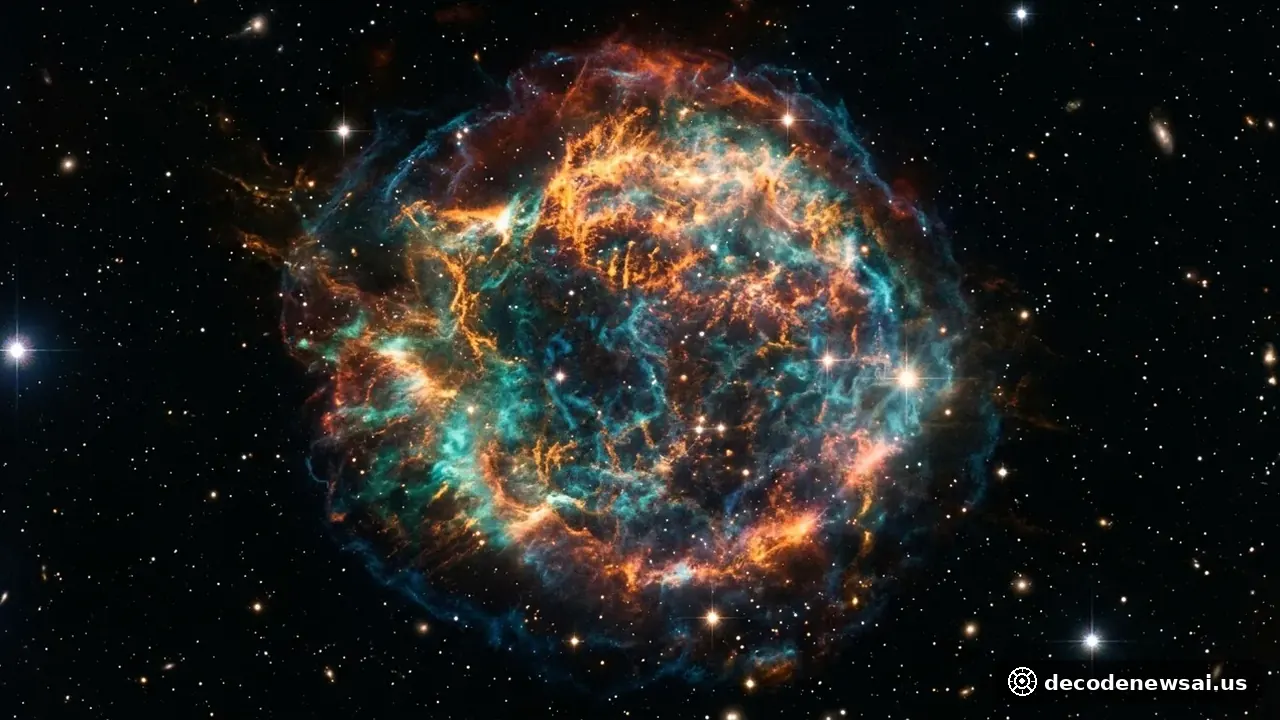
GREENBELT, Md., Nov. 23, 2026 — NASA announced on Nov. 23 that mid-infrared observations from the James Webb Space Telescope reveal how supernova dust inside Cassiopeia A preserves a chemical record of a massive star's interior structure just hours before core collapse.
Published on Nov. 23 in The Astrophysical Journal Letters, the study examined Cassiopeia A, a remnant about 11,000 light-years from Earth. By mapping individual solar-system-sized dust clumps, astronomers found evidence of a shell merger in which internal stellar layers mixed violently shortly before exploding.
Chemical Fingerprints Reveal Pre-Explosion Mixing
Guided by earlier data from NASA's retired Spitzer Space Telescope, researchers targeted three regions. Two lay inside the remnant's reverse-shocked zone—one dominated by silica dust and the other by carbon dust—while the third, a structure dubbed the Green Monster, proved rich in complex magnesium silicates shed before the blast.
"Material within these shells churns and circulates, which can cause the shells to merge shortly before the supernova explosion," said lead author Tea Temim of Columbia University. "So, for example, the oxygen- and carbon-burning shells in a star merge together and change the structure of the star significantly."
New Method Decodes Progenitor Star Anatomy
Combining Webb's dust map with X-ray data from NASA's Chandra X-ray Observatory and the JAXA-led XRISM mission, the team showed merger signatures span much of the remnant. Co-author Dan Milisavljevic of Purdue University said resolving individual clumps lets scientists tie the explosion back to the original star's makeup hundreds of years later.