Zero-Field NMR Resolves Molecular Fingerprints From Natural Carbon-13
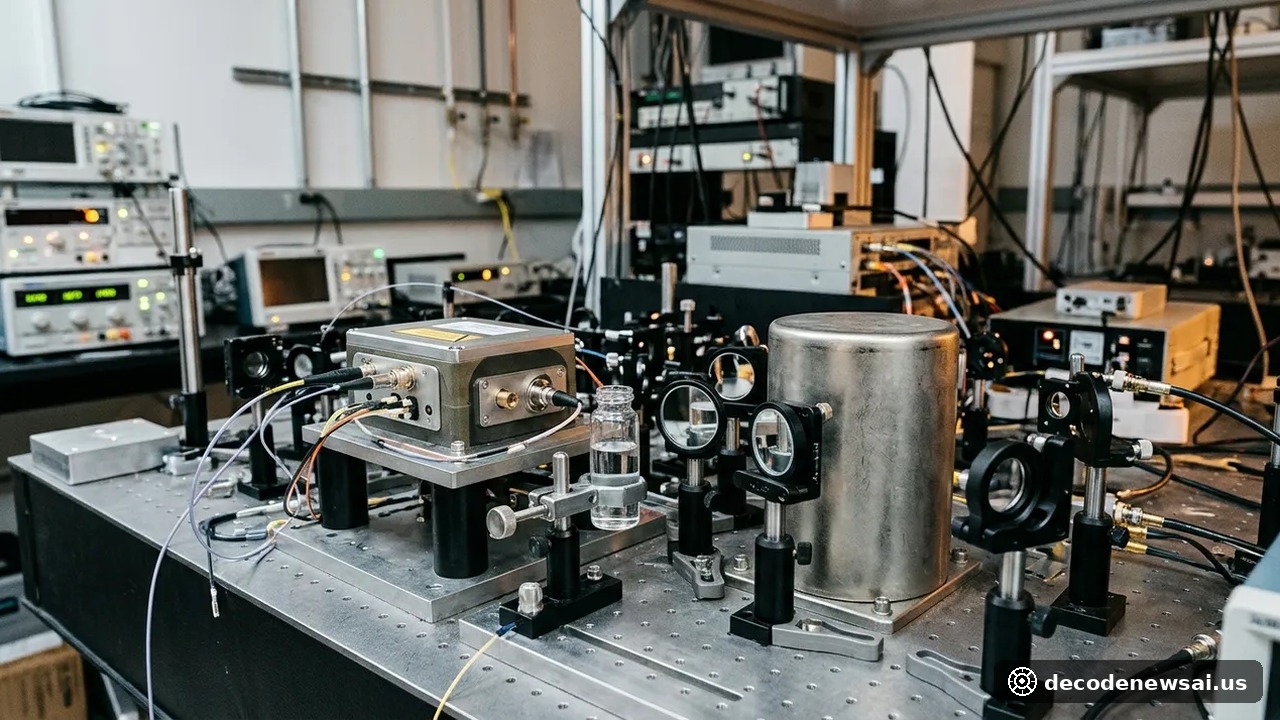
Photo: AI-generated
Zero-Field NMR Resolves Molecular Fingerprints From Natural Carbon-13
BERKELEY — Researchers have demonstrated that zero-field nuclear magnetic resonance (NMR) can resolve molecular fingerprints from natural-abundance carbon-13 in ordinary liquids without isotopic enrichment or hyperpolarization, The Watchers reported Nov. 27, citing Science Advances.
Optical Magnetometry Captures 0.0121% Rare Isotopomer
Because natural carbon-13 accounts for only 1.1% of carbon atoms, its magnetic signals are faint. Andrews et al. prepolarized liquid samples for 17.5 seconds in a 9.4 T magnet before shuttling them into a magnetically shielded zero-field detector monitored by a rubidium-87 optically pumped magnetometer with roughly 40 fT Hz−1/2 sensitivity. Maintaining signal-to-noise stability for more than 10 days, the system achieved linewidths of 250 mHz or less across a 13-molecule library and resolved doubly carbon-13-substituted acetic acid—occurring at a natural probability of 0.0121%—after 23,215 scans.
Quantum-Chemical Modeling Decodes Dense Multiplets
Using density functional theory with vibrational corrections, the team simulated scalar J-coupling networks that qualitatively matched experimental fingerprints for methyl formate, acetone, diethyl ether, and ethyl acetate, while tracking solution-environment shifts such as 4.4 Hz upon formic acid dilution and 27.8 Hz upon conversion to formate.
Prepolarization Limits Immediate Field Deployment
Authors noted that samples still require high-field prepolarization and thousands of scans for faint signals, leaving portable industrial monitoring as a prospective future application.