Jodrell Bank's Lovell Dish: Ministers "Explore" a Future That Still Lacks Money
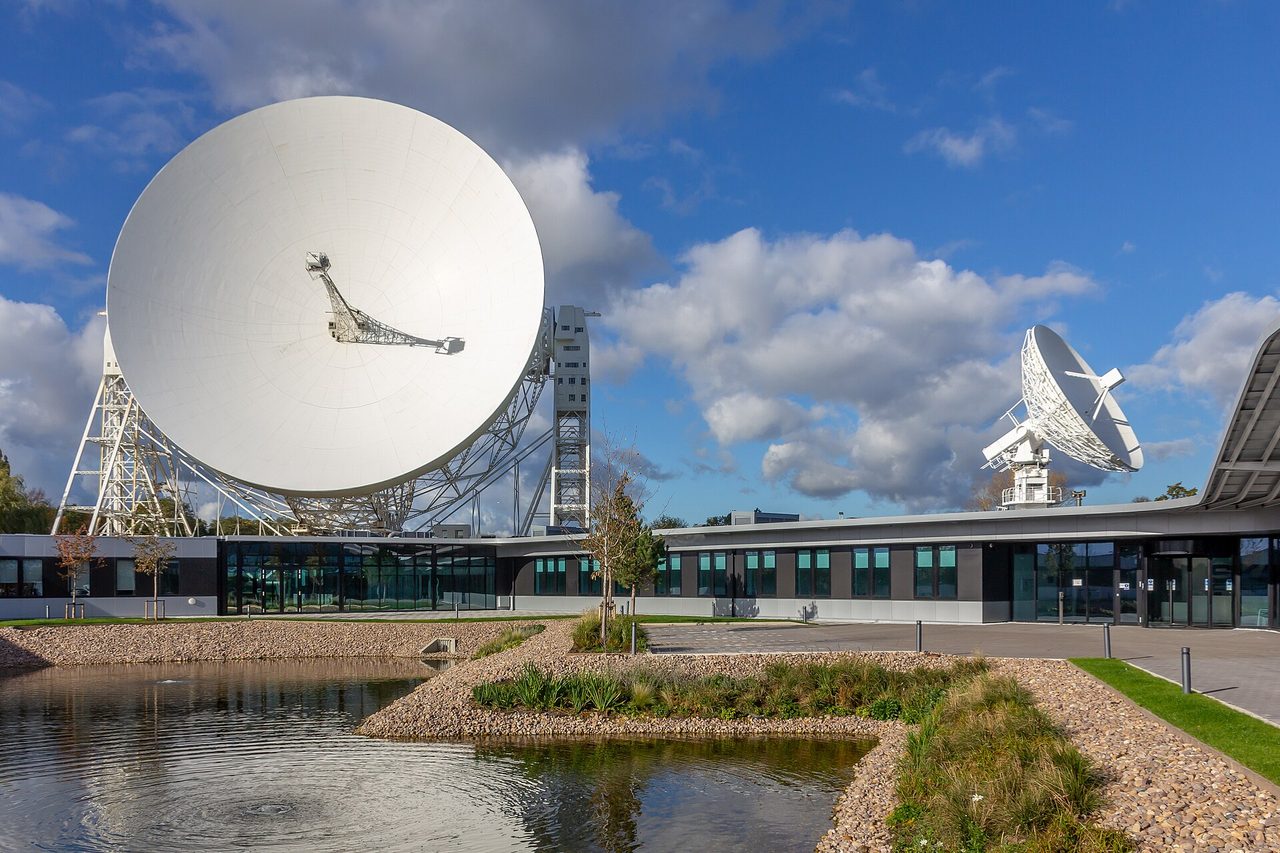
Photo: Photograph by Mike Peel (www.mikepeel.net). / CC BY-SA 4.0 · via Wikimedia Commons
Jodrell Bank's Lovell Dish: Ministers "Explore" a Future That Still Lacks Money
A 76-metre dish that has watched the sky since 1957
Britain's largest telescope is the Lovell telescope at Jodrell Bank Observatory, near Knutsford in Cheshire. It has stood on the site since 1957, measures 76.2 metres (250ft) across, was once the largest radio telescope in the world and remains the third largest steerable dish of its kind. It has been a Grade I listed building since 1988.
The money that runs it stops in March 2028
What is at risk is not the observatory site but the funding that keeps its science going. The Science and Technology Facilities Council (STFC), part of UK Research and Innovation (UKRI), confirmed on 27 July 2026 that the £2.8 million annual grant for e-MERLIN — the national radio astronomy network of seven English telescopes anchored by the Lovell dish — will not be renewed when the current agreement expires in March 2028.
Ministers say the site has a "secure future"
On 15 October, Business Secretary Jonathan Reynolds told the House of Commons that the government was "exploring" the long-term options for the telescope. He said "the prime minister and I have been clear Jodrell Bank has a secure future", adding that he had met the University of Manchester, which runs the observatory, a few days earlier, and that local MPs had been "incredibly supportive in finding a solution".
The prime minister promised to find a way
On 1 September, Prime Minister Andy Burnham told the Commons, answering Congleton MP Sarah Russell, that Jodrell Bank was "a heritage asset for the country as well as a research asset". "There must be a way to save Jodrell Bank ... It will not happen under my Government," he said, committing to a meeting. Weeks later, however, the university said the lost UKRI money would not be restored.
Rising costs, the SKA, and a defence bill
UKRI attributes the cut to rising research and laboratory costs. Reynolds called the move from e-MERLIN to the Square Kilometre Array "a science-based decision". The SKA is an intergovernmental project headquartered at Jodrell Bank but largely built in Australia and South Africa; it is due more than £300 million between 2021 and 2027. Reynolds also acknowledged having to find money from the science budget for defence. One analysis puts real-terms cuts to major astronomy and space science projects at around 35 per cent.
28 jobs, 3,000 scientists, and a mothballed dish
Without replacement funding, scientific observations at Jodrell Bank are expected to cease on 1 April 2028; 28 specialist jobs are at risk, and the work of around 3,000 scientists who use the array would be affected. More than 150 public figures — among them astronaut Tim Peake, Brian May, Brian Cox and Johnny Marr — have backed calls to reverse the decision. Twin dishes at Knockin in Shropshire and Winsford in Cheshire face the same uncertainty.
Manchester hunts a "constellation" of funders
Professor Sarah Sharples, dean of the university's Faculty of Science and Engineering, said Manchester was pursuing a "constellation" of routes with government, public agencies, industry and philanthropic funders so that "the work of radio astronomy [can] be preserved at the Jodrell Bank site". Observatory staff say the telescopes would likely be "mothballed" — kept safe but no longer doing everyday science. The site has also received £50,000 in public donations.
Heritage status cannot pay the science bills
Jodrell Bank became a UNESCO World Heritage Site in 2019, and its £21 million First Light Pavilion opened in 2022. A council motion warned that e-MERLIN's capabilities, including satellite and space-debris tracking, matter for UK space resilience and defence, and that "the loss of this specialist capability would be extremely difficult and costly to reverse". Some fear the site could survive as a heritage attraction rather than a working laboratory.
Two gateway points in 2027 and 2028
In an update on 14 October, UKRI said two formal gateway points in 2027 and 2028 would assess progress on savings, and that missing key targets would require further action, "including the potential closure of a multidisciplinary facility". For Jodrell Bank the timetable is already fixed: funding ends in March 2028, observations are due to stop on 1 April, and any alternative must be agreed before those gateways.
Sources
- BBC
- Times Higher Education
- Birmingham World
- Warrington Guardian
- Northwich Guardian