Reflection Ships Beam's Weights: The Pitch Is Fewer Tokens, Not Cheaper Ones
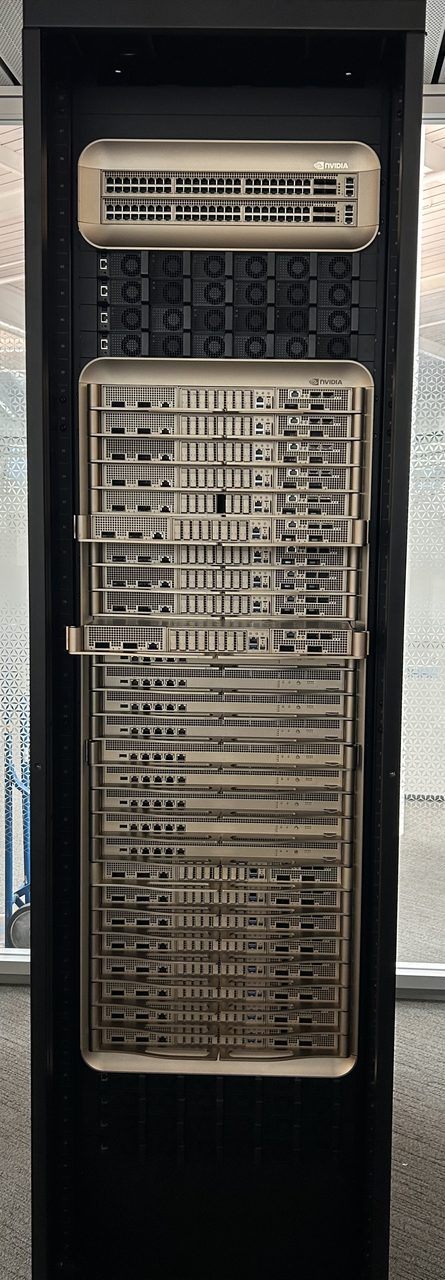
Photo: NVIDIA, CC BY-SA 4.0, via Wikimedia Commons · via Wikimedia Commons
Reflection Ships Beam’s Weights: The Pitch Is Fewer Tokens, Not Cheaper Ones
501B weights are live, 23B wake up per token
On October 16, Reflection AI put the weights of Beam, its first open-weight model, on Hugging Face under the Apache 2.0 license. Beam is a sparse mixture-of-experts model: 501 billion parameters in total, but only 23 billion active for each token it writes — by technology.org’s arithmetic, roughly one in every 22 parameters does any work. It takes text in and puts text out, carries a 1-million-token context window, and ships as BF16, FP8 and NVFP4 checkpoints alongside a DFlash2 drafter, a tokenizer and Mirror, a Rust-based harness. When Reflection first unveiled it on October 5, Beam was still in final red-teaming and reachable only through a waitlist.
The official claim: three to four times less compute
Reflection says Beam reaches scores "comparable to GLM-5.2" on advanced reasoning tests while spending a third to a quarter of the inference compute. The company also names its own weakness: on raw capability, frontier open models such as Kimi K3 remain ahead, and "Beam’s advantage is efficiency at inference time." The pitch is not a leaderboard win. It is finishing the same job on less silicon.
The training bill: 6,144 GPUs, then 10,500
Per eWeek, pretraining consumed 23.8 trillion tokens across 6,144 Nvidia GB300 chips over roughly four weeks. A further four-week reinforcement-learning run used 10,500 GB300s and about 1.3 billion sandbox evaluations; one analysis put that RL stage at $20–40 million. The "three to four times" efficiency figure is Reflection’s own estimate, computed as active parameters times mean generated tokens — it excludes prompt reading, attention and serving overhead. VentureBeat is blunt that this is an estimate, not a measurement.
Why the comparison changes: cost per finished task
U.S. companies already run cheaper Chinese open models, so Reflection is not bidding on price per million tokens; it wants the bill measured per completed task. Part of the mechanism is a controllable length penalty in reinforcement learning that discourages padding. Reflection also says browsing skills improved even though browsing tasks were not in the RL mix.
Self-reported scores hold up; CLI agents still lag
Reflection’s own table gives Beam 80.9 on SWE-bench Verified, 80.1 on Terminal-Bench 2.1, 78.0 on SWE-bench Multilingual, 90.5 on GPQA Diamond, 97.8 on AIME 2026 and 78.7 on MCP Atlas. On the same table, GLM-5.2 scores 81.0 on Terminal-Bench 2.1, Kimi K3 88.3, DeepSeek V4.1 Flash 90.6 and Qwen 3.8-Max 86.6. Every figure is vendor-reported; Epoch AI has not published an independent evaluation.
Who feels it: enterprises, sovereigns, and Nvidia
Beam targets enterprises and sovereign AI programs that want the model inside their own racks and compliance boundaries rather than rented through an API. Launch came with 40-plus ecosystem partners, availability in Amazon SageMaker JumpStart, and day-zero vLLM support that the project says cut decode latency 2.71×. The catch is hardware: self-hosting means holding all 501 billion parameters in memory — roughly 501GB of FP8 weights by one estimate. For Nvidia, an investor in Reflection, either outcome sells racks.
Chinese models still win on price per token
For contrast, DeepSeek V4 Pro lists at $0.66 per million input tokens and $1.98 per million output tokens, while Beam has published no per-token price at all; its platform bills through prepaid credits. "Cheaper" is therefore still an unpriced claim. The honest test is logging tokens per solved task against whatever model a team runs today.
The company ledger: $4.7B raised, $7B in compute
Reflection was founded in 2024 in Brooklyn by former Google DeepMind researchers Misha Laskin and Ioannis Antonoglou. It has raised $4.7 billion, with Nvidia contributing $800 million, and reached a $25 billion pre-money valuation in April. On compute, it pays SpaceX about $150 million a month for Colossus 2 capacity through 2029, a lease worth up to $6.3 billion, plus a Nebius deal above $1 billion — more than $7 billion committed.
What’s next: independent evals, and an Nvidia rumor
Artificial Analysis, which received early access, said early indicators suggest Beam will be one of the most token-efficient open models it has seen at that intelligence level. The Financial Times reported on October 10 that Nvidia is in early talks to deepen its investment or acquire Reflection, possibly through an acqui-hire. Laskin told CNBC the first model puts Reflection within "shooting distance" of the Chinese open-weight frontier. The practical advice from several outlets is the same: measure tokens per task before moving anything to production.
Sources
- VentureBeat
- TechCrunch
- SiliconANGLE
- DataCamp
- eWeek