Starfall Rides Again: SpaceX Slips a Return Capsule Into a 31-Payload Rideshare
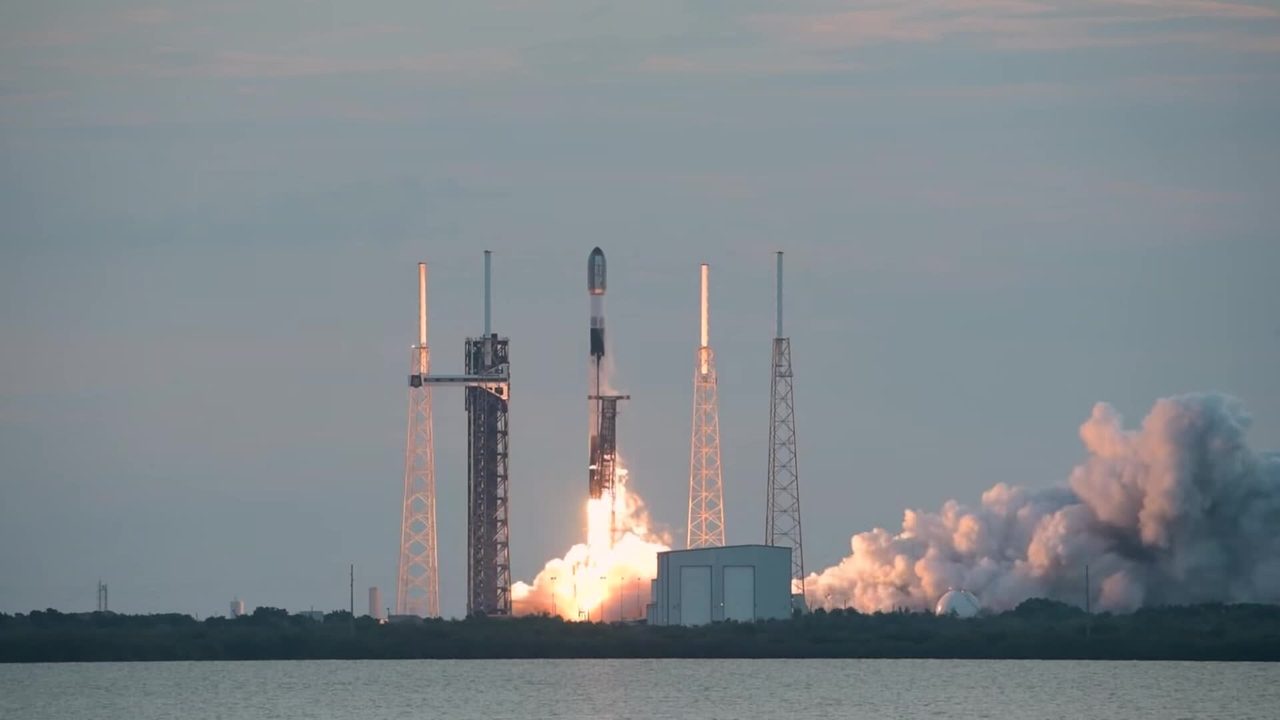
Photo: U.S. Space Force video by Gwendolyn Kurzen / Public domain · via Wikimedia Commons
Starfall Rides Again: SpaceX Slips a Return Capsule Into a 31-Payload Rideshare
The most unusual spacecraft on SpaceX's next Falcon 9 is not a satellite. It is Starfall, a squat, disk-shaped capsule that will ride on top of a stack of 31 customer payloads and, if all goes well, come back to Earth under parachutes. Liftoff from Space Launch Complex 40 at Cape Canaveral Space Force Station is set for 6:30 a.m. EDT (10:30 UTC) on Monday, Oct. 19, at the opening of a one-hour window.
A predawn slot at Pad 40, with weather on the edge
The 45th Weather Squadron puts the chance of acceptable conditions at just 55 percent, citing gusty liftoff winds and a moderate-to-high risk that weather at the booster recovery zone will not cooperate. SpaceX has reserved the same hour on Tuesday, Oct. 20, as a backup. The first stage, booster B1085, is making its 19th flight and is slated to land on the droneship A Shortfall of Gravitas in the Atlantic. A successful mission would be the 60th orbital launch from Florida's Space Coast in 2026.
Thirty-one customers, and a capsule on top
Bandwagon-5 is the latest in SpaceX's series of mid-inclination rideshare flights. Exolaunch, the Berlin-based mission manager, manifested 20 of the 31 customer payloads, among them four radio-frequency monitoring satellites for HawkEye 360, four Iceye satellites and six navigation satellites for Xona Space Systems. Planet Labs is flying its Pelican-12 optical imager, and Portal Space Systems is sending up Starburst-1, a bus built to demonstrate rapid retasking and orbital maneuvers. Starfall sits at the apex of the stack, which makes it the last payload to separate.
SpaceX calls it a lab, not a return vehicle
The company's public language stays deliberately narrow. During the June 23 debut broadcast, SpaceX avionics supply chain engineer Zachary Luppen described Starfall as "a microgravity lab researchers and entrepreneurs can leverage to develop their products and innovations." SpaceX's mission page does not use the term "return capsule" and does not confirm whether this second vehicle is reused hardware. Nor has the company said what, if anything, Starfall is carrying on this flight. Tech-insider notes that much of the "second demonstration" framing originates in third-party launch listings rather than a SpaceX statement.
A saucer with no engine of its own
Federal Aviation Administration environmental documents describe a vehicle 3.1 meters across and 0.75 meters tall, with an empty mass of about 2,100 kilograms and room for up to 1,000 kilograms of cargo. Starfall has no deorbit engine; the launch vehicle sets its reentry trajectory. An aluminum top plate houses the payload and cold-gas nitrogen thrusters that orient the capsule, a carbon-fiber heat shield is jettisoned after reentry, and pilot, drogue and main parachutes slow it for a Pacific splashdown. On the first flight the capsule came down roughly 1,300 kilometers off the U.S. West Coast and was recovered days later.
The second flight is the one that counts
The debut proved the basic chain: controlled flight, reentry, splashdown, retrieval. The harder claim is repeatability. A service marketed as a regular cargo route has to show that the sequence works on schedule, not merely once. Starfall can loiter in orbit indefinitely and return on a pre-planned path, which gives customers more scheduling freedom than hitching a ride on a crewed spacecraft.
Downmass is the scarce half of the business
Launch prices have fallen far enough that getting mass uphill is no longer the main constraint. Bringing it back intact still is. Pharmaceutical crystals, optical fiber and biological materials made in weightlessness, along with defense cargo that needs rapid return, all depend on that leg. Starfall's one-ton capacity sits between laboratory batches and industrial volumes, and SpaceX is also pitching the capsule for point-to-point delivery from orbit to specific sites on Earth.
Bookings already stretch to 2029
Customers are lining up anyway. Redwire's SpaceMD venture bought an entire Starfall mission for 2028 and plans to fly 32 PIL-BOX pharmaceutical research platforms; Space Cargo Unlimited has booked all 1,000 kilograms on a 2028 flight and says it has already sold about a third of the capacity; Exolaunch has contracted a mission no earlier than 2029, its first move beyond launch brokering into microgravity services. All three are slated for Starship, not Falcon 9.
A competitor shares the ride
Varda Space Industries' W-Series 7 spacecraft is on the same Falcon 9. Varda has completed six reentry and recovery missions since 2023 and closed a $250 million Series D in late September at a $1.6 billion valuation, funding orbital drug production as well as hypersonic test work for the military. Germany's ATMOS Space Cargo is developing its Phoenix capsule, ESA has Space Rider, and startup Inversion Space is chasing point-to-point transport. If Starfall pushes return costs toward Falcon 9 economics, those rivals will face a capacity fight as much as a technology one.
Tuesday is the fallback
For now the near-term question is narrower: whether the weather holds long enough for a predawn liftoff, and whether B1085 comes back for a 19th time. The larger test will not be visible on launch day. It will arrive when a second Starfall capsule splashes down and a recovery ship proves the return half of the business can be run like a schedule.
Sources
- Spaceflight Now
- nasaspaceflight
- SpaceNews
- tech-insider
- SpaceX