Treasury Moves to Wall Off U.S. Money From China's High-Tech Rise
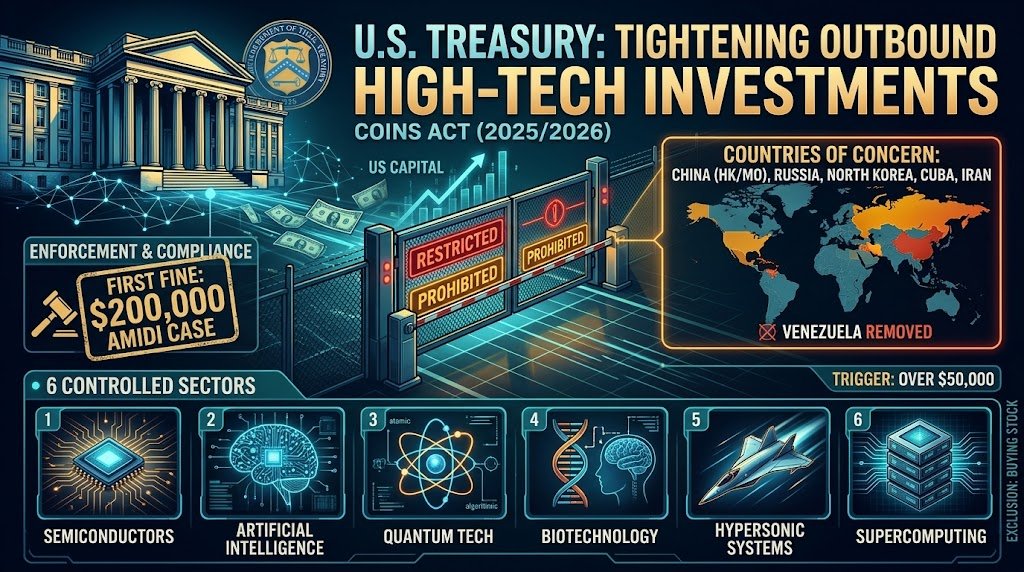
Photo: AI-generated
Treasury Moves to Wall Off U.S. Money From China's High-Tech Rise
The U.S. Treasury Department on October 22 proposed a rule that would tighten American high-tech investment in China, Russia, North Korea and other "countries of concern," covering semiconductors, artificial intelligence, quantum technology, supercomputing and hypersonic systems — with biotechnology newly added by Secretary Scott Bessent. The proposal implements the Comprehensive Outbound Investment National Security Act of 2025, known as the COINS Act, and marks the biggest expansion yet of an investment-screening regime that began with a 2023 executive order under then-President Joe Biden.
Congress Ordered It, Treasury Wrote the Details
The Notice of Proposed Rulemaking implements the COINS Act, passed as part of the fiscal 2026 National Defense Authorization Act and signed into law on December 18, 2025. The law puts the outbound-investment framework on a statutory footing and directs Treasury to flesh it out. According to Treasury's press release, the act authorizes the Secretary to set technical parameters for "prohibited technology" and "notifiable technology" across five sectors: semiconductor technologies and microelectronics, artificial intelligence systems, quantum information technologies, high-performance computing and supercomputing, and hypersonic systems. The Secretary may also add technologies, in consultation with congressional committees, that enable the military, intelligence, surveillance or cyber capabilities of a country of concern — the authority Treasury used to add biotechnology.
Biotech Joins the List as AI Faces a Near-Total Ban
Biotechnology is the headline addition. As reported by Unite.AI, the biotech prohibition covers certain bio-derived compounds or materials, brain-computer interfaces, biomanufacturing equipment and facilities, bioinformatics tools, and hardware or software for automated scientific discovery or experimentation. The AI provisions go further still: Treasury would bar American investment in any company developing AI systems in China, Russia and other countries of concern. The Associated Press reports that Treasury describes the AI category as "superintelligence." "The proposed regulations would strengthen the existing Outbound Investment Security Program to prevent our adversaries from using U.S. investment to develop critical technologies that threaten U.S. national security," Bessent said in a statement.
China, Russia, Cuba, Iran and North Korea Named
The "countries of concern" are China, including Hong Kong and Macau, Cuba, Iran, North Korea and Russia, according to Treasury's fact sheet. Reuters reports that Venezuela, once on the list, has been dropped now that former president Nicolas Maduro is no longer in power. Treasury Assistant Secretary Chris Pilkerton, who oversees investment security, told Reuters the program looks beyond the dollars: "It's not just about the investment itself; it's not just about the money. It's about the network, the supply chain, and things like that that come from that investment." Such webs of relationships, he added, would be hard to regulate through export controls alone.
A $50,000 Floor, and Stock Purchases Are Exempt
The rule would apply only to investments exceeding $50,000 and would exclude many financial investments, including stock purchases, the AP reports. The design follows the "small yard, high fence" approach: deals involving notifiable technologies must be reported to Treasury, while deals involving prohibited technologies with covered foreign firms are barred outright. Treasury will accept public comments through December 7 via regulations.gov before issuing a final rule that sets an effective date.
From Biden's 2023 Order to a First $200,000 Fine
The program originated in an August 2023 executive order and took effect for China-focused investments in semiconductors, quantum technologies and AI on January 2, 2025. Congress then codified and expanded it through the COINS Act in December 2025. Enforcement is already real: on October 7, Treasury announced its first civil penalty under the program — $200,000 against Amidi, LLC, a U.S. entity whose controlled foreign entity, a Chinese fund, invested in a Chinese AI and robotics company without notifying Treasury, as documented by Cleary Gottlieb's securities law analysis.
Beijing Cries Discrimination, Investors Count Compliance Costs
China pushed back swiftly. Asked about Washington's move to add biotechnology, Foreign Ministry spokesperson Mao Ning said that "overstretching the concept of national security, taking discriminatory measures against specific countries, and artificially restricting trade, economic and investment activities serve no one's interests," as carried by the AP. On the U.S. side, venture firms, multinational tech companies and research partners face longer deal timelines and new filing burdens — and the $200,000 first penalty has already focused minds on compliance.
Comments Close December 7, Final Rule to Follow
Treasury will review public comments and publish a final rule with an effective date. The statute leaves room for further expansion: the Secretary can designate additional technologies after consulting Congress. For U.S. investors with exposure to China, the coming months will mean auditing portfolios line by line — what must be notified, what must be unwound, what can never be funded. From chips to capital, Washington's fence around rival tech ambitions keeps getting higher.
Sources
- ABC News: US Treasury proposes a rule to crack down on high-tech investments in China, other adversaries
- Reuters: US Treasury drops Venezuela from countries facing outbound US investment restrictions
- The Hill: Treasury proposes curbs on high-tech investments in China, Russia, North Korea
- U.S. Department of the Treasury: Treasury Issues Proposed Rule to Implement Comprehensive Outbound Investment National Security Act
- Unite.AI: Treasury Proposes Rules to Expand Outbound Tech Investment Curbs