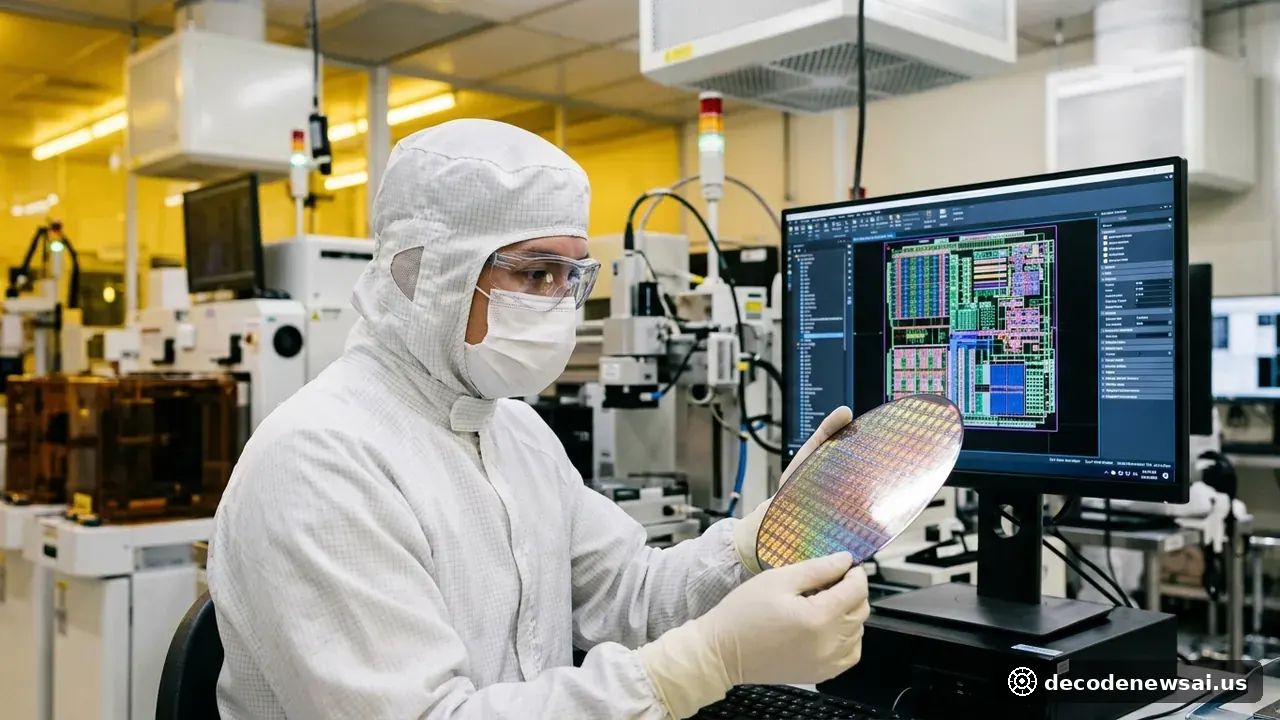
SAN FRANCISCO - OpenAI announced on Nov. 18, 2026, that its artificial intelligence models achieved up to a 14% improvement. It covered power, performance, and area. It came on AMD's flagship graphics processor intellectual property. The work took under five months.
Model Circuit Rewrites Enter AMD Manufacturing Pipeline
OpenAI's models rewrote SystemVerilog hardware code. They verified behavior with Synopsys tools. The AMD baselines were heavily optimized. The models delivered roughly a year's worth of engineering progress.
AMD has already included some model-generated circuit changes. They went into a design sent for manufacturing. AMD verified single-digit percentage gains on upcoming flagship central processor blocks.
OpenAI stated. "We have partnered with AMD on PPA improvements and seen up to 14% improvement relative to heavily optimized baselines on the flagship GPU IP," OpenAI stated.
Custom Jalapeño Chip Cuts Compute Block Area
Jalapeño is OpenAI's own custom inference chip. Model-driven logic and pipeline redesigns reduced standard-cell area. Area fell by about 13% in the vector unit and 10% in the matrix unit.
One matrix multiplier redesign cut cell area by about 15%. It lowered latency from two clock cycles to one. The optimizations were proven during silicon bring-up.
RISC-V Benchmarks and Synopsys Tool Partnership
There were 9,881 scored runs on open-source PicoRV32 and Ibex 32-bit RISC-V processor cores. GPT-6.2 Astra posted the highest average throughput scores. Scores were roughly 112,000 tokens per run.
OpenAI is also partnering with Synopsys. It will train a specialized GPT-Synopsys model. The model will operate electronic design automation software.