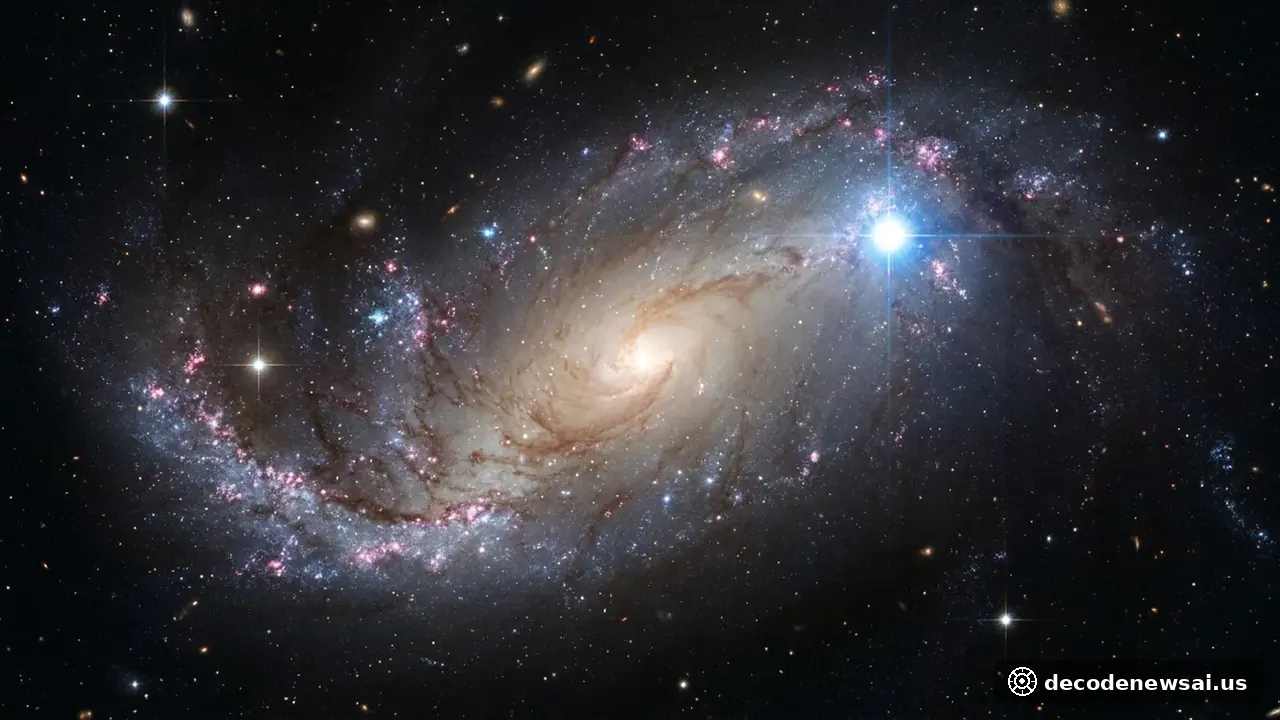
TUCSON, Ariz. - NSF NOIRLab is coordinating multi-telescope observations of newly discovered supernova SN 2026ahvu, an exploding white dwarf about 50 million light-years away in spiral galaxy NGC 1433, featured Nov. 18 by Space.com.
Early Detection Captures Rising Stellar Explosion
The Asteroid Terrestrial-impact Last Alert System (ATLAS) discovered the object on Nov. 2 at apparent magnitude 17, and it brightened within days to magnitude 13.5. Spectroscopy on Nov. 3 confirmed it as a young Type Ia supernova, and NOIRLab expects it to peak at magnitude 10.5 to 12.1 between Nov. 18 and Nov. 23. "This is one of the nearest Type Ia supernova observed since SN 2011fe was discovered in the Pinwheel Galaxy (Messier 101) in 2011," NOIRLab stated in its release.
Dark Energy Camera and Gemini South Combine Imaging
New images from the Dark Energy Camera (DECam) on the Blanco 4-meter Telescope in Chile and the Gemini South telescope show the supernova brightening near NGC 1433's center. Astronomers can compare the new captures against pre-explosion DECam images taken during the Dark Energy Survey from 2013 to 2019. Because Type Ia supernovae reach consistent peak brightness, tracking SN 2026ahvu helps refine them as standard candles for measuring cosmic expansion.
Southern Observers Spot Faint Point of Light
At its current brightness, SN 2026ahvu is visible through small to moderately sized amateur telescopes from southern latitudes. Archival Chandra X-ray Observatory images from 2015 and 2024 showed no prior X-ray source at the site, leaving post-explosion observations to clarify whether a companion star or white dwarf merger triggered the blast.