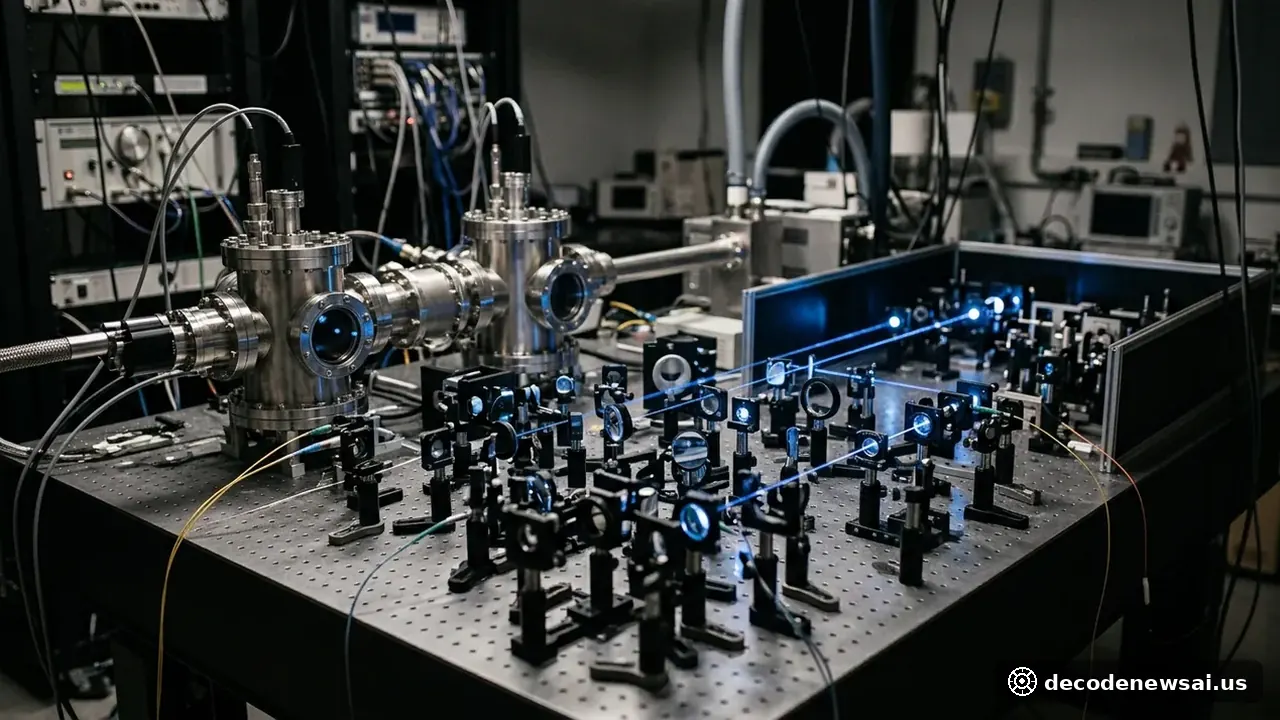
FUKUOKA, Japan — Physicists led by Kyushu University reported in Physical Review Letters in November 2026 a new technique for controlling trapped-ion atomic clocks. The method boosts sensitivity to the quantum superposition of times by 100 to 1,000 times.
Motion Control Unlocks Existing Atomic Clocks
Motion Control Unlocks Existing Atomic Clocks
Associate Professor Joshua Foo at Kyushu University's Institute for Advanced Studies led the study with collaborators from the United States, Canada, and Sweden.
General relativity dictates that gravity and motion alter how fast time flows, while quantum mechanics lets particles exist in multiple states at once. By steering a clock's motion along overlapping paths, researchers showed existing trapped-ion atomic clocks could detect subtle interference patterns.
Testing Where Relativity Meets Quantum Theory
"We introduced a new technique for controlling the atomic clock's motion, improving its sensitivity to this effect by 100 to 1000 times," Foo said.
Testing Where Relativity Meets Quantum Theory
In a quantum superposition of time, a single quantum clock can effectively experience two different rates of time simultaneously. Scientists previously assumed this crossover between gravity and quantum physics was far too faint for laboratory detection.
Next Step Moves From Theory to Lab Trials
Next Step Moves From Theory to Lab Trials
Researchers now plan to translate the theoretical proposal into a controlled laboratory experiment.
"Naturally, bringing our theoretical model to reality is the big next step, and developing a detailed experiment that accounts for real-world unpredictability will give us further insight into our model," Foo concluded.