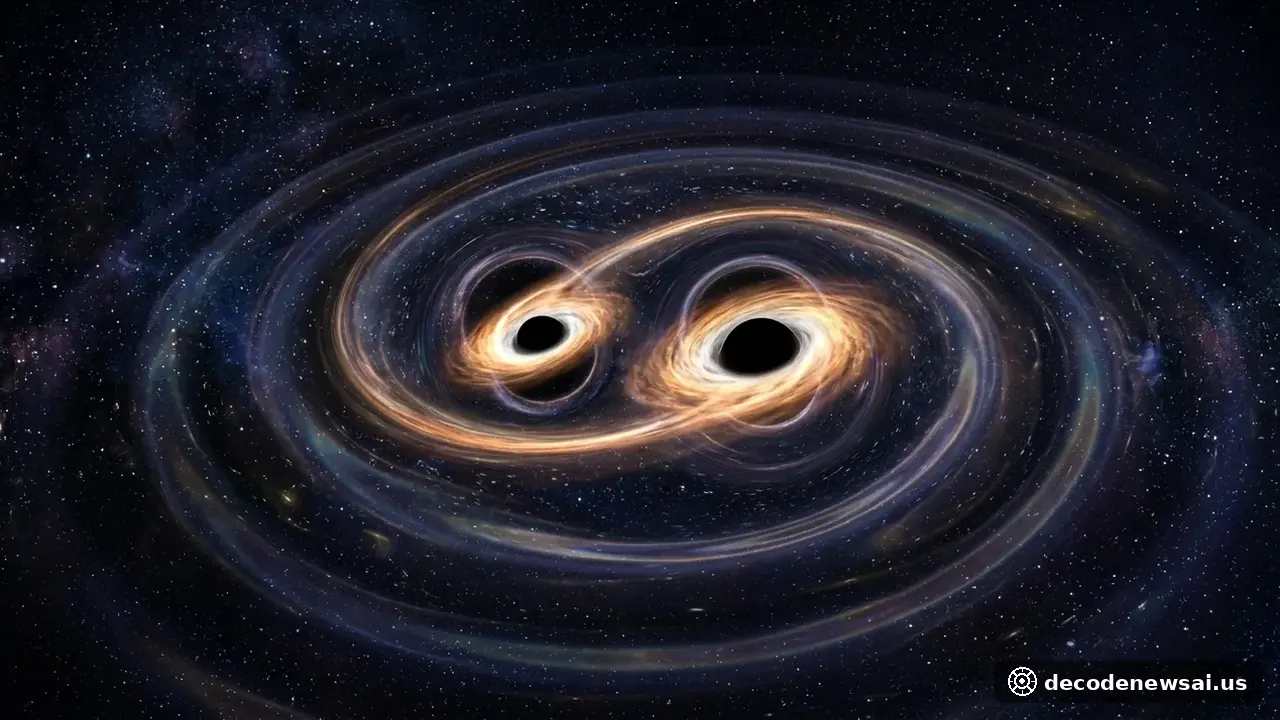
PASADENA, Calif. — A Caltech-led study of 257 black hole mergers over 10 years revealed a distinct gap between 12 and 16 solar masses, pointing to massive stars that collapsed without exploding, according to Nov. 22 reports.
Legred-Led Team Links Mass Gap to Failed Supernovae
Mass Gap Points to Direct Collapse
Researchers found that black holes near 10 solar masses make up roughly three-quarters of the sample, followed by a sharp drop between 12 and 16 solar masses. This pattern matches stellar models in which certain massive stars collapse straight into black holes in so-called failed supernovae.
The team, led by Isaac Legred, Katerina Chatziioannou and Jacob Golomb, also observed narrower spin distributions in that population. Published in Physical Review D on Nov. 10, the paper draws on data from the LIGO, Virgo and KAGRA observatories.
Detectors Logged Over 300 Black Hole Collisions
Ten Years of Gravitational-Wave Data
The dataset spans a decade of observations during which detectors have logged more than 300 black hole collisions since 2015. Gravitational waves are ripples in spacetime created when dense objects spiral together, letting astronomers weigh unseen black holes directly.
Researchers Link Signals to Stellar Physics
Chatziioannou Says Black Hole Group May Share Origin
"Our data are showing that this group of black holes may have a common origin -- they may be a distinct subpopulation that failed to go supernova. These results represent a connection between the gravitational-wave data and underlying astrophysics we are trying to extract," Chatziioannou said. Further observing runs will test how metallicity and stellar winds shape those collapses.