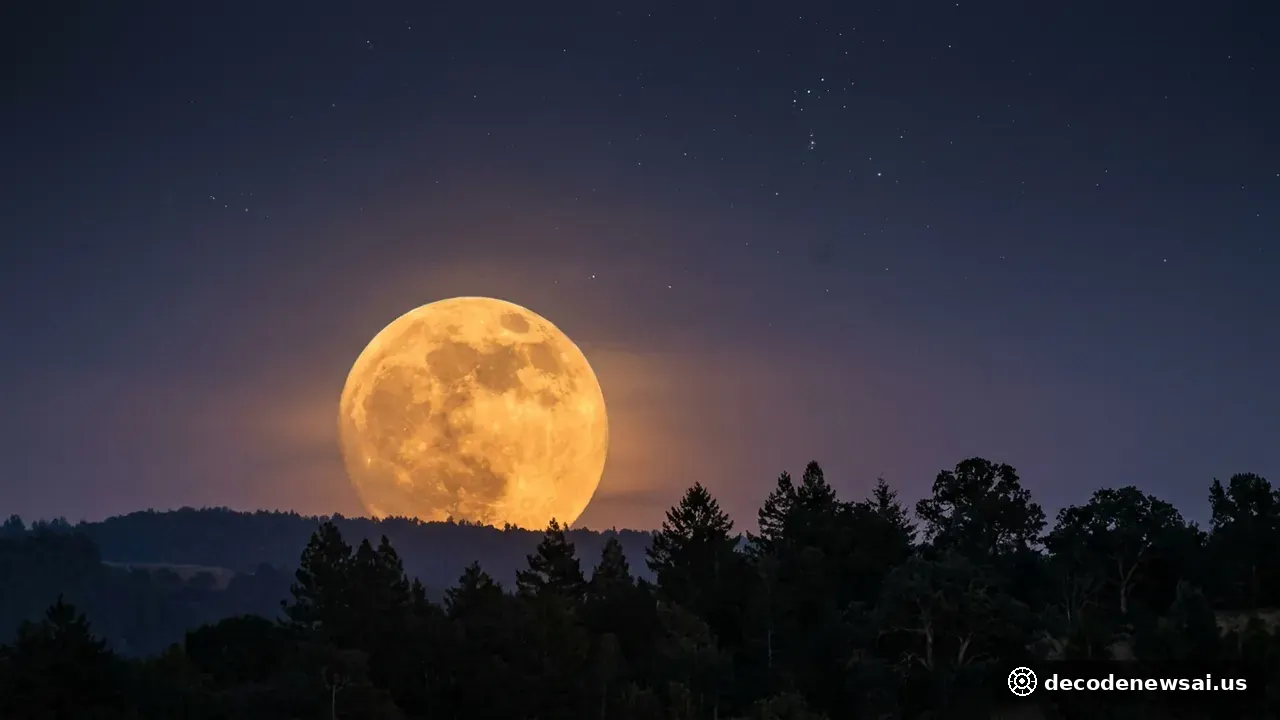
WASHINGTON - The full Beaver Moon reaches peak illumination at 9:53 a.m. EST on Nov. 24, 2026, kicking off a sequence of three consecutive supermoons after passing near the Pleiades star cluster before dawn.
Closest Orbital Approach Boosts Brightness
A supermoon occurs when a full moon coincides with perigee, the Moon's closest orbital approach to Earth. "At its closest point, the full Moon can appear up to 14 percent bigger and 30 percent brighter than the faintest Moon of the year, which occurs when it's farthest from Earth in its orbit," NASA explains on its lunar guide, adding that closer alignment can also produce higher tides. At full phase on Nov. 24, the Moon sits roughly 224,200 miles from Earth before reaching perigee 30 hours later on Nov. 25 at 223,400 miles.
Dawn Star Passage and Sunset Horizon Views
Because peak fullness occurs during morning daylight in the Americas, the best evening views come shortly after sunset on Nov. 24 as the Moon rises in the east. Atmospheric scattering gives the rising lunar disk an orange-yellow tint, while the Moon illusion makes it appear larger near the horizon. Before sunrise on Nov. 24, the nearly full Moon also grazed the Pleiades cluster in Taurus while Mars and Jupiter shone in the southern sky.
Two Closer Supermoons Follow Through January
November's Beaver Moon is the first of three consecutive supermoons extending into early 2027. Subsequent full moons arrive Dec. 23, 2026, and Jan. 22, 2027, with December's perigee reaching 221,800 miles as the closest of the trio.