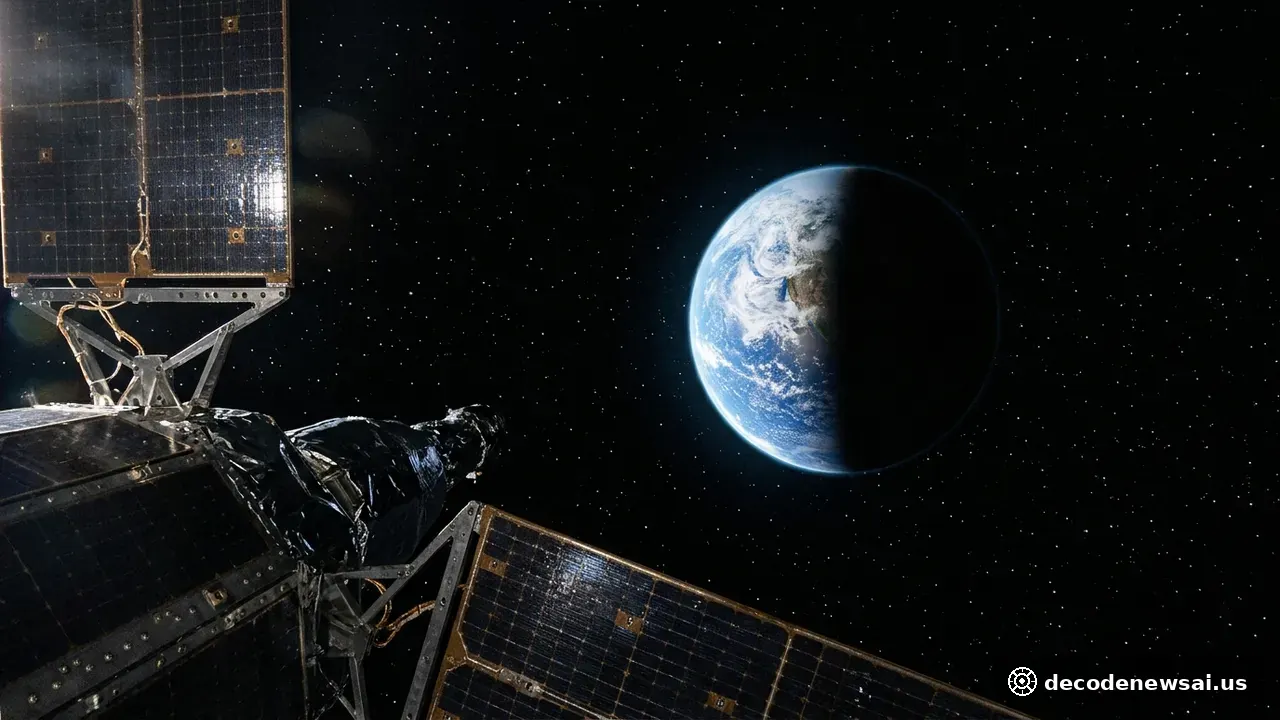
WASHINGTON - NASA released farewell images of Earth on Nov. 23, 2026, captured by one of its twin ESCAPADE spacecraft from about 38,500 miles away as the probes began a 10-month journey to Mars.
Western Hemisphere Viewed in Visible and Infrared Light
The second ESCAPADE probe, dubbed Gold, snapped the views around 9 a.m. EST on Nov. 9, roughly three hours after its closest approach to Earth. Using a camera built by Northern Arizona University, the spacecraft imaged Earth's Western Hemisphere in both visible light and infrared thermal bands with its solar panel in the foreground.
First Powered Earth Flyby for a Mars Mission
Built by Rocket Lab and operated by UC Berkeley, the twin Blue and Gold probes launched on Nov. 13, 2025 into a loiter orbit around the Sun-Earth Lagrange point 2 before returning for gravitational slingshots on Nov. 7 and Nov. 9. "This is the first time NASA has used a powered Earth flyby to propel a spacecraft toward Mars, and we've now executed this maneuver twice, flawlessly, in just two days," NASA heliophysics official Asal Naseri said.
Arrival Scheduled for September 2027
Each spacecraft accelerated from 6.3 miles per second to 6.7 miles per second during its nine-minute engine burn. Gold and Blue are scheduled to enter Mars orbit on Sept. 7 and Sept. 9, 2027, respectively, to study how solar wind strips away the Martian atmosphere.