DRESDEN, Germany - Researchers led by the Max Planck Institute for Chemical Physics of Solids (MPI CPfS) have found experimental evidence of elusive p-wave magnetism in europium silicide (EuSi), according to a Nature study highlighted on Nov. 18 and Nov. 24.
Zero Net Magnetization Still Splits Electron Spins
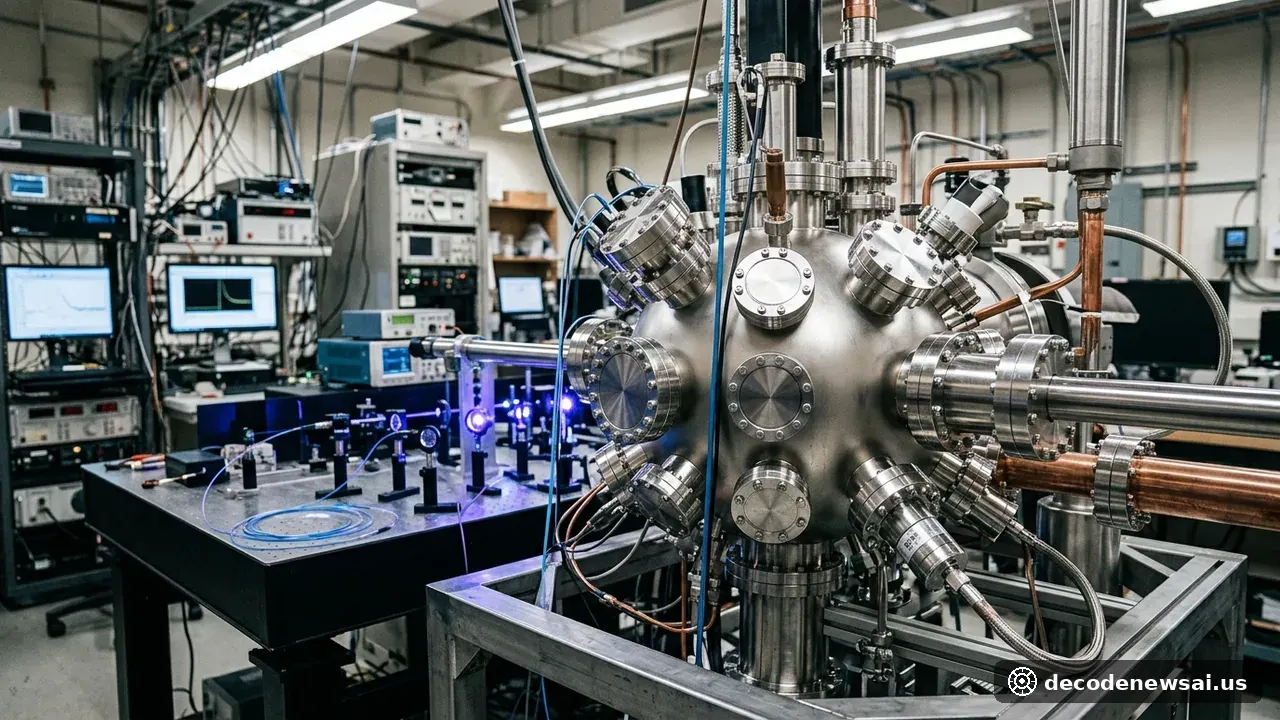
Between roughly 33 and 62 kelvin, magnetic moments of europium atoms in EuSi align into a spiral that cancels out overall magnetization. Despite zero net magnetic field, electrons moving in opposite directions carry opposite spin polarizations, with angle-resolved photoemission spectroscopy revealing magnetically driven energy separations exceeding 100 millielectronvolts.
38-Scientist Collaboration Maps Chiral Magnetic Domains
The project began about three years ago when Dr. Erjian Cheng grew EuSi single crystals in Dresden and grew into a 38-researcher collaboration across 19 institutions, including ShanghaiTech University, Hong Kong University of Science and Technology, and Oak Ridge National Laboratory. Using neutron diffraction and magnetic force microscopy, the team also detected spiral domains roughly 10 micrometers wide with opposite handedness that respond differently to circularly polarized light.
Platform Opens Path to Spintronics and Superconductivity Tests
Because EuSi is a chemically simple stoichiometric metal that yields clean single crystals, researchers say it solves a major materials bottleneck in studying p-wave magnetism. "What makes EuSi particularly exciting is that an unconventional electronic spin structure emerges from the magnetic order of a chemically simple metal," MPI CPfS Director Prof. Claudia Felser said, noting predicted spintronic and superconducting effects remain to be tested.