Baku Sideline, Blunt Message: China Tells Israel to Reverse West Bank Settlements
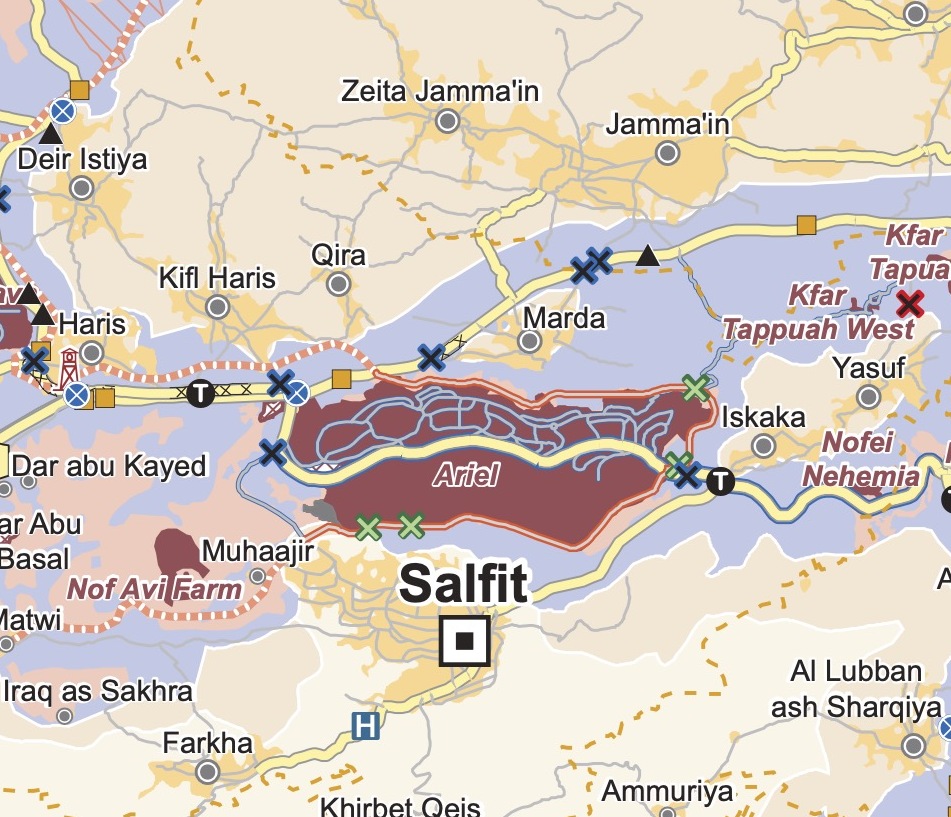
Photo: United Nations OCHA oPt / Public domain · via Wikimedia Commons
Baku Sideline, Blunt Message: China Tells Israel to Reverse West Bank Settlements
A meeting Beijing says Israel requested
Chinese Foreign Minister Wang Yi met Israeli President Isaac Herzog in Baku on October 15, on the sidelines of the seventh summit of the Conference on Interaction and Confidence-Building Measures in Asia. China's foreign ministry published its readout the next day, and the phrasing travelled fast: Reuters, Al Jazeera, The Independent, The Times of Israel and others picked it up within hours. Herzog was in Azerbaijan for the summit, alongside delegations from Iran, Turkey, Russia, Qatar, the UAE and the Palestinians. Wang attended as Xi Jinping's special representative.
"Stop and reverse" the forced establishment
Beijing's language was unusually operational. Wang said the immediate priority is to fully open access routes into Gaza, so that two million civilians are not left "struggling at the edge of survival" and a humanitarian catastrophe is not allowed to spread. In the same breath, he said Israel should stop and reverse what the ministry's English version called the "forced establishment" of West Bank settlements. He repeated that China regards the Palestinian question as the greatest historical injustice of this century, that the two-state solution is the right path, and that promoting peace and reconciliation is the cornerstone of China's Middle East policy.
The E1 pipeline: 3,401 units, two tenders
The timing explains the attention. A UN report to the Security Council found that between 13 June and 18 September, Israeli planning authorities advanced or approved nearly 4,570 housing units in Area C and 3,515 in East Jerusalem, and published tenders for almost 2,240 units, including 1,234 in the E1 corridor. E1 totals 3,401 units: bidding on the first 1,234 closed on October 19; the tender for the remaining 2,167 opens on October 25 — two days before Israel's election. Peace Now counts 163 settlements, roughly 750,000 settlers, and nearly 28,000 units advanced inside existing settlements in 2025 alone.
Two readouts that barely overlap
Jerusalem's account reads differently. Herzog's office said the meeting focused on bilateral relations and the regional situation, with an emphasis on economic, trade and cultural ties; it also said Herzog raised the threat from Iran and its proxies. Asked about the West Bank and the Palestinians, his office declined to comment. Herzog said publicly that Israel wants peace rather than war and is willing to keep talking to Beijing. Two accounts of one conversation, with almost nothing shared between them.
Why Beijing got specific now
China has long stated principles; this time it handed over a to-do list. Wang met Palestinian Foreign Minister Varsen Aghabekian Shahin in Baku the same day and said the Palestinian issue "should not be marginalized," urging all peace-loving countries to back a two-state solution. Beijing keeps channels open on several sides at once: it is Iran's largest trading partner and a top trade partner of Gulf states and Israel. At the Security Council on September 29, China's ambassador Fu Cong had already urged Israel to immediately halt and reverse its settlement policy.
Gaza access is part of the same demand
China tied the two files together. A year into the Gaza ceasefire, more than 100 NGOs say it "exists in name only"; Gaza's health ministry says 20,719 patients are still waiting for treatment abroad; Israel controls roughly two-thirds of the strip; reconstruction is estimated at $71.4 billion. UN agencies describe access restrictions as the main obstacle to aid and winter shelter. For Beijing, the argument is sequential: as long as the crossings stay shut and the settlements keep expanding, the two-state solution has no ground to stand on.
The cost lands on West Bank communities first
The immediate pressure falls on Palestinians in the West Bank. The UN documented 630 settler attacks between 13 June and 18 September, killing 11 Palestinians, injuring 430 and displacing 343 people. Aid agencies count more than 1,600 attacks this year, averaging 6.7 a day against five a day in 2025. Palestinian data put the 2026 death toll from settler attacks at 30 or more. If E1 is built, it would sever East Jerusalem from the West Bank and cut the territory in two.
Pressure is not coming from Beijing alone
The UN human rights office has called E1 a "grave and unlawful step to consolidate annexation," and the EU's foreign policy chief said the plan would divide the West Bank. Eight Arab and Islamic states warned of a dangerous escalation. On October 14, Britain set out new sanctions powers that can be used against supporters of illegal settlements, and at the Security Council the next day its envoy urged Israel to abandon the E1 tender. In the US Senate, Democrats have introduced legislation to sanction facilitators of E1; co-sponsor Elizabeth Warren called it "a move towards de facto annexation."
The other ledger: China-Israel ties
Trade runs on a separate track. Next year marks 35 years of China-Israel relations; Herzog reaffirmed Israel's one-China policy and pushed cooperation in technology, investment and people-to-people ties. Merchandise trade has doubled over the past decade to well over $10 billion, and Israeli imports from China passed $14.7 billion in 2025. Trust is dented by reports, denied by Beijing, that China supplied Iran with air-defence launchers and that Houthi missiles use Chinese components.
Three dates will test the language
The next tests are on the calendar: October 19, when bidding on the first 1,234 E1 units closed; October 25, when the tender for 2,167 more opens; and October 27, Israel's election. The Israel Land Authority said bids will not be reviewed before November 19, to avoid the tender becoming campaign material. Whether China's demands become action depends on Israel's next government, Council follow-through, and whether Gaza's crossings open. For now, Israel's only public answer is that it is willing to keep talking.
Sources
- Al Jazeera: 中国外交部长要求以色列停止“强行设立”约旦河西岸定居点
- Reuters (via Al-Monitor): 中国称以色列应停止在约旦河西岸“强行设立”定居点
- The Times of Israel: 中国称外长在巴库告诉赫尔佐格以色列应停止“强行设立”西岸定居点
- The Independent: 中国要求以色列停止“强行设立”西岸定居点
- Xinhua / CGTN: 王毅会见以色列总统赫尔佐格,敦促开放加沙通道、叫停西岸定居点