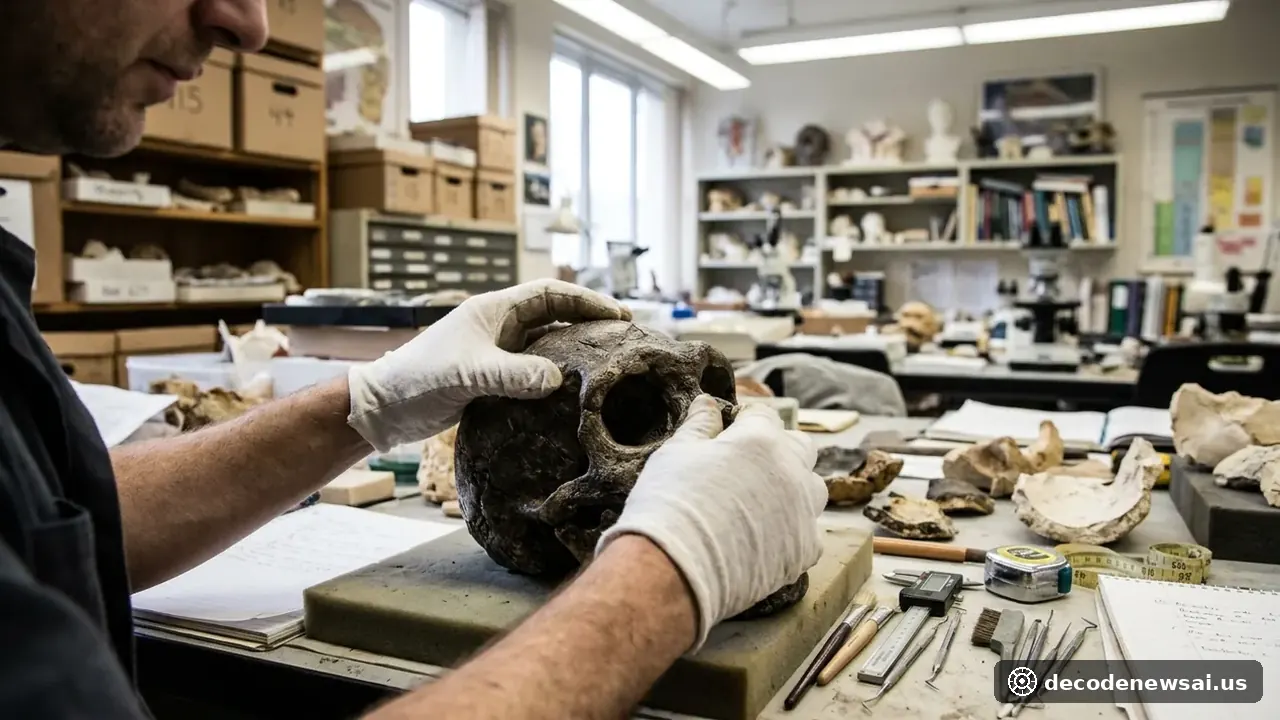
BRUSSELS - A study published in npj Palaeoecosystems and released on Nov. 19, 2026, redates South Africa's 1924 Taung Child fossil to roughly 3 million years ago and challenges linear models of early human evolution.
Uranium-Lead Dating Separates Fossil From Adult Peers
Using uranium-lead dating on surrounding flowstone layers, Vrije Universiteit Brussel professor Gabriele Macho and colleagues placed the fossil between 2.96 million and 3.03 million years ago, with a minimum age of 2.962 million years plus or minus 59,000 years. Dental and braincase growth comparisons also show that adult fossils previously grouped with the Taung Child as Australopithecus africanus do not match it.
Ancient Forest Pollen Points to Climate-Driven Evolution
Fossilized pollen from Podocarpus trees, now found 400 kilometers away, indicates a wetter, forested landscape whose wet-dry cycles repeatedly isolated and reconnected early hominin groups. "Our findings turn that on its head. The human family tree wasn't a neat, straight trunk -- it was a chaotic, tangled bush driven by climate shifts," Macho told Gizmodo.
Findings Prompt Reassessment of Southern African Hominins
Paleoanthropologists plan to re-examine South African hominin collections and test how shifting Pleistocene and Pliocene habitats drove early evolutionary branching across the region.