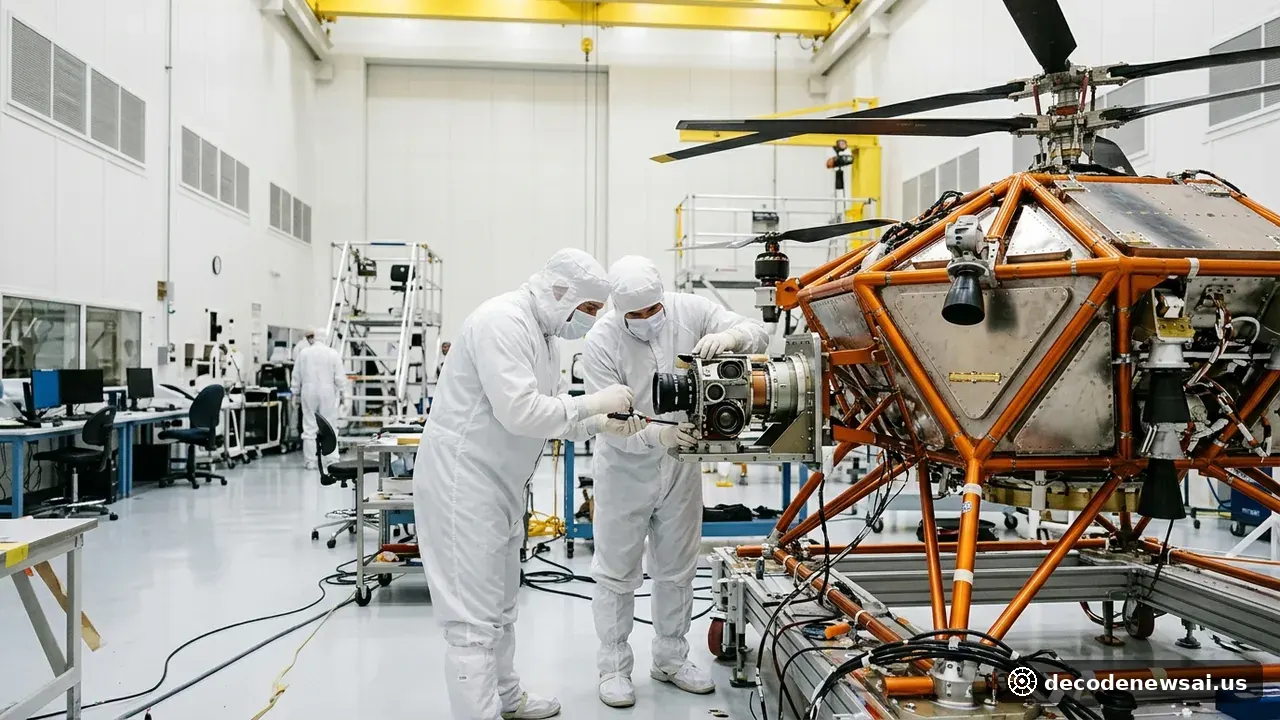
LAUREL, Md. - NASA announced on Nov. 24 that its car-sized Dragonfly rotorcraft has received and integrated its seven-camera DragonCam science imaging suite at the Johns Hopkins Applied Physics Laboratory in Maryland.
Insulated Cameras Built for Minus-290-Degree Titan Nights
Built by Malin Space Science Systems, DragonCam's seven cameras were installed inside insulated foam housings by mid-November to withstand Titan's minus-290-degree-Fahrenheit environment. An APL-built LED array spanning infrared to ultraviolet wavelengths will illuminate surfaces during Titan's nearly eight-Earth-day nights, helping researchers spot fluorescing organic molecules and examine surface colors.
Stereoscopic and Microscopic Lenses Guide Drill Sampling
Joining two navigation cameras installed earlier in 2026, forward wide- and medium-angle cameras provide a 90-degree stereoscopic view, while side and downward cameras assist panoramic mapping and safe landing checks. "Seeing these cameras become part of the Dragonfly lander is an exciting milestone that brings us another step closer to this unprecedented exploration," principal investigator Elizabeth Turtle said, after engineers captured initial cleanroom test panoramas on Nov. 9.
Additional Instruments Arrive Ahead of 2028 Launch
A high-resolution microscopic imager will inspect millimeter-sized grains at Dragonfly's DrACO drill sites. Remaining spectrometers and meteorology packages are slated for integration over the coming months ahead of a July 2028 launch and late-2034 Titan arrival.