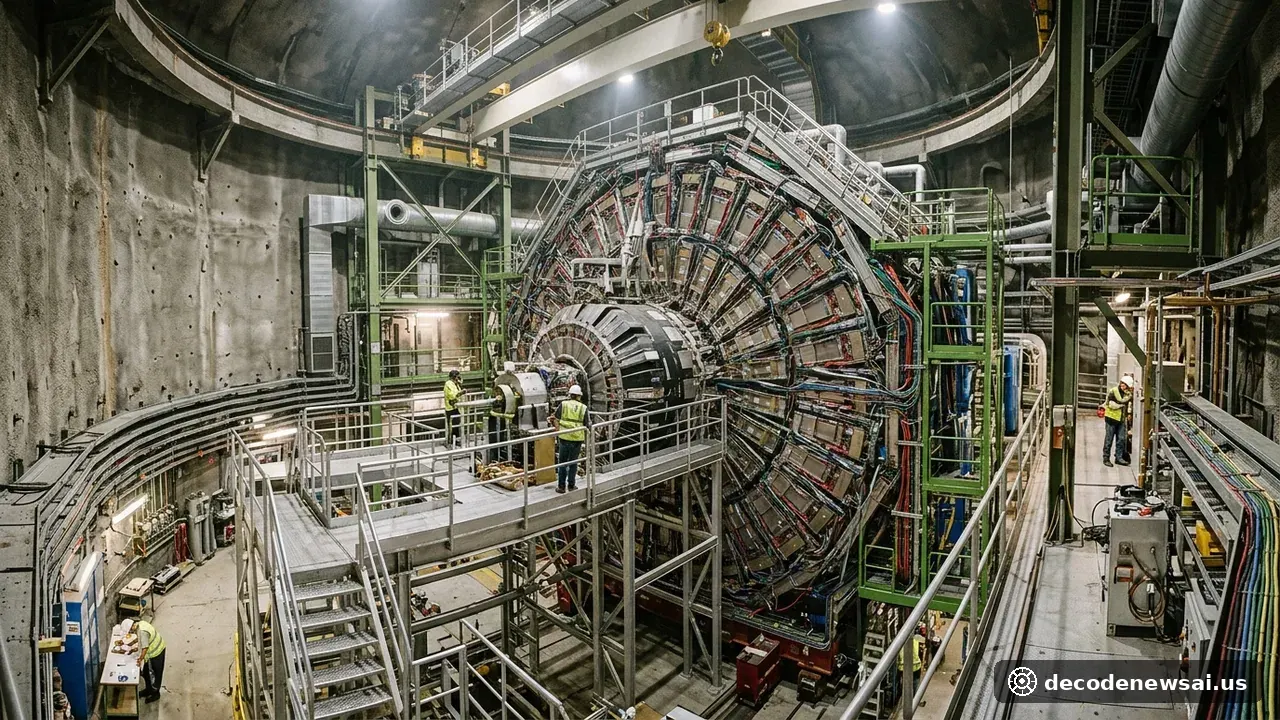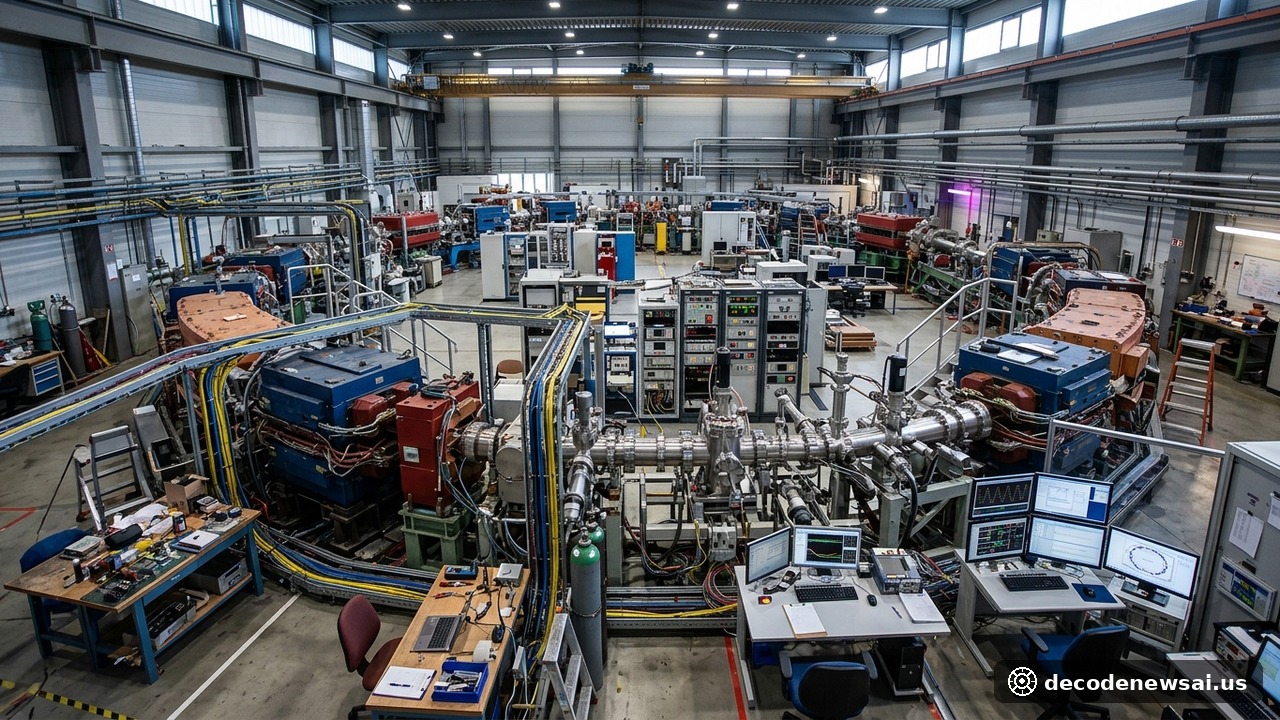
An international nuclear astrophysics research team published definitive experimental measurements on November 14, 2026, in the journal Nature, confirming the first laboratory observation of bound-state beta decay in fully-ionized thallium-205 (205Tl81+). Conducted utilizing the Experimental Storage Ring at the GSI Helmholtz Centre for Heavy Ion Research in Darmstadt, Germany, the measurement resolves a foundational theoretical puzzle in nuclear astrophysics that endured for more than half a century; the decay constant establishes an empirical benchmark calibrating isotopic chronometers that date early stellar nucleosynthesis preceding the formation of the solar system.
Bare thallium-205 decays to lead-205 with months-long half-life
According to research certified by the GSI/FAIR international particle accelerator facility, neutral thallium-205 is completely stable under terrestrial room-temperature conditions; quantum theoretical physics postulated in 1947 that naked thallium ions undergo bound-state beta decay, capturing an emitted electron directly into vacant inner atomic orbitals to transform into radioactive lead-205. Engineers stripped all 81 orbital electrons, injecting a pure beam of bare thallium-205 into the ultra-high vacuum Experimental Storage Ring (ESR); the experimental data established that stripped thallium-205 decays into lead-205 with a half-life measured on the order of months.
Lead-205 possesses a radioactive decay half-life of roughly 15 million years, serving as a natural clock measuring cosmic intervals immediately preceding the collapse of the presolar molecular cloud; prior to the birth of the Sun, previous generations of asymptotic giant branch (AGB) stars synthesized heavy chemical elements through the slow neutron capture process (s-process). Because the competing production of thallium-205 and lead-205 depends critically upon stellar ionization states, the lack of laboratory decay constants previously generated significant discrepancies in modeling the duration of solar system gestation; the definitive GSI measurement eliminates historical modeling ambiguities.