MANCHESTER, England - Physicists on the upgraded LHCb experiment at CERN announced evidence on Nov. 20. The decay is ultra-rare. It is expected just once in every 10 billion beauty particle decays. The search lasted over 40 years.
Evidence Reaches 3.2-Sigma Toward Five-Sigma Discovery
Researchers combined 2024–2025 upgraded run data with 2011–2018 measurements. They recorded the Bd-to-two-muons decay at 3.2 sigma statistical significance. That result qualifies as evidence. It falls short of the five-sigma threshold required for a confirmed discovery.
Beauty quarks live briefly. They exist for roughly 1.5 trillionths of a second. They decay into heavier electron-like particles called muons.
Data Collection Rises Fivefold With Millimeter-Close Detectors
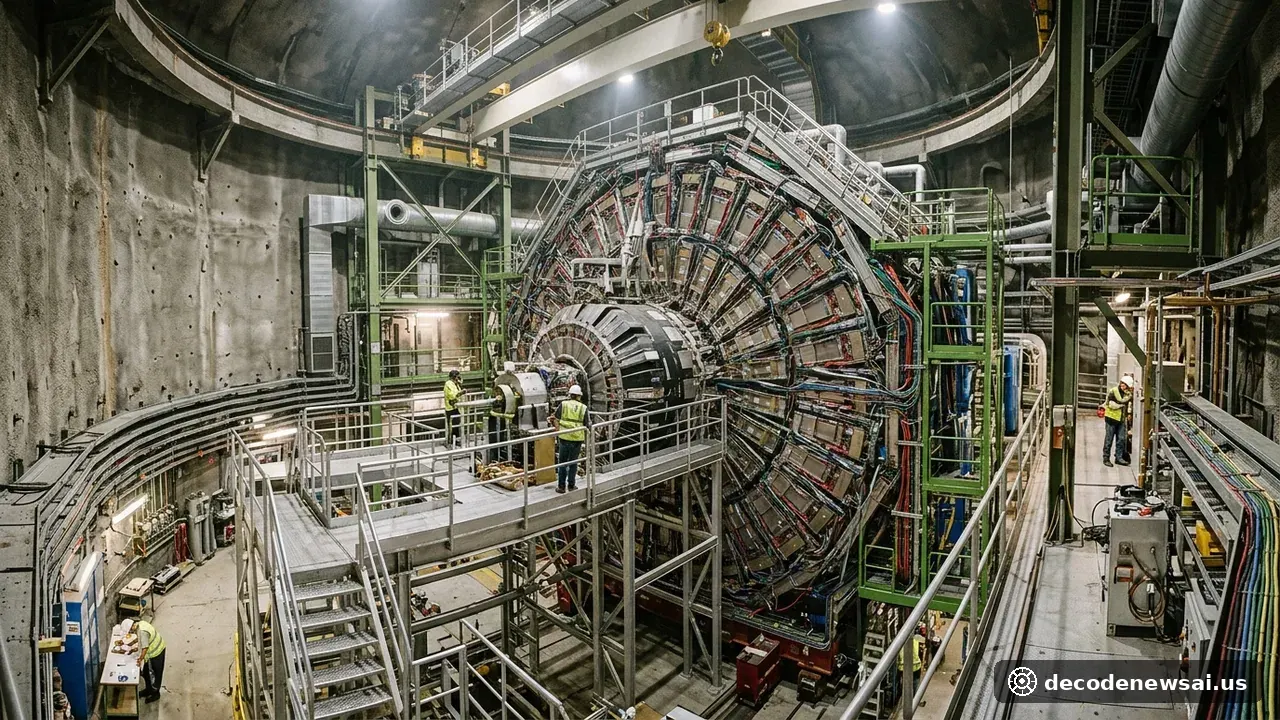
The measurement relied on an LHCb upgrade. That upgrade boosts data collection fivefold. It also relied on a silicon pixel Vertex Locator.
The locator was close. It was built with nearly 90 UK companies and positioned just five millimeters from the particle beam.
The search was long. "There has been a more than forty year long search by physicists worldwide to observe this decay." The channel is golden. "It is a golden channel to observe the effects of new physics from beyond our current knowledge," said University of Manchester professor Conor Fitzpatrick, per ScienceDaily.
High-Luminosity Upgrades Are Planned Into the 2030s
The measured rate currently aligns with the Standard Model. Scientists plan a further tenfold increase in data collection under the High-Luminosity LHC. It is slated for 2030. They hunt for subtle deviations.