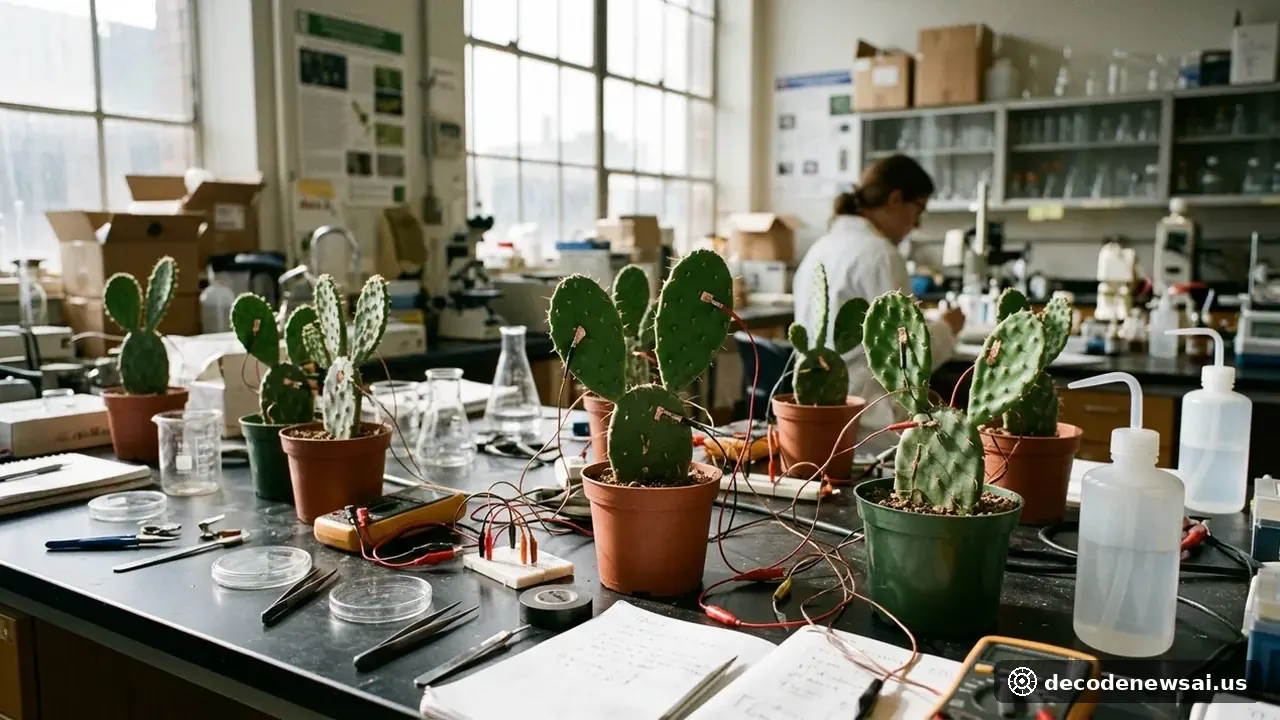
SANTA CRUZ, Calif. — Researchers at the University of California, Santa Cruz, reported on Nov. 19 that they harvested usable electricity from living prickly pear cacti, demonstrating a drought-hardy power source for remote farm sensors.
Daily Acid Shifts Create Natural Voltage
Published in the journal Plants, People, Planet, the system taps into crassulacean acid metabolism, a water-saving photosynthesis cycle common in desert plants. At night, prickly pear cacti absorb carbon dioxide and store it as malic acid; by day, sunlight breaks down the acid in the outer 2 millimeters of sunlit pads, creating a pH voltage gradient across the stem. A single stem generated up to 0.5 volts, and linking eight stems produced 4.5 volts—triple the output of a standard 1.5-volt AA battery.
Cacti Keep Generating After 15 Months Dry
Even prolonged drought failed to shut down the biological power cells during laboratory testing. "This was a really surprising result, but also showed how resilient a cactus is—it could still produce electricity even when it seems, to us, like it's near death," lead researcher Charlie Chesney said after withholding water from test plants for 15 months.
Targeting Low-Maintenance Agricultural Sensors
Researchers Michael Loik and Chesney plan to refine electrode coatings and power-harvesting circuits to extend field durability. If scaled, living cactus batteries could power soil-moisture monitors and environmental sensors in arid farmland without frequent disposable battery replacements.